2022 Kia Sorento Plug-In Hybrid Reviews, Pricing & Specs

Pros & cons
What we like
Impressive electric range
Impressive technology
Excellent value for money
What to consider
Unpredictable drivability traits
Cramped third-row
Unimpressive voice recognition technology
Expert review
The 2022 Kia Sorento Plug-in Hybrid is an affordable way to dip your toes into the electric vehicle pool.
Interest in electric vehicles (EVs) is increasing, but many people remain skeptical of the technology, don’t own a home where overnight charging is easy, or think a family-sized EV is too expensive. Enter the new-for-2022 Kia Sorento Plug-in Hybrid electric vehicle (PHEV), which gives you 51 kilometres of electric driving range and returns a Natural Resources Canada-rated 6.9 litres-equivalent per 100 kilometres in combined driving when you run it on its turbocharged gasoline engine in hybrid mode. The new 2022 Sorento PHEV also has three rows of seats and up to 2,138 litres of cargo capacity.
out of 10 expert review
Look & feel
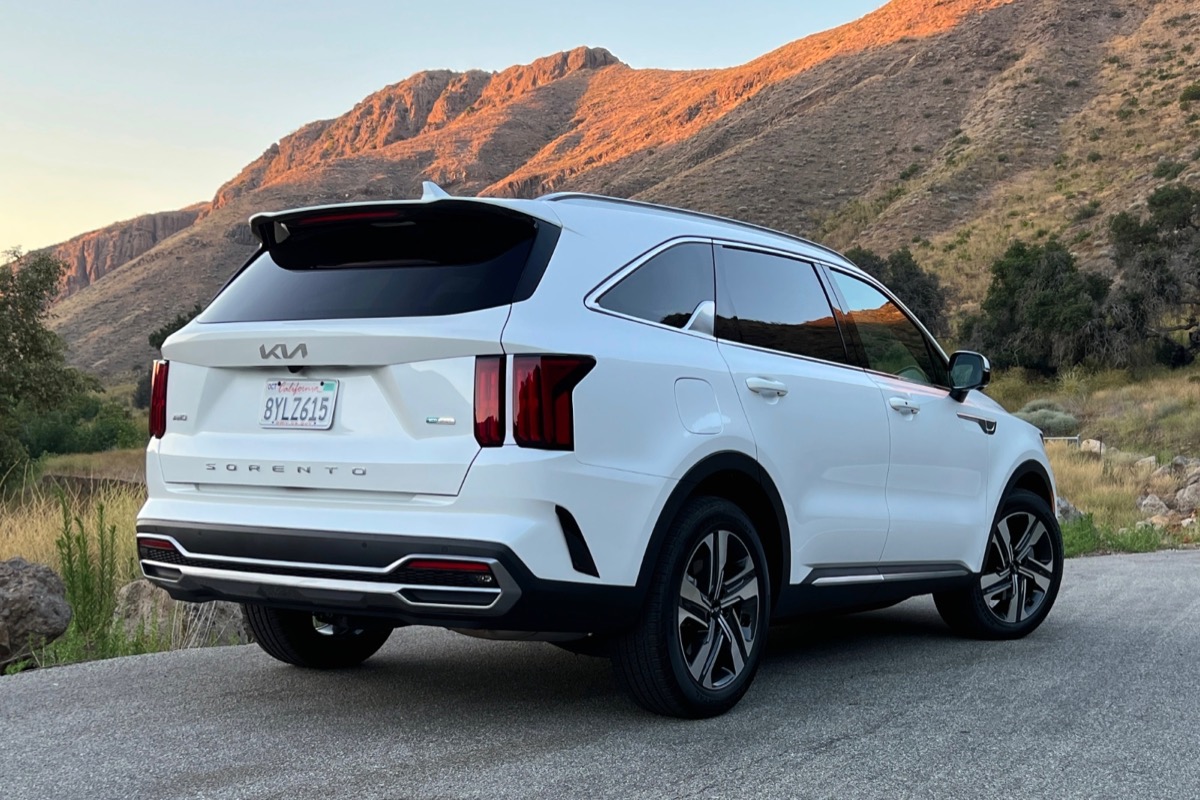
If you like the way the current-generation Kia Sorento looks, then you’ll like the styling of the 2022 Sorento Plug-in Hybrid—because it is a near carbon copy of a standard Sorento. In Canada, the Sorento PHEV comes in EX, EX+, and SX trims, but does not share the gas-only models’ dark wheel finishes. In addition, Kia does not offer the more rugged X-Line treatment on the PHEV model. Instead, the Sorento PHEV gets machined-finish 19-inch aluminum wheels, and a standard ride height in place of the X-Line’s slightly raised height.
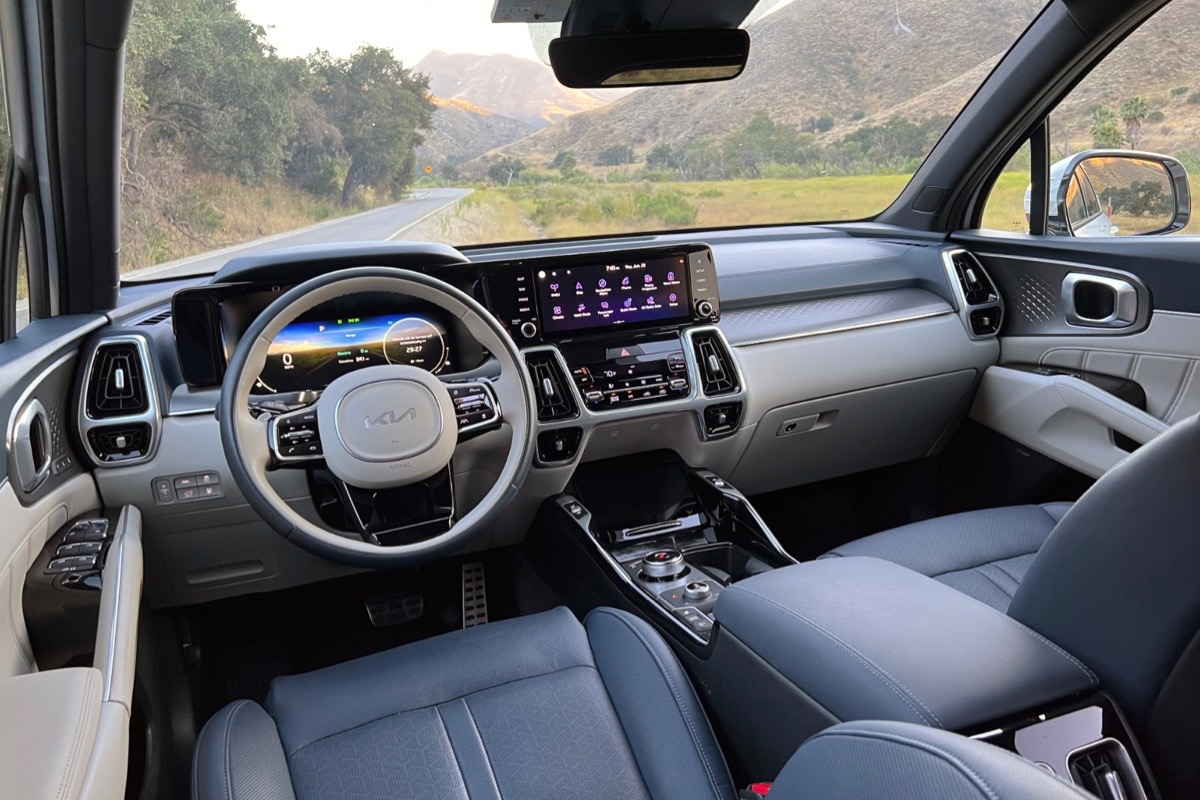
Inside, the three PHEV trim levels are also similar. The EX and EX+ trims equip the cabin with SynTex synthetic leather upholstery, while the SX comes with genuine leather. The SX also introduces an exclusive 12.3-inch digital instrumentation display with remarkably sophisticated graphics that change depending on the time of day.
Our test vehicle arrived in the U.S. equivalent of SX trim with Snow White Pearl paint. In Canada, this trim starts at $54,995, not including the $1,900 destination charge. That sounds like too much to pay for a Kia Sorento, but don’t forget that the Sorento PHEV qualifies for the full $5,000 of the federal government’s iZEV rebate as well as provincial rebates where they exist.
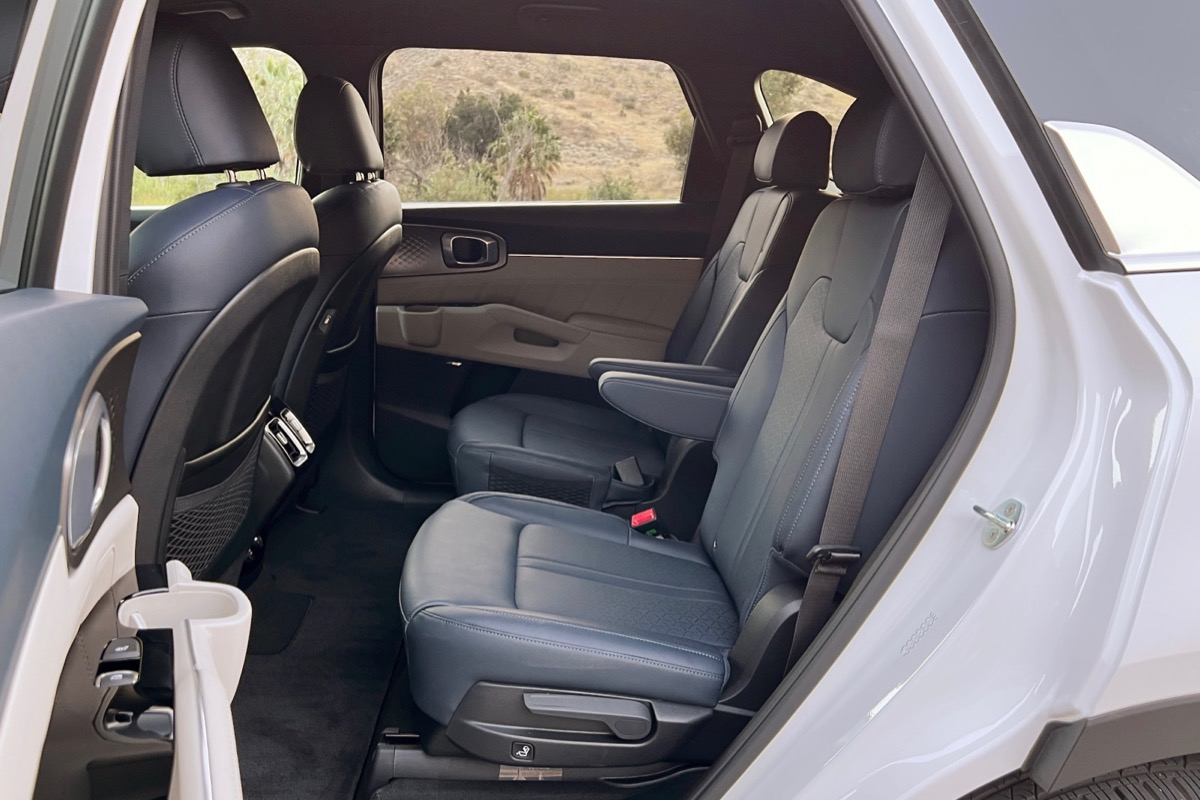
However, even without the discounts, the Sorento PHEV is super-nice inside. Our test vehicle had the navy blue interior, which installs a stylish blue over light gray interior colour combination that adds a luxury look to the Sorento’s stylish, high-tech interior appearance.
To underscore just how premium the Sorento SX PHEV’s interior is, our review vehicle following this Kia was a Cadillac XT6 Premium Luxury that cost $13,000 more, but felt like a downgrade from the driver’s seat. Sure, the Kia had more plastic in it, but otherwise it looked and felt like a luxury SUV.
Performance
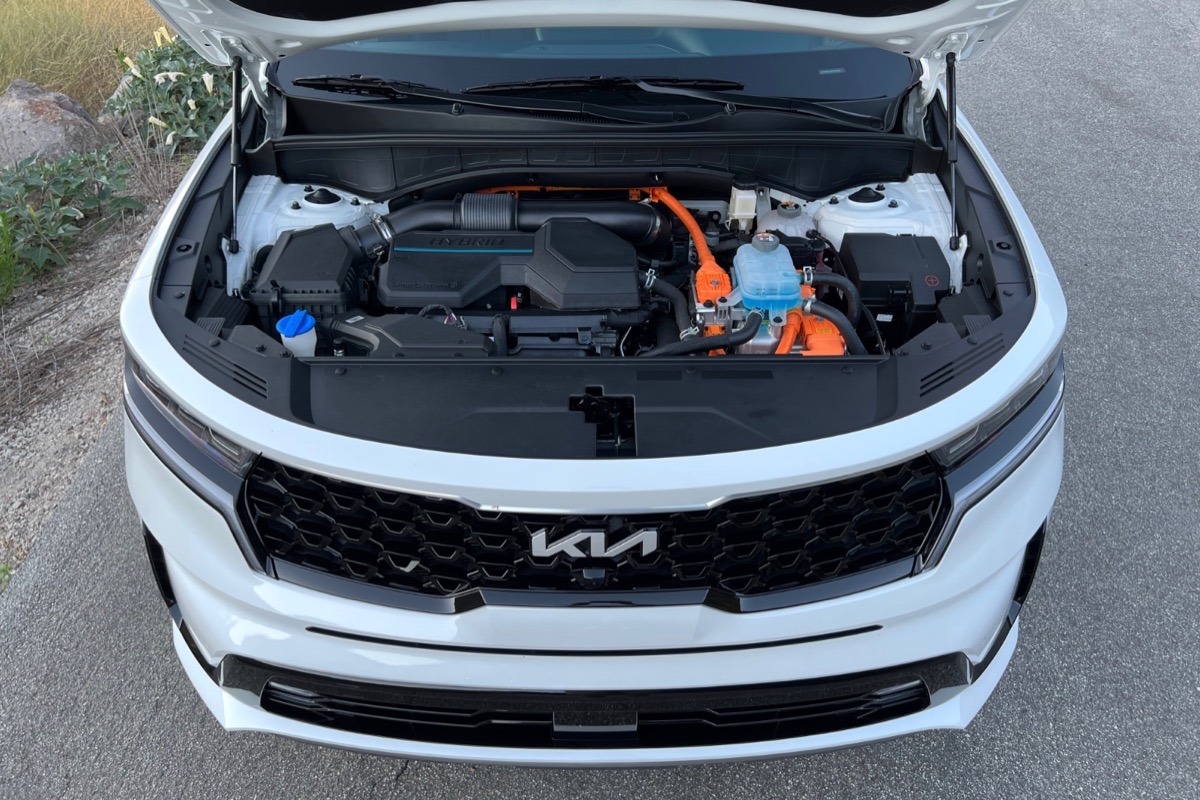
The 2022 Sorento Plug-in builds on the Sorento Hybrid, adding a larger 13.8-kilowatt-hour battery pack and more powerful 66.9-kilowatt (89.7-horsepower) electric motor. These components pair with a turbo 1.6-litre four-cylinder engine, a six-speed automatic transmission, and a torque-vectoring all-wheel-drive (AWD) system with a locking centre differential. You can choose between EV (electric vehicle) and HEV (hybrid electric vehicle) operation modes, and between Eco, Smart, Sport, and Snow driving modes.
Total system output measures 261 hp and 258 pound-feet of torque, which Kia claims will accelerate the Sorento PHEV to 100 kilometres per hour in 8.7 seconds. The Sorento PHEV supplies 51 kilometres of electric driving range and 6.9 L/100 km in combined driving when used as a gas-electric hybrid, providing about 680 kilometres of total driving range before you need to refuel or plug in. You can charge the Sorento PHEV from a standard 120-volt household outlet or a dedicated 240-volt Level 2 charger.
We know. That’s a ton of information to digest. To simplify, let’s say that if you can recharge the Kia Sorento PHEV every night, you’ll save lots of money at the gas pump by running it mostly on electricity for commuting and running errands. And if you need to take a road trip, you can go anywhere you want without worrying about plugging it in because it works just as well as a traditional hybrid vehicle.
We embarked on our evaluation loop with 50 kilometres of projected range, in EV operation mode, and in the Eco driving mode. When the Sorento’s battery pack reached its minimum state of charge showing zero kilometres of remaining range, we had traveled 65 kilometres. After traveling 142 kilometres on a route modified by a road closure, the Sorento PHEV delivered overall fuel efficiency of 5.3 L/100 km.
How did the Sorento PHEV exceed its estimated electric range? The EV driving was almost exclusively on the highway and included a nearly 250-metre descent in elevation where, like other plug-in hybrids, the Sorento PHEV can use regenerative braking to recover some energy. In addition, on a couple of occasions the gasoline engine started to provide assistance during acceleration. Even with the SUV in EV mode, the gas engine will respond to harder pushes on the accelerator pedal, such as when merging onto a highway and accelerating away from an intersection after the light turns green.
A light right foot is the key to running this SUV solely on its electric motor, but if you want to leverage the Sorento PHEV’s maximum output of 261 hp and 258 lb-ft of torque, you’ll want to switch to HEV mode and either the Smart or Sport driving mode. Set up this way, acceleration is brisk and the Sorento PHEV supplies plenty of power.
This plug-in hybrid’s battery pack and electric motor add about 258 kilograms (570 pounds) compared to a gas-only AWD Sorento SX. You can definitely feel this added mass while driving the PHEV, and it is most evident in the form of excessive weight toss and transfer when driving on uneven pavement or on a twisty road.
Furthermore, the powertrain, steering, and braking can behave in unpredictable ways. For example, if you come to an incomplete stop and then need to accelerate, such as if a traffic light changes from red to green, powertrain behaviour and power delivery are sometimes uneven. Furthermore, brakes can feel grabby at times. Another example is the need to make mid-curve steering corrections as the chassis deals with the added weight of the PHEV components and any rises or dips in the pavement.
However, despite these occasional driveability hiccups, we like the Sorento PHEV as a daily driver. It makes plenty of sense as a family-friendly way to give electric vehicle ownership a try without giving up entirely on the convenience of gasoline.
Form & function
Kia offers the Sorento Plug-in Hybrid with three rows of seats but limits passenger capacity to six people due to its standard second-row captain’s chairs. However, because the third-row seat is best reserved for children and also chews up a bunch of cargo space, it will probably stay folded most of the time, effectively making the Sorento PHEV a four-passenger vehicle.
Those four people will be quite comfortable, at least. Heated, power-adjustable front seats and a heated steering wheel are standard, heated rear seats and a panoramic sunroof come in at the EX+ trim, and the SX trim adds genuine leather seats and ventilated front seats.
Adults and children alike will enjoy riding in the second-row captain’s chairs. Kia’s thoughtfulness abounds with cupholders designed into each rear door panel, storage pockets and separate nets on the backs of each front seat, and airline-style USB ports embedded into the front seatbacks. Climate control air vents and additional power outlets are also present. The Kia Sorento PHEV does offer less second-row legroom than you’ll find in the gas-only version, but it remains roomy and accommodating.
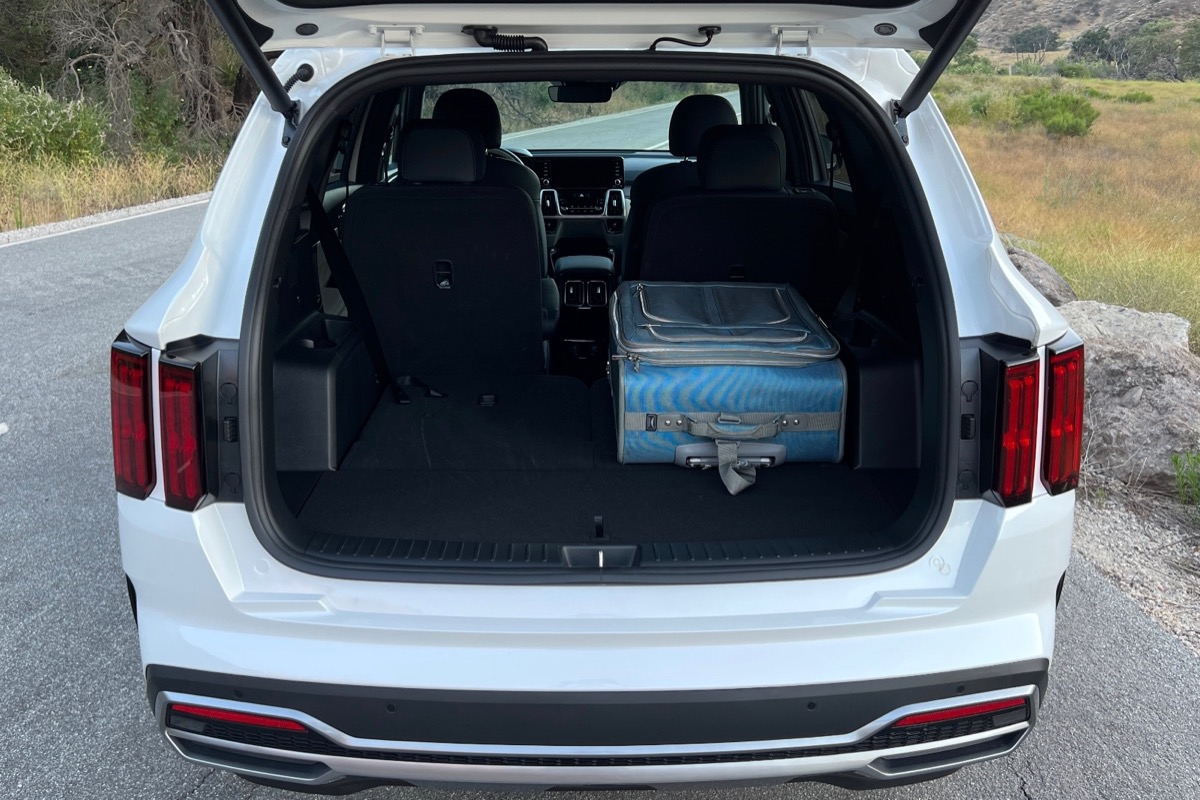
Again, the third-row seat is a tight fit for grown-ups, far from the minivan-like space you’d get from a larger midsize SUV such as the Kia Telluride. It lacks the requisite legroom, headroom, and foot room to make it habitable for more than a few minutes. Kids will likely be happier in this location, but the third-row seat is also located perilously close to the rear liftgate—a concern with regard to rear-impact collisions.
There is no shortage of cargo space aboard the Sorento, and choosing the Plug-in Hybrid doesn’t diminish it. Just like its gas-only and hybrid siblings, the PHEV supplies 357 litres behind the third-row seats, 1,090 litres behind the second-row seats, and 2,138 litres behind the front seats.
Technology
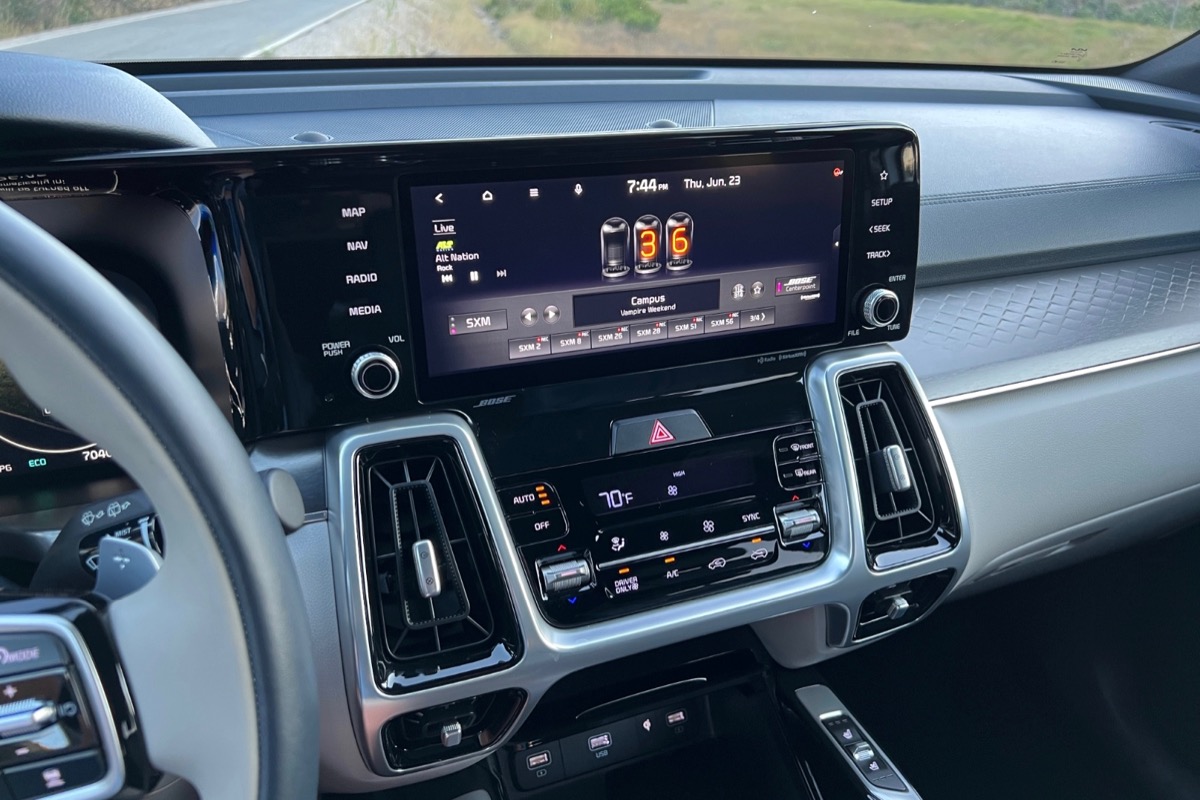
Kia equips the Sorento PHEV with its best infotainment technology. That includes a 10.25-inch touchscreen infotainment system, simultaneous Bluetooth connectivity for multiple devices, and Kia Connect connected services. Wireless smartphone charging and SiriusXM satellite radio are standard equipment as well, and a navigation system comes in at the EX+ trim.
The SX trim adds an unexpectedly impressive 12-speaker Bose Centerpoint premium surround-sound audio system delivering a rich amount of bass and remarkable high-frequency clarity.
However, the infotainment system doesn't include wireless Apple CarPlay and Android Auto, so you still have to connect your smartphone to a USB port. That’s odd considering how wireless Apple CarPlay and Android Auto are increasingly common now. We’re not necessarily fans of the highly stylized on-screen icons and fonts Kia uses either, nor the default neon-hued violet purple colour theme, which owners cannot change.
In addition, the voice recognition technology is as irritating. It isn’t anywhere close to being as natural to use and helpful in its responses as what Kia puts in its all-electric EV6. The native digital voice assistant was not conversational and forced a process of trial-and-error for some commands while utterly failing at others. For this reason, you’ll probably want to run Apple CarPlay or Android Auto instead.
We’ve mentioned how great the new 12.3-inch digital instrument display is. The background graphic depicts a highway disappearing toward a horizon where a distant city skyline and a mountain range rise from a flat, rural, agrarian landscape. White, puffy clouds and a deep blue sky show during the day, and at dusk the scene transitions to a sunset view. Presumably, the display is dark at night and shows a sunrise in the morning. Whatever the case may be, it might be the single most impressive graphical approach to digital instrumentation in any modern automobile.
Safety
If the Sorento Plug-in Hybrid’s infotainment tech is impressive, the long list of safety features is even more so. It comes with nearly every driver-assist and collision-avoidance system in the Kia arsenal, including forward collision avoidance and available Highway Driving Assist and an adaptive cruise control system that can take into account navigation system data to automatically adjust speed for upcoming curves.
Highway Driving Assist (HDA) pairs the adaptive cruise control with a lane-centring assist feature. Set it, and it will help with speed, following distance, and steering to ease driving on the highway. The HDA in this Sorento Plug-in Hybrid operated with more refinement and accuracy than the same tech in a gas-only Sorento we evaluated earlier this year. We think low winter sun befuddled the HDA in the gas-only Sorento; this evaluation took place in June with the sun higher in the sky.
HDA offers extended periods of hands-off driving, though it isn’t designed for that activity. And if you fall asleep or suffer a medical emergency, there isn’t an automatic emergency stop system to serve as a backup safety net. Ignore HDA’s requests to put your hands back on the steering wheel, and it will slow but not stop the vehicle.
On the SX trim, the Sorento PHEV comes with a surround-view camera system and a Blind View Monitor. That technology is in addition to the standard blind-spot monitoring system, and it uses cameras to show drivers a view of what’s in the adjacent lane when they signal a lane change. The camera view displays within the digital instrumentation panel, replacing either the left or right data panel depending on which lane it shows.
Several of the Kia Sorento PHEV’s safety systems are particularly useful to parents. A Rear Occupant Alert system reminds the driver to check the back seat before locking and leaving the vehicle. If that doesn’t work, ultrasonic sensors monitor the interior for movement for 24 hours, so if a sleeping child wakes, it will trigger flashing lights and a honking horn as well as owner notification via text or the Kia Connect smartphone app.
Additionally, a Safe Exit Assist system warns occupants when it is unsafe to open a door and exit the vehicle, such as when parked parallel to a curb with traffic approaching from behind. Kia Connect equips the Sorento with alerts related to vehicle speed, curfew time, and geo-fenced boundaries, letting Mom and Dad know when their offspring are bending the driving rules. Kia Connect also provide a panic button inside the vehicle, which can alert the owner when the person driving the Sorento needs help.
As for crash-test ratings, the Kia Sorento earns a Top Safety Pick rating from the Insurance Institute for Highway Safety (IIHS). The National Highway Traffic Safety Administration (NHTSA) gives the related 2022 Kia Sorento Hybrid a four-star overall safety rating.
Cost-effectiveness
It’s not uncommon for a midsize SUV to far exceed $50,000, though the models that do are typically larger inside than the Kia Sorento. Nevertheless, even at its sticker price, the Sorento PHEV is appealing. If you can factor in federal and provincial rebates along with the downright luxurious interior and impressive fuel economy, the Sorento PHEV is a steal.
Rivals to the Kia Sorento PHEV include its corporate cousin, the Hyundai Santa Fe Plug-in Hybrid, which uses the same platform, powertrain, and underlying technology. The Jeep Grand Cherokee 4xe is another alternative, but the Jeep’s base price is more than $20,000 higher than the loaded Sorento PHEV SX. Other plug-in hybrid SUVs include the Mitsubishi Outlander Plug-in Hybrid, the Toyota RAV4 Prime, Kia’s own Sportage PHEV compact SUV, and the related Hyundai Tucson PHEV, each of which can save you money on the purchase price but also have less interior space and aren’t nearly as nice on the inside.
Overall, the 2022 Kia Sorento Plug-in Hybrid is an excellent way to give living with an EV a try without fully committing to an electric-only drivetrain. Better yet, you’ll always feel like you got your money’s worth, especially with the SX trim level.
Note: Images show a US model.

What owners say
"Overall, owners of the 2022 Kia Sorento Hybrid Plug-In appreciate the impressive gas mileage, spacious interior, and a good set of standard features. Many highlight the vehicle's efficiency, especially its electric range for daily commuting. However, some reviewers noted concerns with the white interiors being a bit high maintenance and the difficulty in finding one at a reasonable price."
We really like the Kia Sorento PHEV! The fact that it covers our daily commutes with ~35 miles on electric power alone is fantastic. Plus, the overnight charging on a regular outlet only takes about 11 hours, and with a Level 2 charger, its down to just 3 hours. Even when the battery runs out, the gas mileage around town is impressive, giving us around 38 MPG, which drops to about 30 on long highway commutes. With a family of 4 or 5, the spacious interior is a huge bonus. Its the perfect blend of efficiency and versatility.
September 6, 2023You get a lot of standard features with this vehicle and great gas mileage for an AWD SUV. It also has a great design.
April 13, 2022As for the first part of that equation, the 2022 Kia Sorento PHEV is EPA rated at 32 miles of electric range
May 5, 2022What owners say
We really like the Kia Sorento PHEV! The fact that it covers our daily commutes with ~35 miles on electric power alone is fantastic. Plus, the overnight charging on a regular outlet only takes about 11 hours, and with a Level 2 charger, its down to just 3 hours. Even when the battery runs out, the gas mileage around town is impressive, giving us around 38 MPG, which drops to about 30 on long highway commutes. With a family of 4 or 5, the spacious interior is a huge bonus. Its the perfect blend of efficiency and versatility.
September 6, 2023You get a lot of standard features with this vehicle and great gas mileage for an AWD SUV. It also has a great design.
April 13, 2022As for the first part of that equation, the 2022 Kia Sorento PHEV is EPA rated at 32 miles of electric range
May 5, 2022Nice features, very spacious, white interiors may be high maintenance
June 17, 2023Trims & specs
Base MSRP N/A | Seating N/A |
Engine N/A | Cargo Capacity N/A |
Combined MPG N/A | Drivetrain N/A |
Base MSRP N/A | Seating N/A |
Engine N/A | Cargo Capacity 12.6 cu ft |
Combined MPG N/A | Drivetrain N/A |
Base MSRP $53,090 | Seating 6 |
Engine 1.6L 261 hp I4 Hybrid | Cargo Capacity 12.6 cu ft |
Combined MPG 74 | Drivetrain AWD |
Base MSRP N/A | Seating 7 |
Engine N/A | Cargo Capacity N/A |
Combined MPG N/A | Drivetrain N/A |


Pricing trends
MSRP range
$45,190 - $48,090
Current avg. market price
$32,476
Trending up by 1.9% this month
May 2026 - November 2026

