2022 BMW i4 Reviews, Pricing & Specs



The CarGurus verdict
Meet the BMW i4. The German firm’s latest EV is more conservative than its first, but also more appealing.
After entering the modern electric car era with the radical i3 hatchback, BMW is dialing things back a bit. The 2022 BMW i4 isn’t as radical as the i3, but it may also appeal to a wider audience.
Instead of a dedicated platform, the i4 uses the same body shell as the gasoline BMW 4 Series Gran Coupe, which in turn is a four-door version of the BMW 4 Series coupe and convertible. The result is an electric vehicle with dimensions fairly close to the BMW 3 Series, the Bavarian automaker’s signature product. By offering an electric alternative, BMW is showing that it’s serious about electric vheicles (EVs).
The i4’s closest rivals are the Tesla Model 3 and Polestar 2, as both are electric four-doors from premium brands. Most of BMW’s traditional rivals, such as Audi and Mercedes-Benz, are focusing on electric crossover SUVs and more expensive sedans for now. The Porsche Taycan is positioned above the i4 in price and performance aspirations.
As with other BMW models, the i4 launches in multiple configurations based on its drivetrain rather than conventional trim levels. The single-motor rear-wheel drive (RWD) BMW i4 eDrive40 is the base model, and the one we test drove for this review. Buyers looking for more power can upgrade to the dual-motor all-wheel drive (AWD) i4 M50, which is featured in our video review, above.
out of 10 expert review
Look & feel
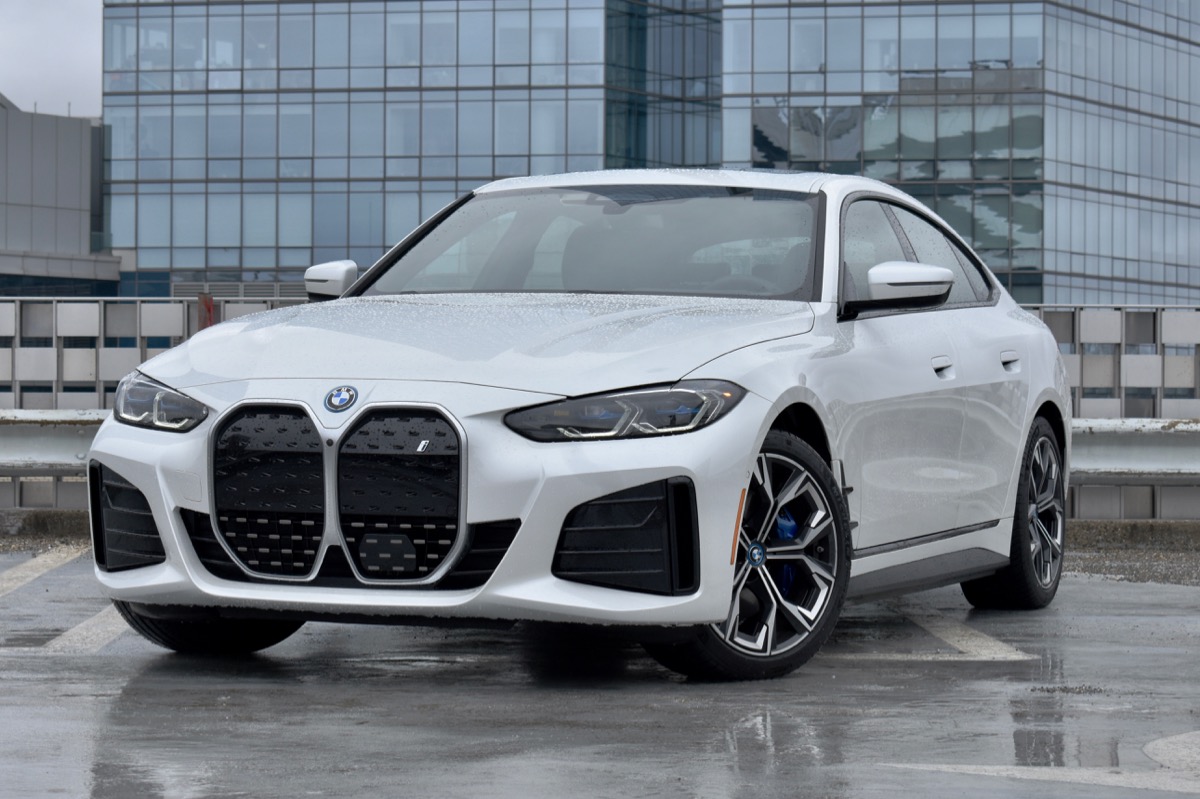
The new BMW i4’s styling isn’t a major departure from the gasoline 4 Series Gran Coupe (which isn’t sold in Canada), so it’s likely to prove polarizing because of the oversized grille, and confusing because of BMW’s use of the term “Gran Coupe” to described what is essentially a four-door sedan with a rear tailgate instead of a trunk. Traditionally applied to two-door vehicles, the word “coupe” has an increasingly elastic definition these days.
The i4 is a bit more aerodynamic than its gasoline-powered sibling, however. BMW says the base i4 eDrive40 has a drag coefficient (Cd) of 0.24, compared to 0.28 for the base 430i Gran Coupe. The BMW i4 M50 has a claimed 0.25 Cd, compared to 0.30 for the equivalent gasoline M440i xDrive Gran Coupe. BMW achieved this with a number of tweaks, including a smooth underbody, front spoiler, rear diffuser, and an active flap to control airflow through the massive grille (only a small portion of which is open).
BMW also gave the i4 lighter alloy wheels. The eDrive40 gets standard 18-inch wheels, while the M50 gets 19-inch wheels (with staggered tire sizes). Larger wheels are optional on both models.
The battery pack is mounted below the floor and connected to the front axle subframe which, along with a standard bracing package, provides extra structural rigidity, according to BMW. That’s always a good thing when it comes to handling. While the battery pack also adds a significant amount of weight, BMW used an aluminum hood and front fenders to counteract some of that. The body shell itself is made from a mix of hot-stamped steel and aluminum.
The interior design strikes a good balance between Tesla-style minimalism and traditional BMW styling elements. A freestanding screen sits atop the dashboard, but below it the horizontal layout of the air vents and other controls is familiar BMW. So was the oversized M Sport steering wheel on our test car. Material quality appeared up to BMW’s traditional standards, but leather upholstery isn’t standard.

Performance
The base i4 eDrive40 gets power specs of 335 horsepower and 317 pound-feet of torque from its electric motor, getting it from zero to 100 kilometres per hour in 5.7 seconds, according to BMW. That’s quicker than a base RWD Tesla Model 3. The M50 variant’s two-motor powertrain produces 536 hp and 586 lb-ft of torque (using a Sport Boost function) and a claimed zero to 100 km/h time of 3.9 seconds—quicker than an AWD Model 3 Long Range, and a few tenths behind the Model 3 Performance.
BMW built its performance reputation on more than just straight-line acceleration, though. What set classic BMWs like the E30-generation 3 Series apart is the way they handle, and BMW claims its electric models have the same cornering abilities.
Thanks to a battery pack mounted underneath the floor, the automaker claims the i4’s centre of gravity is 3.3 centimetres lower (i4 M50) or 5.3 cm lower (i4 eDrive40) than a 3 Series sedan. However, both i4 models are fairly heavy. BMW’s quoted curb weights of 2,123 kilograms (4,680 pounds) and 2,276 kilograms (5,018 pounds) for the i4 eDrive40 and i4 M50, respectively, are about 450 kilograms (1,000 pounds) heavier than comparable 3 Series models. You can thank those battery packs for that, too.
Both i4 models get rear air suspension and lift-related shocks (shared with the 4 Series Gran Coupe), which provide damping force in response to spring travel, helping to reduce body roll, BMW claims. The M50 version also gets adaptive M suspension, variable sport steering, and BMW M Sport brakes. The upgraded suspension and brakes can also be added to the eDrive40 with the optional M Sport Pro Package.
Our test car had that option package, and it really made a difference. The adaptive suspension provided one of the smoothest rides we’ve experienced in a recent BMW. The impact from even the nastiest potholes was barely discernible in the cabin—even in the more aggressive Sport mode. The ride in Sport and the default Eco Pro mode was so good, in fact, that we didn’t feel the need for the Comfort mode.
This Bimmer is no overstuffed sofa on wheels, though. Along with the suspension, the upgraded brakes and steering included with the M Sport Pro Package made the i4 worthy of BMW’s “Ultimate Driving Machine” tagline. Despite its hefty curb weight, the i4 was seriously fun and playful. Our RWD test car was able to rotate nicely in corners without feeling loose or nervous, and we could also tell what the back end was doing. The steering was remarkably precise and communicative. And of course you get the shove of instant torque common to all EVs.
Electric cars rely on regenerative braking to achieve maximum range, but that can interfere with the linear brake pedal feel necessary in a performance car. BMW’s solution is a so-called integrated braking system that uses an electric actuator to generate brake pressure based on the driver’s inputs, which the automaker claims provides more natural pedal feel.
The i4 also has an adaptive recuperation system that automatically adjusts the level of regenerative braking, switching between maximum regeneration and a lower setting that allows the car to coast in certain situations, depending on what’s deemed more efficient.
We did find the pedal feel to be reassuringly natural, but weren’t completely sold on the adaptive recuperation system. In practice, it tended to increase regen when following another car, creating a sensation almost like using adaptive cruise control. But in other situations, regen wasn’t strong enough to enable one-pedal driving. The fact that you never know how much regen you’re getting is also a little worrying, as it makes it harder to judge when to use the brake pedal.

Form & function
The seating position is remarkably low considering that you’re sitting on top of a battery pack, but that didn’t hinder outward visibility in our experience. However, the fastback roof limits headroom. The i4 has less headroom in both rows than the Polestar 2, which also has a fairly sleek roofline. The Polestar also has more front legroom, but the BMW has more legroom for rear-seat passengers.
Subjectively, the interior felt airy and open for a car with relatively little side glass. That’s thanks in part to the efficiently designed centre console, which didn’t take up a lot of space despite housing the shift lever, infotainment controller, and a generously sized storage bin and cupholders.
However, both front- and second-row seats in our i4 eDrive40 test car felt flat and hard. The front seats in particular lacked the bolstering one would normally expect in a sporty car. We noticed a couple of other smaller issues as well. The wireless charging pad won’t accommodate larger phones, and we think the lack of a power adjustable steering column is unacceptable in a car this expensive.
The i4 does have folding rear seats, but BMW only quotes a cargo-space figure with the seats up. At 283 litres, the i4 has less cargo space than a Polestar 2 or a Tesla Model 3. Both the BMW and Polestar are hatchbacks, and thus provide a wider opening for loading and unloading cargo than the Model 3, which is a conventional sedan with a trunk. BMW didn’t include a front trunk—a.k.a. “frunk”—like Tesla and Polestar, though.

Technology
Because automakers seem obligated to make their EVs showcases for elaborate connectivity tech, the i4 gets the latest BMW iDrive8 infotainment system and BMW Curved Display. The latter consists of a 12.3-inch instrument cluster and 14.9-inch central touchscreen placed side by side to form one long screen, similar to what rival Mercedes has been doing for some time now.
Other notable features include standard Apple CarPlay and Android Auto, Bluetooth, navigation, over-the-air (OTA) update capability, and SiriusXM with 360L satellite radio. A head-up display, Harman Kardon sound system, and wireless device charging are also available.
Despite the new screen configuration and somewhat different graphics, the user experience was similar to other recent incarnations of iDrive, so existing BMW drivers likely won’t face a steep learning curve. The familiar rotary controller remains, and was much easier to use than the Mercedes controller. Combined with menu shortcut buttons and a very effective voice recognition system, it made using the touchscreen pretty much unnecessary.

Safety
Crash-test ratings from the Insurance Institute for Highway Safety (IIHS) and National Highway Traffic Safety Administration (NHTSA) were not available at the time of publication.
Standard driver-assist features include forward-collision warning, high beam assist, and intelligent emergency calling. Adaptive cruise control with stop-and-go functionality, Driving Assistant (lane departure warning, blind spot monitoring, rear cross-traffic alert), Driving Assistant Professional (highway drive assist functions), front and rear parking sensors, and Traffic Jam Assistant are available in packages. The latter handles acceleration, braking and lane centring at low speeds (below 65 km/h) on divided highways.
Finally, the Parking Assistant Package adds a 360-degree camera system, Park Distance Control parking sensors and low-speed automatic braking, and Parking Assistant, which can steer the car in and out of perpendicular and parallel spaces. The latter also includes Back-Up Assistant, which can remember the path the car took to get into a parking space and automatically reverse out the same way. It’s handy for driveways or tight spaces where you can’t simply back straight out.

Cost-effectiveness
Both versions of the i4 use the same 83.9-kilowatt-hour battery pack, with 81.5 kWh of usable capacity. Range and efficiency are very dependent on wheel choice.
With the standard 18-inch wheels, the BMW i4 eDrive40 has a Natural Resources Canada-rated 484 kilometres of estimated range and efficiency ratings of 2.2 Le/100 km combined (2.1 city, 2.2 highway). That drops to 454 km of electric range and rises to 2.4 Le/100 km combined (2.4 city, 2.4 highway) with the optional 19-inch wheels. Similarly, the i4 M50 is rated at 435 km and 2.5 Le/100 km combined (2.5 city, 2.4 highway) with its standard 19-inch wheels, and 365 km and 3.0 Le/100 km combined (3.0 city, 2.9 highway) with the optional 20-inch wheels.
This electric BMW is capable of charging at up to 11 kilowatts with an AC Level 2 charger, allowing for a full recharge in just over eight hours, BMW claims. A maximum DC fast charging power rate of 200 kW can accomplish a 10%-80% charge in a claimed 31 minutes.
BMW provides a four-year, 80,000-kilometre, new vehicle warranty and an eight-year, 160,000-kilometre warranty for the battery pack. Four years of roadside assistance with unlimited mileage are included as well.
Pricing starts at $54,990 for the i4 eDrive40 and $72,990 for the i4 M50 (prices do not include the mandatory $2,480 destination charge). With the changes to the federal government’s iZEV program qualifications, the eDrive40 qualifies for $5,000 in rebates, but the M50 does not. That’s also the case for Polestar but not Tesla.
The i4 may be electric, but it’s still a BMW. So, to get most of the features that justify its luxury-car status, you’ll need to spend substantially more than the base price. Our test car had a number of options, ranging from Mineral White Metallic paint and Mocha Vernasca leather upholstery to the M Sport Pro, Advanced Driver Assistance, and Premium Essential option packages. These are desirable features, but they bring the as-tested MSRP to $77,075, including fees (Canadian, estimated).
While the i4 suffers from BMW’s penchant for nickel and diming customers, it also benefits from the automaker’s experience with both EVs and performance cars. With a maximum 484-kilometre range and a fantastic driving experience, the i4 is a match for the Polestar 2 and Tesla Model 3 in desirability. But if we were spending our own money, we’d also seriously consider EVs from mainstream brands, such as the Ford Mustang Mach-E, Hyundai Ioniq 5, and Kia EV6, which offer most of what the BMW does as a new car for a lot less money.
Note: Images show a US model.

What owners say
"Overall, drivers are impressed with the 2022 BMW i4, highlighting its performance, sleek design, and BMW's quality. Many love the smooth ride, power, and features, making it feel like a traditional BMW despite being electric. However, some drivers noted the weight of the car and expressed disappointment in certain design elements like the front grill and manual seat controls."
Love this car! First electric vehicle I have ever owned and was very apprehensive. However, I drove it from the dealership in NC back home to Little Rock AR and launched into this new endeavor head first. Bottom line. I love this car already! The BMW i4 controls all operate like a normal vehicle and drives like a regular car. Pretty much the only difference is you fill with electricity instead of liquid gas. Other than that you would think you are driving a normal 4series BMW. It is absolutely amazing! I have the M50 model and this thing has unbelievable torque and power. Can’t say enough about my new BMW purchase.
August 22, 2022Absolutely amazing and beautiful car!! Fully loaded with shadow line package and ambient lighting. Quality is exceptional!! Smoothiest ride ever
November 15, 2022The 2022 BMW i4 is a great looking car that is fun to drive. I drove the loaded edrive40 model and it had tons of features including automatic parking, assisted drive adaptive cruise control, drive video recorder, and plenty of power. Inside and out it has the expected BMW build quality with perfect fit and finish. The car is the iconic BMW 4 Gran Couple, but with no internal combustion engine. The car looks and drives like a BMW should and I think its a keeper!
August 24, 2022What owners say
Love this car! First electric vehicle I have ever owned and was very apprehensive. However, I drove it from the dealership in NC back home to Little Rock AR and launched into this new endeavor head first. Bottom line. I love this car already! The BMW i4 controls all operate like a normal vehicle and drives like a regular car. Pretty much the only difference is you fill with electricity instead of liquid gas. Other than that you would think you are driving a normal 4series BMW. It is absolutely amazing! I have the M50 model and this thing has unbelievable torque and power. Can’t say enough about my new BMW purchase.
August 22, 2022Absolutely amazing and beautiful car!! Fully loaded with shadow line package and ambient lighting. Quality is exceptional!! Smoothiest ride ever
November 15, 2022The 2022 BMW i4 is a great looking car that is fun to drive. I drove the loaded edrive40 model and it had tons of features including automatic parking, assisted drive adaptive cruise control, drive video recorder, and plenty of power. Inside and out it has the expected BMW build quality with perfect fit and finish. The car is the iconic BMW 4 Gran Couple, but with no internal combustion engine. The car looks and drives like a BMW should and I think its a keeper!
August 24, 2022Beautiful car. Disappointed that the seats are manually controlled, not electric; also the back window is too small, and most of that is blocked by 3 headrests.
January 15, 2024We test drove the BMW I4. The car felt a bit heavy and you could feel the weight right away. But once you get over that feeling the smooth ride and acceleration take over. When I pressed the pedal down in sport plus, I think I gave my wife whiplash! Great ride, a little noisy, very nimble,
August 28, 2022Finally a car to rival Tesla in terms of performance and range, and better quality
April 28, 2022Great looking car except for the front grill. Why change the traditional grill?
September 6, 2022Trims & specs
Base MSRP $70,700 | Seating 5 |
Engine 536 hp Electric | Cargo Capacity 16.6 cu ft |
Combined MPG 94 | Drivetrain AWD |
Base MSRP $57,900 | Seating 5 |
Engine 335 hp Electric | Cargo Capacity 16.6 cu ft |
Combined MPG 118 | Drivetrain RWD |


Pricing trends
MSRP range
$55,400 - $65,900
Current avg. market price
$48,695
Trending up by 2.8% this month
July 2026 - November 2026

