Used Ford Explorer for Sale nearSudbury, ON
- Year:
- 2022
- Make:
- Ford
- Model:
- Explorer
- Body type:
- SUV / Crossover
- Doors:
- 4 doors
- Drivetrain:
- All-Wheel Drive
- Engine:
- 2.3L I4
- Exterior colour:
- Gray
- Combined gas mileage:
- 11 L/100km
- Fuel type:
- Gasoline
- Interior colour:
- Black
- Transmission:
- Automatic
- Mileage:
- 51,342
- Stock #:
- P6165T
- VIN:
- 1FMSK8KH9NGC16007


Sponsored by Thor Motors Orillia Ltd.
2022 Ford Explorer
ST-Line AWD
51,342 km
$37,695
- Year:
- 2020
- Make:
- Ford
- Model:
- Explorer
- Body type:
- SUV / Crossover
- Doors:
- 4 doors
- Drivetrain:
- All-Wheel Drive
- Engine:
- 2.3L I4
- Exterior colour:
- White
- Combined gas mileage:
- 10 L/100km
- Fuel type:
- Gasoline
- Transmission:
- Automatic
- Mileage:
- 163,259
- Stock #:
- 00D454A
- VIN:
- 1FMSK8FH6LGB58090

Sponsored Listing
2020 Ford Explorer
Limited AWD
163,259 km
$23,488
- Year:
- 2020
- Make:
- Ford
- Model:
- Explorer
- Body type:
- SUV / Crossover
- Doors:
- 4 doors
- Drivetrain:
- All-Wheel Drive
- Engine:
- 3L V6
- Exterior colour:
- Red
- Combined gas mileage:
- 12 L/100km
- Fuel type:
- Gasoline
- Interior colour:
- Black
- Transmission:
- Automatic
- Mileage:
- 95,992
- Stock #:
- PT1815A
- VIN:
- 1FM5K8GCXLGB69741

Sponsored Listing
2020 Ford Explorer
ST AWD
95,992 km
$33,995
- Year:
- 2025
- Make:
- Ford
- Model:
- Explorer
- Body type:
- SUV / Crossover
- Doors:
- 4 doors
- Drivetrain:
- All-Wheel Drive
- Engine:
- 300 hp 2.3L I4
- Exterior colour:
- Black
- Combined gas mileage:
- 10 L/100km
- Fuel type:
- Gasoline
- Transmission:
- Automatic
- Mileage:
- 71,581
- Stock #:
- A25614
- VIN:
- 1FMUK8DH6SGA07065

-$971
2025 Ford Explorer
Active AWD
71,581 km
$39,887
$39,296
- Year:
- 2017
- Make:
- Ford
- Model:
- Explorer
- Body type:
- SUV / Crossover
- Doors:
- 4 doors
- Drivetrain:
- All-Wheel Drive
- Engine:
- 365 hp 3.5L V6
- Exterior colour:
- White
- Combined gas mileage:
- 13 L/100km
- Fuel type:
- Gasoline
- Transmission:
- Automatic
- Mileage:
- 87,859
- Stock #:
- 26046A
- VIN:
- 1FM5K8GT6HGD27774

2017 Ford Explorer
Sport AWD
87,859 km
$16,767
- Year:
- 2022
- Make:
- Ford
- Model:
- Explorer
- Body type:
- SUV / Crossover
- Doors:
- 4 doors
- Drivetrain:
- All-Wheel Drive
- Engine:
- 2.3L I4
- Exterior colour:
- Green Metallic
- Combined gas mileage:
- 11 L/100km
- Fuel type:
- Gasoline
- Interior colour:
- Black (Ebony)
- Transmission:
- Automatic
- Mileage:
- 26,382
- Stock #:
- 22-06847JB
- VIN:
- 1FMSK8DH4NGA06847

2022 Ford Explorer
XLT AWD
26,382 km
$36,981
- Year:
- 2024
- Make:
- Ford
- Model:
- Explorer
- Body type:
- SUV / Crossover
- Doors:
- 4 doors
- Drivetrain:
- All-Wheel Drive
- Engine:
- 3L V6
- Exterior colour:
- Black
- Combined gas mileage:
- 12 L/100km
- Fuel type:
- Gasoline
- Transmission:
- Automatic
- Mileage:
- 39,703
- Stock #:
- EB145R
- VIN:
- 1FM5K8GCXRGA09643

2024 Ford Explorer
ST AWD
39,703 km
$52,778
- Year:
- 2023
- Make:
- Ford
- Model:
- Explorer
- Body type:
- SUV / Crossover
- Doors:
- 4 doors
- Drivetrain:
- All-Wheel Drive
- Engine:
- 2.3L I4
- Exterior colour:
- Gray (Carbonized Grey Metallic (M7))
- Combined gas mileage:
- 10 L/100km
- Fuel type:
- Gasoline
- Transmission:
- Automatic
- Mileage:
- 62,178
- Stock #:
- K26-429A
- VIN:
- 1FMSK8DH3PGA43729

2023 Ford Explorer
XLT AWD
62,178 km
$35,470
- Year:
- 2022
- Make:
- Ford
- Model:
- Explorer
- Body type:
- SUV / Crossover
- Doors:
- 4 doors
- Drivetrain:
- All-Wheel Drive
- Engine:
- 2.3L I4
- Exterior colour:
- Gray
- Combined gas mileage:
- 12 L/100km
- Fuel type:
- Gasoline
- Interior colour:
- Black
- Transmission:
- Automatic
- Mileage:
- 79,000
- Stock #:
- 1042-15B
- VIN:
- 1FMSK8JH7NGA07205

2022 Ford Explorer
Timberline AWD
79,000 km
$35,399
- Year:
- 2023
- Make:
- Ford
- Model:
- Explorer
- Body type:
- SUV / Crossover
- Doors:
- 4 doors
- Drivetrain:
- All-Wheel Drive
- Engine:
- 2.3L I4
- Exterior colour:
- Gray
- Combined gas mileage:
- 10 L/100km
- Fuel type:
- Gasoline
- Interior colour:
- Black
- Transmission:
- Automatic
- Mileage:
- 59,861
- Stock #:
- PGA52414
- VIN:
- 1FMSK8KH8PGA52414

2023 Ford Explorer
ST-Line AWD
59,861 km
$39,710
- Year:
- 2023
- Make:
- Ford
- Model:
- Explorer
- Body type:
- SUV / Crossover
- Doors:
- 4 doors
- Drivetrain:
- All-Wheel Drive
- Engine:
- 2.3L I4
- Exterior colour:
- White
- Combined gas mileage:
- 10 L/100km
- Fuel type:
- Gasoline
- Interior colour:
- Black
- Transmission:
- Automatic
- Mileage:
- 77,570
- Stock #:
- LT0096
- VIN:
- 1FMSK8FH8PGA19794

2023 Ford Explorer
Limited AWD
77,570 km
$36,495
- Year:
- 2020
- Make:
- Ford
- Model:
- Explorer
- Body type:
- SUV / Crossover
- Doors:
- 4 doors
- Drivetrain:
- All-Wheel Drive
- Engine:
- 2.3L I4
- Exterior colour:
- Gray
- Combined gas mileage:
- 10 L/100km
- Fuel type:
- Gasoline
- Transmission:
- Automatic
- Mileage:
- 107,417
- Stock #:
- T2671
- VIN:
- 1FMSK8DH7LGB69022

2020 Ford Explorer
XLT AWD
107,417 km
$23,259
- Year:
- 2023
- Make:
- Ford
- Model:
- Explorer
- Body type:
- SUV / Crossover
- Doors:
- 4 doors
- Drivetrain:
- All-Wheel Drive
- Engine:
- 2.3L I4
- Exterior colour:
- Oxford White
- Combined gas mileage:
- 10 L/100km
- Fuel type:
- Gasoline
- Transmission:
- Automatic
- Mileage:
- 89,992
- Stock #:
- E2845
- VIN:
- 1FMSK8DH4PGA36854

-$1,000
2023 Ford Explorer
XLT AWD
89,992 km
$32,998
$32,798
Recommended model year:
2025 Ford Explorer
Shop 2025 Ford Explorer »With 68 currently listed for sale near Sudbury, ON and an average price of $55,995 CAD, 17.6% of 2025 Ford Explorers for sale on CarGurus are rated as good or great deals.
Favourably reviewed: Owners rated the 2025 Ford Explorer 5 / 5 stars and CarGurus experts gave it an 8 / 10.
100.0% of 2025 Explorer models on CarGurus are accident free.
- Year:
- 2020
- Make:
- Ford
- Model:
- Explorer
- Body type:
- SUV / Crossover
- Doors:
- 4 doors
- Drivetrain:
- All-Wheel Drive
- Engine:
- 2.3L I4
- Exterior colour:
- Black
- Combined gas mileage:
- 10 L/100km
- Fuel type:
- Gasoline
- Transmission:
- Automatic
- Mileage:
- 199,681
- Stock #:
- HP113
- VIN:
- 1FMSK8DH6LGA98556

2020 Ford Explorer
XLT AWD
199,681 km
$16,995
- Year:
- 2022
- Make:
- Ford
- Model:
- Explorer
- Body type:
- SUV / Crossover
- Doors:
- 4 doors
- Drivetrain:
- All-Wheel Drive
- Engine:
- 3L V6
- Exterior colour:
- Black
- Combined gas mileage:
- 12 L/100km
- Fuel type:
- Gasoline
- Interior colour:
- Black
- Transmission:
- Automatic
- Mileage:
- 106,266
- Stock #:
- PT1852
- VIN:
- 1FM5K8GC2NGB05437

2022 Ford Explorer
ST AWD
106,266 km
$33,995
- Year:
- 2023
- Make:
- Ford
- Model:
- Explorer
- Body type:
- SUV / Crossover
- Doors:
- 4 doors
- Drivetrain:
- All-Wheel Drive
- Engine:
- 2.3L I4
- Exterior colour:
- Black
- Combined gas mileage:
- 10 L/100km
- Fuel type:
- Gasoline
- Transmission:
- Automatic
- Mileage:
- 57,741
- Stock #:
- N0225
- VIN:
- 1FMSK8FH1PGA91551

2023 Ford Explorer
Limited AWD
57,741 km
$38,043
- Year:
- 2020
- Make:
- Ford
- Model:
- Explorer
- Body type:
- SUV / Crossover
- Doors:
- 4 doors
- Drivetrain:
- All-Wheel Drive
- Engine:
- 2.3L I4
- Exterior colour:
- Red
- Combined gas mileage:
- 10 L/100km
- Fuel type:
- Gasoline
- Transmission:
- Automatic
- Mileage:
- 75,920
- Stock #:
- 26640A
- VIN:
- 1FMSK8DH8LGA74226

2020 Ford Explorer
XLT AWD
75,920 km
$26,005
- Year:
- 2023
- Make:
- Ford
- Model:
- Explorer
- Body type:
- SUV / Crossover
- Doors:
- 4 doors
- Drivetrain:
- All-Wheel Drive
- Engine:
- 3L V6
- Exterior colour:
- White
- Combined gas mileage:
- 12 L/100km
- Fuel type:
- Gasoline
- Interior colour:
- Black
- Transmission:
- Automatic
- Mileage:
- 46,726
- Stock #:
- 26RG193A
- VIN:
- 1FM5K8GC2PGC04570

2023 Ford Explorer
ST AWD
46,726 km
$46,500
- Year:
- 2026
- Make:
- Ford
- Model:
- Explorer
- Body type:
- SUV / Crossover
- Doors:
- 4 doors
- Drivetrain:
- All-Wheel Drive
- Engine:
- 400 hp 3L V6
- Exterior colour:
- Gray
- Combined gas mileage:
- 11 L/100km
- Fuel type:
- Gasoline
- Interior colour:
- Black
- Transmission:
- Automatic
- Mileage:
- 4,266
- Stock #:
- SP00373M
- VIN:
- 1FMWK8GC8TGA02749

2026 Ford Explorer
ST AWD
4,266 km
$64,002
- Year:
- 2024
- Make:
- Ford
- Model:
- Explorer
- Body type:
- SUV / Crossover
- Doors:
- 4 doors
- Drivetrain:
- All-Wheel Drive
- Engine:
- 2.3L I4
- Exterior colour:
- Gray (Carbonized Grey Metallic)
- Combined gas mileage:
- 10 L/100km
- Fuel type:
- Gasoline
- Transmission:
- Automatic
- Mileage:
- 88,317
- Stock #:
- E2483
- VIN:
- 1FMSK8DH2RGA24530

2024 Ford Explorer
XLT AWD
88,317 km
$32,798
- Year:
- 2023
- Make:
- Ford
- Model:
- Explorer
- Body type:
- SUV / Crossover
- Doors:
- 4 doors
- Drivetrain:
- All-Wheel Drive
- Engine:
- 2.3L I4
- Exterior colour:
- White
- Combined gas mileage:
- 10 L/100km
- Fuel type:
- Gasoline
- Interior colour:
- Black
- Transmission:
- Automatic
- Mileage:
- 122,505
- Stock #:
- PT1813A
- VIN:
- 1FMSK8KH6PGA46742

2023 Ford Explorer
ST-Line AWD
122,505 km
$33,995
- Year:
- 2019
- Make:
- Ford
- Model:
- Explorer
- Body type:
- SUV / Crossover
- Doors:
- 4 doors
- Drivetrain:
- All-Wheel Drive
- Engine:
- 2.3L I4
- Combined gas mileage:
- 11 L/100km
- Fuel type:
- Gasoline
- Transmission:
- 6-Speed Automatic
- Mileage:
- 117,500
- Stock #:
- U7659
- VIN:
- 1FM5K8FH2KGA17903

2019 Ford Explorer
Limited AWD
117,500 km
$21,259
- Year:
- 2026
- Make:
- Ford
- Model:
- Explorer
- Body type:
- SUV / Crossover
- Doors:
- 4 doors
- Drivetrain:
- All-Wheel Drive
- Engine:
- 300 hp 2.3L I4
- Exterior colour:
- Red
- Combined gas mileage:
- 10 L/100km
- Fuel type:
- Gasoline
- Interior colour:
- Red (Maroon)
- Transmission:
- Automatic
- Mileage:
- 2,289
- Stock #:
- PT1838
- VIN:
- 1FMUK8HH7TGA03070

Sponsored Listing
2026 Ford Explorer
Platinum AWD
2,289 km
$60,995
How much does the Ford Explorer cost in today's market?
Used Ford Explorer prices span a wide range depending on model year. Here's what the market looks like right now:
| Model Year | Current Avg. Price | Year-Round Range |
|---|---|---|
| 2025 | $52,697 CAD | $52,697 CAD – $60,237 CAD |
| 2024 | $43,439 CAD | $43,439 CAD – $52,426 CAD |
| 2023 | $39,205 CAD | $39,205 CAD – $45,459 CAD |
| 2022 | $35,714 CAD | $35,714 CAD – $41,569 CAD |
| 2021 | $29,919 CAD | $29,919 CAD – $37,155 CAD |
| 2020 | $26,926 CAD | $26,926 CAD – $32,689 CAD |
| 2019 | $21,363 CAD | $21,363 CAD – $26,529 CAD |
| 2018 | $18,186 CAD | $18,186 CAD – $23,013 CAD |
| 2017 | $16,112 CAD | $16,112 CAD – $19,163 CAD |
| 2016 | $15,368 CAD | $14,757 CAD – $17,278 CAD |
| 2015 | $12,607 CAD | $12,194 CAD – $14,490 CAD |
| 2014 | $11,277 CAD | $10,023 CAD – $13,140 CAD |
The Ford Explorer's current nationwide average price is $32,457 CAD, and its lowest point over the past year was $32,199 CAD. Recently, prices have come down for the 2023, 2024, and 2025 models, making now a good time to shop recent model years.
Is the Ford Explorer a good car?
Yes — the Ford Explorer is a strong used pick if you want a spacious three-row SUV with broad capability and a long list of available features. The all-generations owner rating is 4.35/5 across every model year in the data.
Owners repeatedly praise the Explorer for its spacious interior, comfort, strong performance, and cargo room. Review summaries also point to its useful family-friendly layout, high-tech features, and versatile character as recurring strengths.
Expert reviews rate the 2025 and 2026 models among the highest across all years.
The main trade-offs in recent expert reviews centre on bland styling, a nondescript interior, and pricing that can climb quickly with options.
30.3% of listings are priced as good or great deals.
Are Ford Explorer models reliable?
Owners and experts consistently praise the Explorer for its spacious cabin, comfort, and strong performance, and those themes show up across multiple model years. The model also earns repeated credit for practicality and everyday usefulness, especially for families.
- Owners rate the Ford Explorer between 3.0 and 5.0 out of 5 stars across all model years in the data.
For used buyers, long-term ownership risk is best managed by choosing a well-kept example with a clear service history, since some older model years carry more mixed reliability feedback than others.
What should I look for when buying a used Ford Explorer?
Key things to evaluate:
- Safety package: CoPilot 360+ on the 2026 Active model includes adaptive cruise control with stop-and-go and lane centring, automatic high beams, a blind-spot monitor with trailer coverage and safe exit assist, rear cross-traffic alert, lane departure warning, lane keep assist, forward collision warning, automatic emergency braking, rear parking sensors, rear cross traffic braking, post-collision braking, and traffic sign recognition.
- Infotainment: A 13.2-inch touchscreen and 12.3-inch digital instrument cluster are standard on all models, along with wireless Apple CarPlay and Android Auto connectivity, Google Maps, Google Play Store, and SiriusXM with 360L satellite radio.
- Fuel efficiency: The turbo-four engine returns a Natural Resources Canada-rated 10.4 litres per 100 kilometres combined (11.9 city; 8.7 highway), while V6 models are rated at 11.6 L/100 km combined (13.3 city; 9.6 highway).
Which Ford Explorer trim should I buy?
The 2026 Ford Explorer offers these trims:
- Active: The entry trim brings the CoPilot 360+ suite, the standard 2.3-litre turbocharged four-cylinder, and the new 13.2-inch touchscreen with wireless Apple CarPlay and Android Auto; it suits buyers who want the most affordable path into the lineup.
- ST-Line: This trim adds a more road-focused look with blacked-out exterior trim and bigger wheels on lower-profile tires, making it a good fit if style matters to you.
- Tremor: The Tremor adds all-terrain tires, a raised ride height, off-road lights in the grille, a Torsen limited-slip rear differential, an off-road drive mode, and steel skid plates; it is the best choice if you want the most off-road hardware.
- Platinum: The Platinum adds the most luxurious feel in the lineup, including leather upholstery and a more upscale cabin presentation.
- ST: The ST adds the twin-turbo 3.0-litre V6, sport-tuned suspension, and beefier brakes, making it the performance pick.
What Ford Explorer do most buyers choose?
The Ford Explorer years with the most listings are 2022, 2021, and 2023.
| Model Year | Total Listings | Good + Great Deals % |
|---|---|---|
| 2022 | 554 | 35% |
| 2021 | 538 | 32.5% |
| 2023 | 485 | 31.5% |
| 2024 | 423 | 36.6% |
| 2020 | 378 | 34.4% |
| 2019 | 363 | 27% |
These higher-volume years tend to be popular because they give you a wider selection of trims, prices, and equipment levels to compare. They also sit in the part of the market where many shoppers can balance newer features with more accessible pricing.
What is the Ford Explorer's resale value?
| Model Year | Current Avg. Price | Year-Over-Year Change |
|---|---|---|
| 2018 | $18,186 CAD | −21.23% |
| 2019 | $21,363 CAD | −19.84% |
| 2021 | $29,919 CAD | −19.49% |
| 2020 | $26,926 CAD | −17.42% |
| 2024 | $43,439 CAD | −17.09% |
| 2017 | $16,112 CAD | −15.79% |
| 2022 | $35,714 CAD | −14.07% |
| 2023 | $39,205 CAD | −13.77% |
| 2015 | $12,607 CAD | −12.77% |
| 2025 | $52,697 CAD | −12.02% |
| 2016 | $15,368 CAD | −11.47% |
| 2014 | $11,277 CAD | −10.65% |
Most model years in the table are down by double digits year over year, which is good news if you are shopping used and want more value for your money. The newer and pricier examples are also seeing meaningful price drops, so recent model years can be especially worth watching. A few older years are falling a bit less sharply, but the overall pattern still favours buyers.
The 2014, 2016, and 2025 model years have held their value best, with the smallest year-over-year price changes.
Is the Ford Explorer safe?
- 2026: 10/10
- 2025: 9/10
- 2022: 10/10
- 2020: 8/10
The 2026 Explorer includes the CoPilot 360+ suite on Active models, and higher trims add CoPilot 360 2.0 with a 360-degree camera system, predictive speed assist, and road-edge detection for lane keep assist.
For the safest used buy, the 2022 and 2026 models both post the highest confirmed score of 10/10.
Should I buy a used Ford Explorer now or wait for the next model?
Buy now if:
- Price trend: The 2025 model is at −12.02% versus a year ago, and the 2024 model is at −17.09%.
- Deal availability: The 2024 model has 36.6% good and great deals.
- Sweet-spot year: The 2022 model has the most listings at a current average price of $35,714 CAD. The Ford Explorer offers a spacious three-row cabin that works well for families and everyday use.
Consider waiting if:
- Powertrain/efficiency: The standard 2.3-litre turbocharged four-cylinder engine produces 300 horsepower and 310 pound-feet of torque, while the twin-turbo 3.0-litre V6 produces 400 hp and 415 lb-ft of torque, and both engines come with a 10-speed automatic transmission and standard all-wheel drive (AWD) in Canada.
- Tech: A 13.2-inch touchscreen and 12.3-inch digital instrument cluster are standard on all models, along with wireless Apple CarPlay and Android Auto connectivity, Google Maps, Google Play Store, and SiriusXM with 360L satellite radio.
- Safety: BlueCruise is upgraded from version 1.2 to version 1.5 for 2026, adding automated lane change capability.
- Starting price: Pricing starts at $54,495 CAD for the most basic Active 100A spec.
If you're buying used today, the 2022 model year offers the best mix of value and availability. If you want the latest tech and features, it may be worth waiting for the next model year's inventory to build up.
These recommendations are based on CarGurus' proprietary market data from September 22, 2026, CarGurus experts' opinions, and generative AI.
4.4 Overall rating
Customers say
The Ford Explorer has consistently impressed owners across its model years for its spacious interior, comfort, and strong performance, making it a top choice for families and those needing versatility in an SUV. Many drivers appreciate the powerful engine options, high-tech features, and ample cargo space. However, concerns about fuel economy, handling on certain models, and specific comfort issues have been commonly noted. Overall, the Explorer stands out for its reliability and practicality, though some drivers wish for improvements in gas mileage and additional features.
AI generated from the text of customer reviews.
Filter by year
Filter by rating
What people say
Chris D
Reviewed a 2017 Ford Explorer on Jun 25, 2026
It’s loaded the way I like it. The twin turbo v6 has plenty of spunk
Cristian A
Reviewed a 2020 Ford Explorer on May 8, 2025
I was looking for some Sporty, reliable, and comfortable, all at the same time, and I found the answer to that with this beautiful Ford Explorer ST. I love all the features it offers. Overall, it's a dream vehicle.
Grayson R
Reviewed a 2020 Ford Explorer on Apr 30, 2026
Love the reliability. The Explorer is perfect for in town or the highway, exceptional for safety!
Uriel C
Reviewed a 2025 Ford Explorer on Mar 26, 2026
Great Family SUV! Great features and drives great with the V6 Twin Turbo
Ford Explorer Trims
| Trim type | MSRP |
|---|---|
| Tremor AWD | $48,965 |
| Platinum AWD | $52,965 |
| ST AWD | $56,905 |
| ST-Line AWD | $47,155 |
| Active AWD | $40,465 |
Ford Explorer Price Trends
CarGurus tracks the prices of millions of used car listings every year. See how the average price of Ford Explorer prices has changed over time.
See more price trendsFord Explorer Pricing Analysis: Sudbury, ON Market Report
Pricing Analysis by Model Year
Key Insights
- New-Car Premium: The 2025 model is priced at $52,998 CAD, reflecting a 32.3% premium over its starting MSRP of $40,050 CAD.
- Steepest Depreciation: The 2019 model exhibits the steepest depreciation at -63.0%, indicating significant value loss in the used market.
- Years Priced Above Starting MSRP: Only the 2025 model is currently priced above its starting MSRP, highlighting a trend of increasing demand for newer models.
Model Year Pricing
| Model Year | Starting MSRP | Avg Price | Avg Price vs Starting MSRP |
|---|---|---|---|
| 2025 | $40,050 CAD | $52,998 CAD | +32.3% |
| 2019 | $32,365 CAD | $11,991 CAD | -63.0% |
| 2018 | $32,140 CAD | $19,999 CAD | -37.8% |
Pricing in Nearby Cities
Market Area: Sudbury, ON
Key Insights
- Highest-Price Market: The Owen Sound, ON market has the highest average price at $35,292 CAD, indicating a premium for vehicles in that area.
- Best Value: The Sault Ste. Marie, ON market offers the lowest average price at $20,933 CAD, presenting a more affordable option for shoppers.
- Inventory Drives Stability: Orangeville, ON leads with 385 total listings, suggesting a robust supply that may help stabilise prices in the region.
City-Level Pricing
| City | Total Listings | Avg Price |
|---|---|---|
| Orangeville, ON | 385 | $27,609 CAD |
| Newmarket, ON | 333 | $27,647 CAD |
| Innisfil, ON | 298 | $27,907 CAD |
| Midland, ON | 293 | $34,940 CAD |
| Barrie, ON | 279 | $28,221 CAD |
| Owen Sound, ON | 263 | $35,292 CAD |
| North Bay, ON | 248 | $28,560 CAD |
| Rouyn-Noranda, QC | 182 | $30,948 CAD |
| Sault Ste. Marie, ON | 172 | $20,933 CAD |
| Timmins, ON | 130 | $29,342 CAD |
Pricing by Trim Packages
Key Insights
- Volume Leader: The ST AWD trim leads with 68 listings, indicating strong demand for this configuration.
- Premium Spread: The ST AWD trim has the highest MSRP at $56,905 CAD, showcasing a significant price gap compared to other trims.
- Drivetrain Effect: All trims listed are equipped with AWD, suggesting a market preference for this drivetrain configuration in the region.
Trim-Level Details
| Trim | Listings | MSRP | Drivetrain | Engine |
|---|---|---|---|---|
| ST AWD | 68 | $56,905 CAD | AWD | 3.0L 400 hp V6 |
| Platinum AWD | 21 | $52,965 CAD | AWD | 2.3L 300 hp I4 |
| ST-Line AWD | 30 | $47,155 CAD | AWD | 2.3L 300 hp I4 |
| Active AWD | 11 | $40,465 CAD | AWD | 2.3L 300 hp I4 |
| Police Interceptor Utility AWD | 3 | $48,550 CAD | AWD | 3.3L 285 hp V6 |
These recommendations are based on CarGurus' proprietary market data from September 25, 2026, CarGurus experts' opinions, and generative AI.
CarGurus recommends the 2025 Ford Explorer
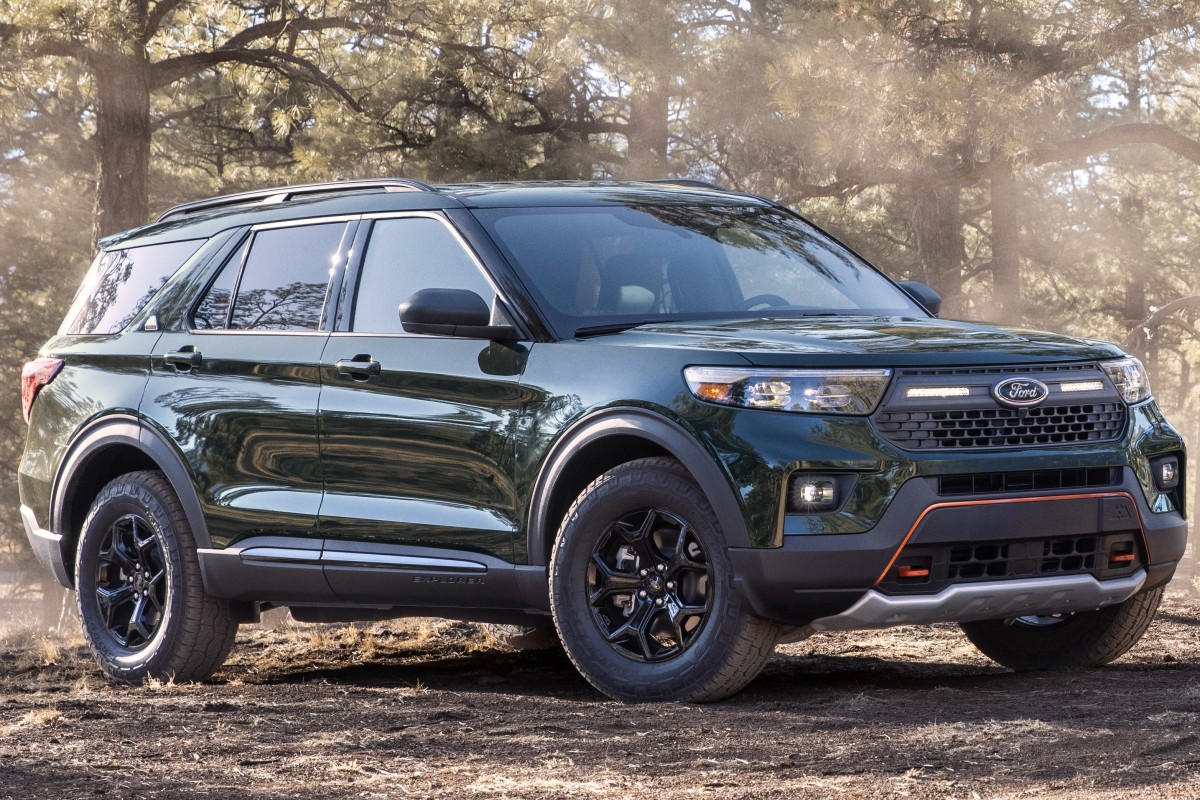
Summary
With 68 currently listed for sale near Sudbury, ON and an average price of $55,995 CAD, 17.6% of 2025 Ford Explorers for sale on CarGurus are rated as good or great deals.
Favourably reviewed: Owners rated the 2025 Ford Explorer 5 / 5 stars and CarGurus experts gave it an 8 / 10.
100.0% of 2025 Explorer models on CarGurus are accident free.
Why it stands out
The 2025 Ford Explorer stands out as a more appealing choice in the midsize three-row SUV segment thanks to a broad set of updates for the year. It gains sophisticated new infotainment and safety technologies, improved interior quality, bolder styling, and a simplified lineup with Active, ST-Line, Platinum, and ST trim levels. Ford’s changes also make it seem properly priced compared with rivals, which adds to its appeal for buyers looking for a family SUV that feels more modern without losing its mainstream practicality.
It is also notable for being fun to drive, with turbocharged power and a rear-drive platform contributing to its driving enjoyment. The cabin is described as comfortable, and the technology is easy to use, both of which matter in a vehicle aimed at families. At the same time, the 2025 Ford Explorer is not without compromises: it does not offer a hybrid or plug-in hybrid option, it lacks an off-road trim level, and its third row is cramped.
Other model years to consider
- Average price: $53,000 CAD
- Good/great deal percentage: 15.0%
- User rating: 4.8 / 5
- Total listings: 75
- Average price: $50,000 CAD
- Good/great deal percentage: 14.5%
- User rating: 4.6 / 5
- Total listings: 80
- Average price: $48,000 CAD
- Good/great deal percentage: 13.0%
- User rating: 4.7 / 5
- Total listings: 90
These recommendations are based on CarGurus' proprietary market data from September 14, 2026, CarGurus experts' opinions, and generative AI.
Relevant articles
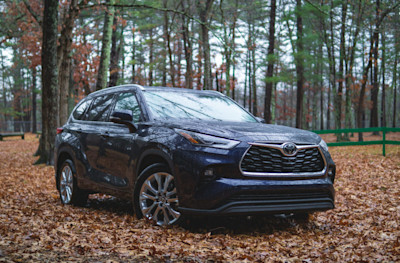
Best Used 7-Seater SUVs in Canada 2026
Our 10 best used seven-seat SUVs offer maximum practicality for the best possible price.
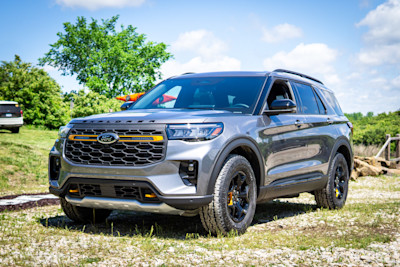
2026 Ford Explorer: Price, Specs and Release Date
The Ford Explorer was one of the kickstarters of today’s SUV craze, and it has remained a major part of the automaker’s lineup since its introduction.
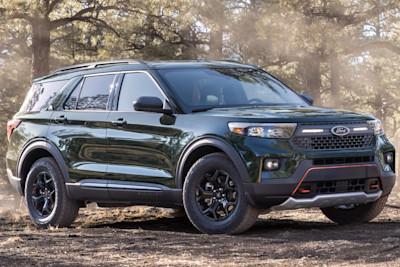
Ford Explorer Buying Guide: Cost, Reliability, and the Best Years to Buy
Discover the ultimate buying guide for purchasing a used Ford Explorer, covering every generation since 1991. Whether you're a first-time buyer or a Ford enthusiast, this comprehensive overview will help you research your next pre-owned Ford Explorer.
