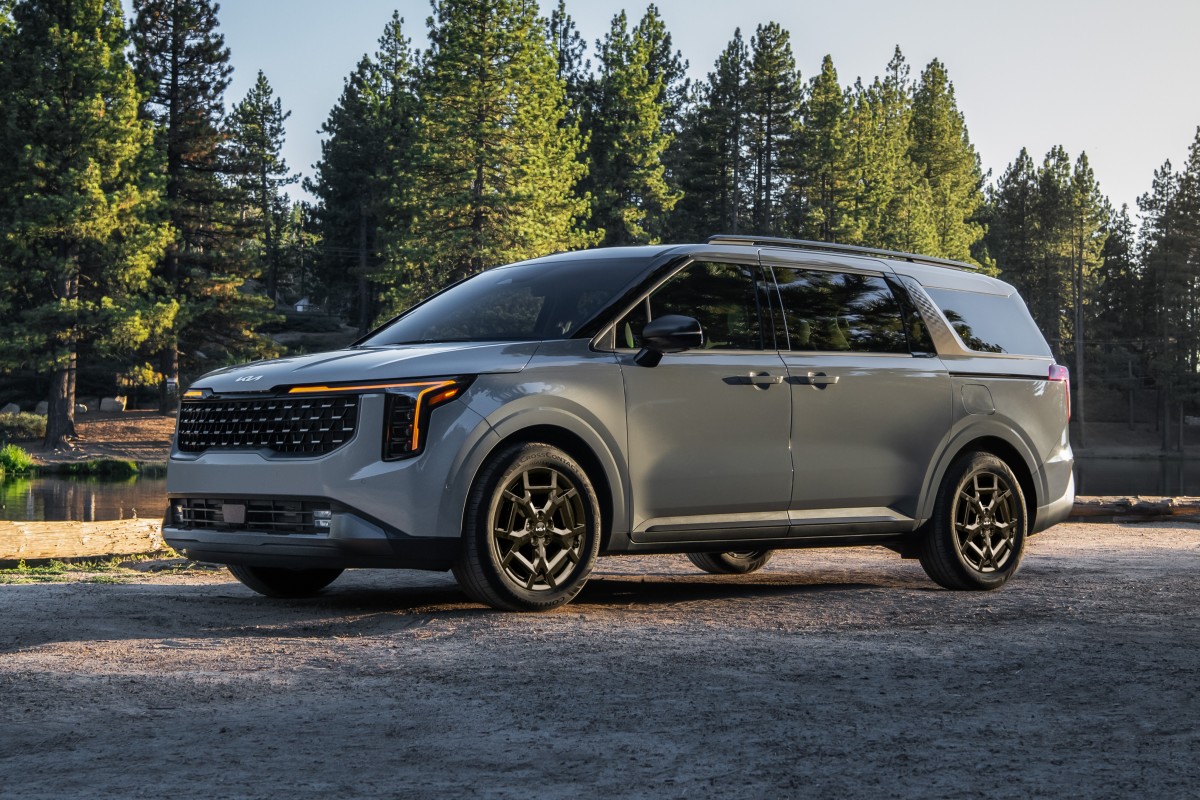
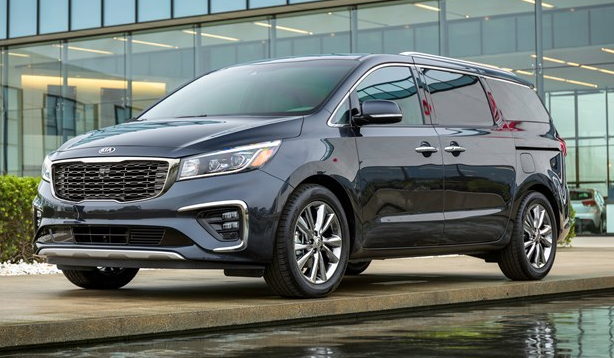
It isn’t the coolest car on the road, but the Sienna is comfortable and efficient. This is especially true of the latest fourth-generation model, which has hybrid-only powertrains, best-in-class fuel economy, and is a fine option for family road trips. It’s also the only hybrid all-wheel drive minivan currently available on the market, and although the plug-in hybrid Chrysler Pacifica comes close to delivering the same efficiency, the additional complexity of a plug-in system can be a negative for some. Their powertrain options are more limited, but the Honda Odyssey and the Kia Carnival compete in the same space.
Toyota Sienna Buying Guide: Cost, Reliability, and the Best Years to Buy
Frequently Asked Questions
Which Toyota years are the best?
The 2015 and 2016 model years are among the best, offering a great blend of value, reliability, and modern features. Fourth-generation models, produced from 2021, are some of the best minivans on the market with handsome styling, spacious interiors, and standard Toyota Safety Sense 2.0.
What are the worst Toyota Sienna years?
Siennas are generally reliable, and it’s difficult to identify the worst years. The 2004 model year—the first of the second generation—has received the most complaints from owners, and the 2017 Toyota Sienna is also one to avoid due to transmission issues. Keep an eye out for them during a test drive.
Is a used Toyota Sienna a good deal?
As a used car, the Toyota Sienna can be a great deal. Toyota has a reputation for building safe and reliable transportation, and the Sienna very much lives up to that. There are plenty of used Toyota Siennas on the market that fit a wide range of budgets, and the first and second generations can provide great value, although these can be hard to find in Canada.
Toyota Sienna Pros and Cons
Pros:
- Safe and reliable
- Lots of passenger space
- Versatile interior
Cons:
- Latest generation models can be expensive
- Issues with power sliding doors
- Not particularly cool
Toyota Sienna Generations
Fourth Generation (2021-Present)
The new Toyota Sienna was introduced for the 2021 model year. It received all-new styling and an all-hybrid lineup, making it one of the most efficient minivans on the market.
While this segment isn’t known for producing fashion icons, the latest Sienna’s front end is inspired by the Highlander, and its wide grille and sleek LED headlights make for a more SUV-like appearance. From the side, the Sienna has a sculpted body that swoops over impressive rear arches, giving it a wide and assertive stance for a minivan.
All versions of the Sienna are fitted with Toyota’s robust and efficient hybrid powertrain. The standard 2.5-litre four-cylinder engine works with two electric motors driving the front wheels, produced 245 horsepower. Natural Resources Canada rates this powertrain at 6.6 L/100 km combined with front-wheel drive (FWD) and 6.8 L/100 km combined with all-wheel drive (AWD).
In this generation, all-wheel drive adds a third electric motor to drive the rear axle. Despite the additional motor, the system is still rated at 245 horsepower, the main limitation being the size of the battery. As in other Toyotas, this all-wheel drive system isn’t mechanically linked like a traditional AWD or 4x4, so there are no transfer cases or driveshafts running front to rear. While ultimate off-road performance suffers, on-road efficiency is dramatically improved while maintaining the sure-footedness of a traditional AWD system in slippery conditions. In Canada, AWD is optional on the LE, XLE, and XSE trims (but standard when the XSE Technology Package is selected) and standard on Limited, including with the new-for-2025 Platinum Package.
All Sienna models come with Toyota Safety Sense 2.0 and either an eight-inch or a 12.3-inch infotainment touchscreen with Apple CarPlay and Android Auto as standard. Toyota’s Safety Sense is a suite of active driving safety features that includes dynamic radar cruise control, lane trace assist, a pre-collision system with pedestrian detection, and automatic high beams.
That meant the base Sienna LE trim is surprisingly well equipped. Toyota even threw in keyless entry, push-button start, and a blind spot monitoring system with rear cross-traffic alert. There’s an incredible amount of USB ports within easy reach of the front and rear passenger seats, too.
The Toyota Sienna XLE has a better sound system and four-zone climate control. The Sienna XSE had standard second row captain’s chairs, more aggressive front and rear bumpers, and a sport-tuned suspension. The FWD version comes with 20-inch wheels with low-profile tyres.
The Sienna Limited trim gets standard leather-trimmed seats, a surround-view camera, and a JBL Premium Audio sound system with 12-speakers, a subwoofer, and an amplifier. Adding the Platinum Package, which joined the Canadian line-up for 2025, equips a head-up display, an on-board vacuum, rain-sensing wipers, and a built-in cooler box.
Fourth-generation Siennas have been largely reliable and live up to Toyota’s reputation for dependability. Owners have reported issues with the 12V battery system, while overactive sensors for the power sliding doors and the power liftgate can cause excessive drain, leading to a dead battery. A quick solution is to disable the sensors for the doors and the trunk hatch through the settings menu, and just open and close them manually.
The average price of a used 2021 Toyota Sienna in Canada with less than 100,000 kilometres on the odometer, at the time of writing, is between $42,000 for lower trims and $55,000 for upper trims. That constitutes a savings of between $9,000 and $13,000 off the current manufacturer’s suggested retail price (MSRP) for a new Sienna.
Third Generation (2011-2020)
Introduced for the 2011 model year, the third-generation Sienna built on the previous model’s success and quickly established itself as one of the best minivans on the market. Reviews at the time ranked it above Honda’s Odyssey, a key rival. It was available in five trims: base, LE, XLE, Limited, and a new, sporty SE trim.
Despite riding on the same wheelbase as its predecessor, the Sienna grew in width to maximize its interior packaging. The second-row seats slid back and forth and reclined. Removing them could be tricky due to their weight, but with the third row folded down, the Sienna could accommodate full-size sheets of plywood, go-karts, or furniture.
The standard four-cylinder motor produced an adequate 187 horsepower driving the front wheels, while the optional 3.5-litre V6 produced 266 horsepower and could be paired with standard FWD or an optional AWD system. The V6 engine was very smooth and pleasant to drive, but fuel economy was a poor 12.7 L/100 km combined when equipped with the AWD system.
Don’t be fooled by the four-cylinder motor, either. The Sienna is a big car, and the four cylinder was quite underpowered, so it wasn’t much better in fuel economy than the V6 engine at 10.5 L/100 km combined. Due to low demand and poor performance, the base four-cylinder was dropped in Canada for the 2014 model year, making the V6 standard for all Siennas.
Toyota added a direct fuel injection system to the V6 for the 2017 model year, bringing the horsepower to 296, and a new eight-speed transmission was introduced to match the revised engine. These changes improved fuel economy, with the all-wheel drive version now rated at 11.7 L/100 km combined and the FWD version at 10.9 L/100 km combined.
The 2018 model year heralded a mild mid-cycle refresh, with all models getting an updated front end, extra USB charging ports, and standard Toyota Safety Sense. This suite of active driving assistance included automatic emergency braking, adaptive cruise control, lane keep assist and lane departure warning, and automatic high beams.
The 2015 and 2016 model years with the V6 engine and front-wheel drive are the most reliable of the third-generation Siennas. While the later 2017 V6 models got more power, the new eight-speed transmission could be problematic, particularly for the 2017 and 2018 model years.
Watch out for the power sliding doors, Toyota issued a recall for these, and out of pocket repairs can be expensive. Check with your local dealership to see if the recall is still active on your Sienna, because it is a matter of when (not if) the power doors have a problem as to whether the repair will be honoured. Inspect and be prepared to replace the front struts and front strut mounts; due to the front-end design, these suspension items wear out often and are considered a regular maintenance item. Inspect the power sliding doors carefully as slush builds up easily in the lower tracks.
Pricing for third-generation Sienna varies greatly by age and condition. Early, high-kilometre models can go for as low as $9,000, while you can expect to pay up to about $45,000 for late-model versions. The 2015 and 2016 model years are the sweet spot, with prices averaging around $15,000 to $25,000 depending on odometer reading, trim, and condition.

Second Generation (2004-2010)
The second-generation Sienna, introduced for the 2004 model year, underwent a significant redesign. It was bigger than its Camry-based predecessor and aimed squarely at the Honda Odyssey, becoming a class leader in interior space both for passengers and cargo with space for up to eight occupants.
The second-row seat was available either as a three-person bench or two captain’s chairs. Both options could slide and be removed, allowing easy access to the three-seater third row, which could also fold flat into the floor. With the second row removed and the third row folded flat, the Sienna could swallow up full-size sheets of plywood or drywall, a key marketing metric that has stuck around ever since.
Power came from a 3.3-litre V6 engine mated to a five-speed automatic transmission. Front-wheel drive was standard on all three trim levels in Canada: CE, LE, and XLE. All-wheel drive was available on all three trims. For the 2007 model year, all Toyota Sienna trims received a new 3.5 litre V6 engine, still paired with a five-speed automatic transmission.
All Siennas came standard with a wide range of safety features, including ABS with brake assist, traction control, and a tyre pressure monitoring system. Higher trims were available with an early form of adaptive cruise control, known as Dynamic Laser Cruise Control, and HID headlights. There was also an optional 10-speaker JBL sound system, along with a rear-seat DVD entertainment system with video input jacks and household-style 115V plugs for video game systems.
Both engines were generally reliable, but each could be prone to oil leaks. The earlier 3.3-litre V6 used a timing belt, which needed to be changed every nine years or 150,000 kilometres. The later 3.5-litre motor used a timing chain that didn’t require such maintenance.
Power sliding doors can cause major headaches, and repairs are expensive. The common failure point is the cable, the replacement for which is expensive, and fitting it is a labour-intensive job. The good news is that, as with the third-generation Sienna, you can turn off the power feature and use the doors manually. It’s even better if you can find a van without the power door option. Canadian Siennas can be prone to rust issues around the subframe, and transfer cases on the all-wheel drive version can leak, again leading to costly repairs.
Due to the aforementioned rust issues, second-generation Toyota Siennas are becoming hard to find in Canada. Prices are largely dependent on odometer reading and condition. Expect to pay anywhere from $5,000 to $12,000 for a good example. Choosing a lower end trim such as the CE or the LE with front-wheel drive can be a more reliable and cost-effective option.
First Generation (1998-2003)
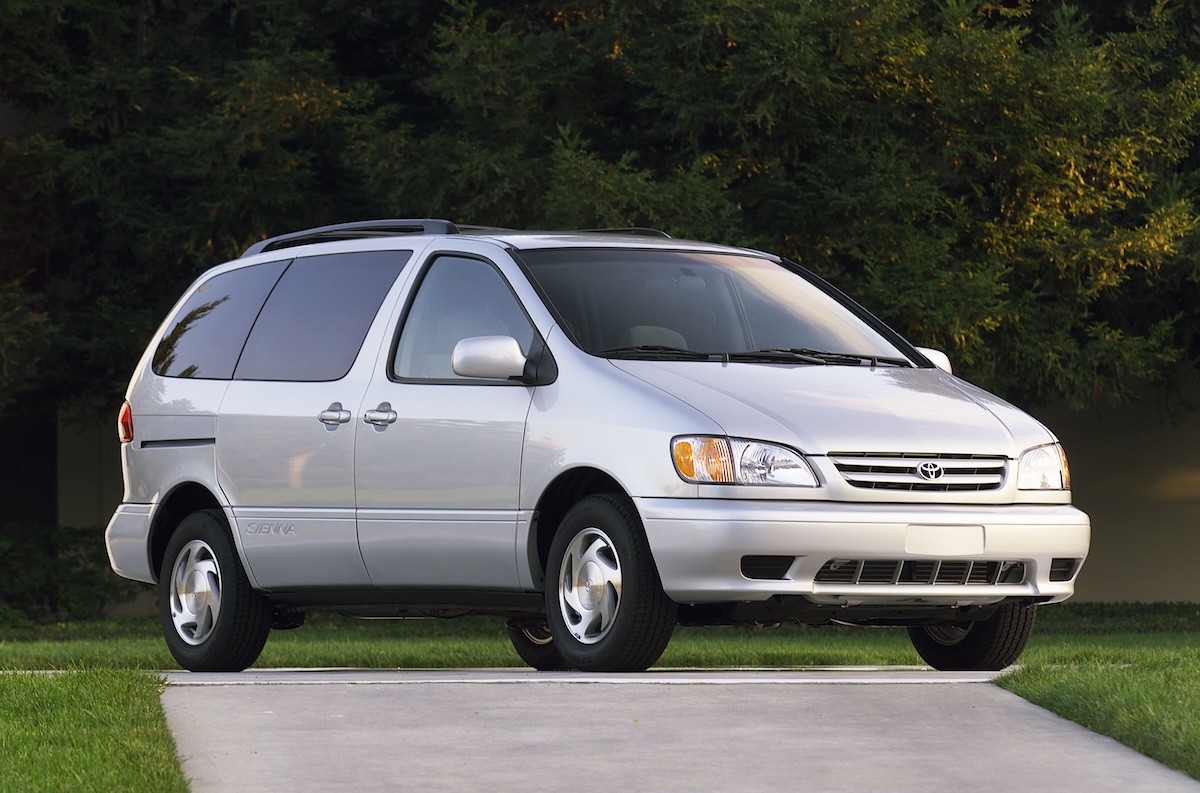
Launched in 1998, the original Sienna replaced Toyota’s egg-shaped, mid-engined, rear-wheel drive Previa. Designed in the United States and based on the best-selling Camry sedan, the Sienna quickly became known in the automotive industry as the “Camry of minivans”.
In Canada, it was sold in two trim levels: CE and LE. The base CE came standard with a three-passenger second-row bench, while the LE was equipped with captain’s chairs. The third-row bench could squeeze three people in a pinch.
Being based on the Camry—and built in the same factory—placed some limitations on the first-generation Sienna. It was smaller, and therefore less practical, than the Dodge Caravan and the Honda Odyssey. However, the driving experience was smooth and refined.
While not the most exciting car on the scene, the Sienna quickly earned praise as a quality family transport. Not only did it have 16 cupholders, it came standard with front side torso airbags, stability control, and anti-lock brakes, which helped to earn it a “good” rating from the IIHS.
The standard 3.0-litre V6 engine delivered 194 horsepower and was familiar from other Toyota products, such as the Camry and the Lexus ES. Paired with a four-speed automatic transmission, the Sienna offered best-in-class fuel economy, rated between 12.3 and 12.6 L/100 km combined depending on the model year.
Refreshed for the 2001 model year, the Sienna got new front and rear fascias, including a new front grill and rear taillights, and the V6 received an updated variable valve timing system, bringing horsepower to 210.
The V6 engines are generally reliable and well regarded, as long as they are regularly maintained. The Sienna was subject to a class-action lawsuit due to an oil sludge issue, and regular oil changes are required to prevent it. These motors also use a timing belt, which needs to be replaced at regular intervals.
Rust has claimed many first-generation Toyota Siennas in Canada, and they’re now a rare find on the used vehicle market. If you find one, expect pricing similar to second-generation vehicles, most commonly in the $5,000 to $8,000 range.
Related Topics