Similarly to the Ram 2500, the Ram 3500 started as a workhorse with few amenities and little in the way of tech. Initially housed under the Dodge brand, the Dodge Ram 350 was essentially just a mild refresh of the D350.
But as the generations progressed, this massive heavy-duty truck gained luxury amenities along with better performance and towing capabilities. By the fourth and fifth generations, it had shifted from pure work truck to more of an everyday driver—even if the Ram 3500’s massive proportions are difficult to manage in towns and cities.
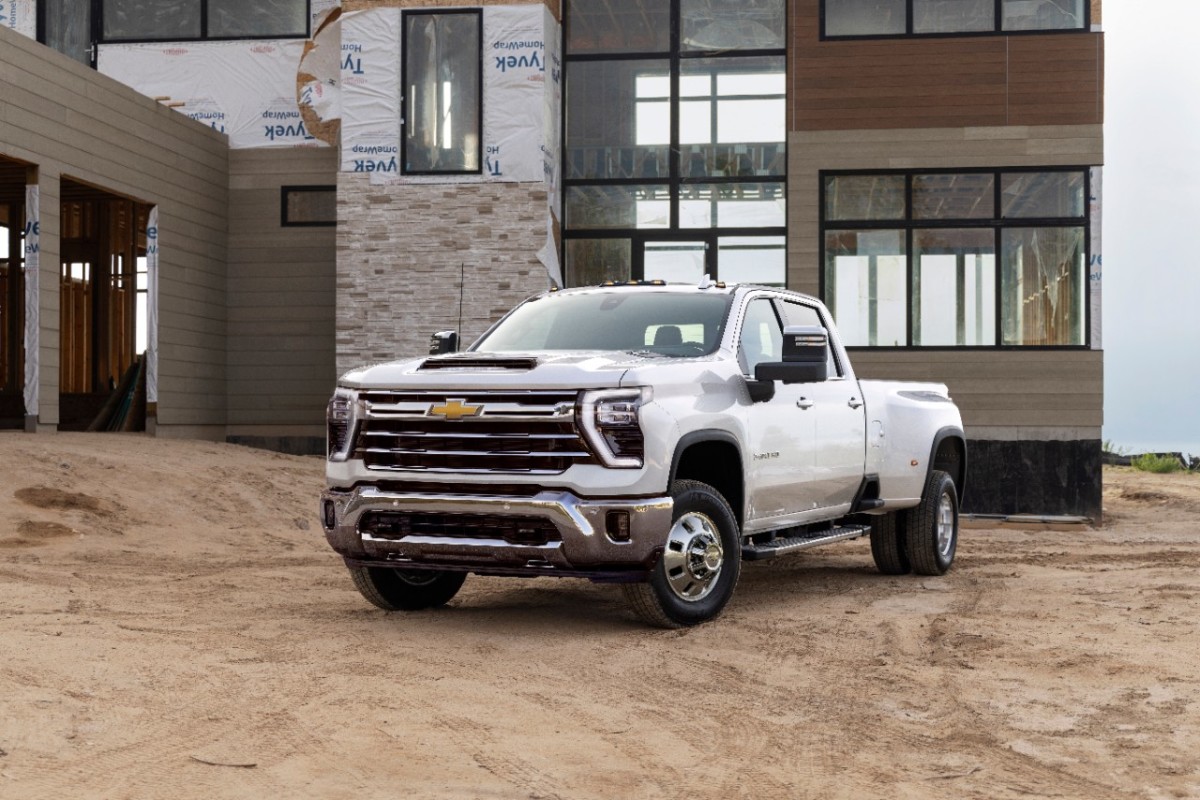
Primary competitors include the GMC Sierra 3500, the Chevrolet Silverado 3500, and the Ford F-350. The latest Ram 3500’s competitive advantage is its powerful Cummins turbo diesel engine, which provides class-leading maximum towing and payload capacities.
Today’s heavy-duty Ram trucks now have all the technology you’d expect from a daily driver, including Apple CarPlay and Android Auto, large touchscreen infotainment systems, cameras galore, and a whole bunch of standard safety features.
Ram 3500: Cost, Reliability, and the Best Years to Buy
- Frequently Asked Questions
- Ram 3500 Pros and Cons
- Ram 3500 Generations
- Ram 3500 Fifth Generation (2019–present)
- Ram 3500 Fourth Generation (2010–2018)
- Dodge Ram 3500 Third Generation (2003–2009)
- Dodge Ram 3500 Second Generation (1994–2002)
- Dodge Ram 3500 First Generation (1981–1993)
Frequently Asked Questions
Which Ram 3500 years are the best?
Though Ram typically gets a bad rap for reliability, newer models have proven more reliable than other trucks. We’d point you in the direction of the current-generation Ram 3500 unless you’re really jonesing for a classic truck. CarComplaints.com shows few or no complaints for the current generation for every year expect its inaugural one, 2019, which has more complaints than any other model in this generation. Stick with 2020 and beyond.
What are the worst Ram 3500 years?
CarComplaints.com dubs 2003 the worst model year of the Dodge-branded 3500s due to high repair costs and problems occurring at lower mileages. It also has the most overall complaints, many of which centre around a cracked dashboard. During the Ram years, 2013 is considered the worst year due to suspension problems and is known for its “death wobble”.
Is a used Ram 3500 a good deal?
You might be tempted to say the Ram 3500 is not a good deal because it’s relatively expensive, but it’s important to consider that prices for three-to-five-year-old trucks are $10,000 to $20,000 less than the original MSRP. While not an amazing deal, that’s fairly reasonable given the demand for pick-ups in Canada.
Ram 3500 Pros and Cons
Pros:
- Impressive towing and payload capability
- Powerful turbodiesel engine
- Spacious and comfortable
Cons:
- Gargantuan proportions
- Noisy diesel engine
- Limited safety technology
Ram 3500 Generations
Ram 3500 Fifth Generation (2019–present)
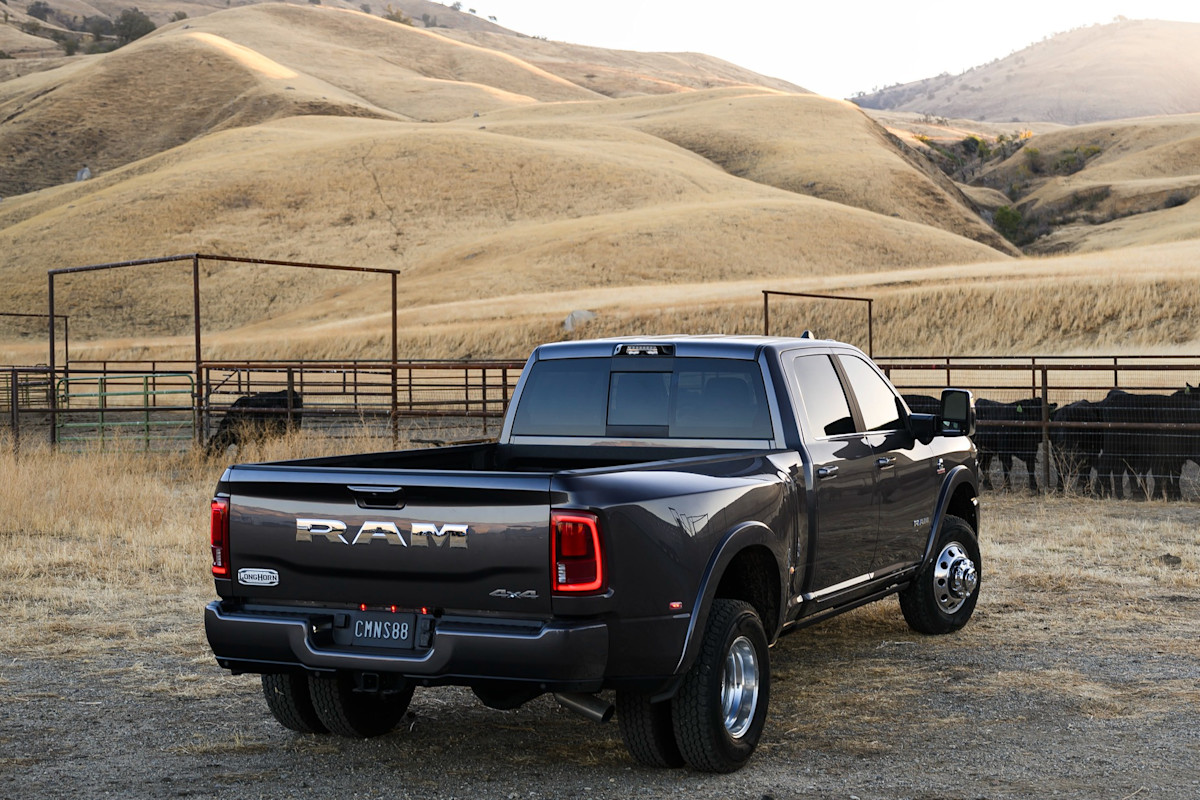
The fifth-generation Ram 3500 adopts a lot of the changes seen on the Ram 1500, and there is a huge focus on luxury and tech. It ditches the crosshair grille and adds LED lighting and a more aerodynamic design. It also receives a stronger frame, new suspension, and a new transmission for the Hemi models. It can tow more than 15,875 kilograms (35,000 pounds) and carry almost 3,600 kilograms (8,000 pounds) of payload, while the RamBox receives a 115-volt outlet with up to 400 watts of power.
The interior also borrows heavily from the 1500 with a serious upgrade in terms of materials and available luxury amenities. It gets a revised instrument cluster and a rotary gear selector for the eight-speed automatic transmission, as well as available features such as a 360-degree camera, adaptive cruise control, a 12-inch vertical infotainment system with wireless Apple CarPlay and Android Auto, and a 750-watt Harman Kardon 17-speaker audio system. Additionally, the tire pressure monitoring system can now monitor up to 12 trailer tires.
At launch, fifth-generation Ram 3500 trim levels comprised Tradesman, Big Horn, Laramie, Laramie Longhorn, and Limited. It has regular, crew, mega, and chassis-cab configurations, long and short bed availability, and rear-wheel-drive (RWD) and four-wheel-drive (4WD) drivetrains, along with optional dual rear wheels.
The base engine is now the 6.4-litre Hemi V8, which is a carryover from the previous generation. The high-output 6.7-litre Cummins turbodiesel inline-six powertrain was introduced in 2019 and delivers specs including 1,000 pound-feet of torque—a first in the heavy-duty segment. Torque increased to 1,075 lb-ft in 2021 and 1,150 lb-ft in 2024.
When properly equipped, this heavy-duty Ram pickup can tow more than 15,875 kilograms (35,000 pounds) and carry nearly 3,600 kilograms (8,000 pounds) of payload.
In 2019, the Ram 3500 added lane keep assist, adaptive steering, and blind-spot monitoring as well as an available 121-litre fuel tank. In 2021, the max tow rating increased by 900 kilograms (2,000 pounds), and a digital rearview mirror was added. In 2022, Uconnect 5 and a new trailer 360-view camera became available, while 2023 brought a refresh that included a new digital cluster. The camera system was upgraded, and there was also a new trailer reverse steering system. There were no significant changes or upgrades for 2024.
Used vehicles in this generation are plentiful and pricey. Fifth-generation Ram 3500s on the Canadian used vehicle market start just under $40,000, and those early trucks tend to have odometer readings well over 100,000 kilometres. You’ll need to spend at least $50,000 for a Tradesman with a more reasonable odometer reading. At the high end, nearly new 2024 and 2025 trucks—even Tradesman models—go for $70,000 to $90,000.
Ram 3500 Fourth Generation (2010–2018)
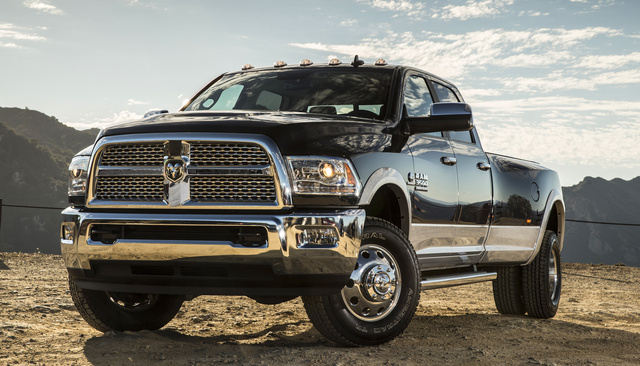
It was in the fourth generation that the Dodge Ram 3500 became the Ram 3500 as Ram Trucks split off into its own brand. The first year still fell under the Dodge moniker, but by 2011 the transition to Ram Trucks was complete.
The Ram 3500 was more than just a work truck at this point. The new generation added luxurious interiors and upscale versions such as the Laramie, Longhorn, and Limited trims. Parent company Chrysler LLC was trying hard to keep its trucks competitive, and it introduced new features such as the RamBox and the Hemi engine during this generation. It also introduced new technology such as the Uconnect infotainment system, premium sound systems, and smart cabin materials. It was available in regular, quad, mega, and chassis-cab configurations, with RWD and 4WD drivetrains.
Engine options for this generation included the 5.7-litre Hemi V8, the 6.4-litre Hemi V8, and the 6.7-litre Cummins turbo diesel. The Ram 3500 retained its manual transmission option throughout this generation, which was significant because both General Motors and Ford had both dropped theirs by the 2011 model year. In 2013, the 3500 also introduced the first Aisin heavy-duty automatic transmission for improved towing with the diesel engine.
Trims available in this generation included the ST, SLT, Laramie, Longhorn, and Limited. The top-tier Ram 3500 Limited was available with only the 6.4-litre Hemi V8 or the 6.7-litre Cummins diesel, and added features such as a leather interior and keyless push-button start.
This generation also heralded new safety and driver assist technology, including front automatic emergency braking, adaptive cruise control, lane keep assist, blind-spot monitoring, and front and rear parking sensors. Maximum towing capacity in this generation ranged from 8,160 kilograms (18,000 pounds) for early models to nearly 13,600 kilograms (30,000 pounds) at the end, depending on the cab configuration.
The RamBox was added in 2012, and a refresh in 2013 included new interior and exterior styling with available features such as a leather-wrapped steering wheel and power-folding side mirrors. Optional air suspension was added in 2014 along with coil-spring suspension in place of old-fashioned leaf springs.
Prices for fourth-generation Ram 3500s in Canada range from $17,000 for early trucks with 300,000 kilometres or more to $65,000 or more for late, low-odometer trucks in higher trims.
Dodge Ram 3500 Third Generation (2003–2009)
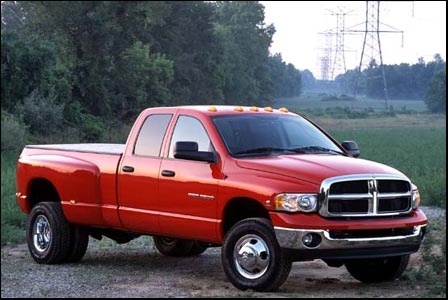
When the third-generation Dodge Ram 3500 finally entered the picture a year after the 1500’s redesign, it got an all-new frame, new suspension, a new interior, and new sheet metal. This generation saw the addition of enhanced tech, navigation systems, and better-quality materials.
The 3500 retained its live axels for the sake of durability, and the RWD models had class-exclusive rack-and-pinion steering for their independent front suspension. At launch, the then-new Dodge Ram 3500 was available in regular cab or quad cab configurations. In 2006, the mega cab option was added. It had RWD and 4WD drivetrain options as well as standard and long beds.
Trims in this generation included the ST, SXT, SLT, Laramie and Limited. The Ram 3500 SLT offered amenities such as power accessories, upgraded cloth seats, and satellite radio. Upgrading to the Ram 3500 Laramie added the likes of heated and ventilated front seats, a touchscreen infotainment system, and an Alpine premium audio system.
The third-generation Dodge Ram 3500 launched with three engine options—a 5.7-litre Hemi V8, the 5.9-litre Cummins diesel, and an 8.0-litre Magnum V10. The V10 was discontinued after 2003, and in 2007 a 6.7-litre Cummins diesel replaced the 5.9-litre option. A new six-speed automatic transmission was also introduced at this time, and manual and automatic transmission options were available throughout the generation.
The third-gen Dodge Ram 3500 was the first heavy-duty truck with a factory-integrated exhaust brake (with the Cummins engine). Maximum towing power at the end of this generation ranged from about 4,080 kilograms (9,000 pounds) to 7,250 kilograms (16,000 pounds), depending on the model year.
A 3500 Chassis Cab was introduced in 2007 for the first time with industry-standard rear frame width and wiring to accommodate upfitters. Engine options included the 5.7-litre V8 or the 6.7-litre Cummins diesel.
Due to their age and the tendency for Canadian pick-ups to migrate south, third-generation Dodge Ram 3500s are becoming scarce on the Canadian used vehicle market. Prices can run the gamut, and we saw a truck with more than 500,000 kilometres on the odometer listed for $15,000, while modified show-worthy trucks can go for $35,000 or more. Expect to pay at least $20,000 for a truck in serviceable condition.
Dodge Ram 3500 Second Generation (1994–2002)
The second generation of the one-ton truck known today as the Ram 3500 also fell under the Dodge brand. With its launch, the 350 designation disappeared in favour of the 3500. As with the full-size 1500 trucks of the time, the 3500 was completely redesigned with a more aggressive big-rig-style front end that was then deemed risky, along with a larger grille and bigger bumpers. It also got improved seats, a more comfortable interior, and basic tech upgrades.
The second-gen Dodge Ram 3500 was available in regular, club, and crew cab configurations. It had both RWD and 4WD drivetrain options as well as a dual rear-wheel option for improved towing stability. Both short and long beds were available depending on cab configurations.
The Cummins diesel engine was a carryover from the previous generation, and the second-gen Dodge Ram 3500 added an 8.0-litre V10. This made the 3500, along with the 2500, the first factory V10-powered truck, and it delivered 300 horsepower and 450 lb-ft of torque. Other available engines included a 3.9-litre V6 and a 5.2-litre V8, while manual and automatic transmission options were available.
The Dodge Ram 3500 was updated in 1998 with the addition of fold-out towing mirrors, a revised interior and instrument panel, dual airbags, and a digital odometer. In 2000, the heavy-duty pickup truck got the options of heated leather seats and an upgraded braking system.
Though the 1500 entered its third generation for 2002, the 3500 was carried over an extra year due to a hold-up with the new 5.7-litre Hemi engine.
Very few second-generation Dodge Ram 3500s remain in Canada today. If you can find one, expect pricing to vary widely. In our research, we found only two examples—a 1998 truck with 250,000 kilometres on the odometer listed for $18,000, and a heavily modified collectable and show-worthy truck with a similar odometer reading priced at $45,000.
Dodge Ram 3500 First Generation (1981–1993)
The first-generation Ram 3500 fell under the Dodge brand and replaced the D-Series trucks introduced in 1972. In fact, the original Dodge Ram was just a facelifted version of that truck and was known as the “square body” due to its hard edges, dual rectangular headlamps, and larger wraparound taillamps. Dubbed the Dodge Ram 350, this one-ton, heavy-duty truck came in regular cab and club cab configurations, had both RWD and 4WD options, and was available with a 6.5-foot or eight-foot bed.
At launch, the first-gen Dodge Ram 3500 was equipped with a gas-powered 5.9-litre V8 engine. Then, starting in 1989, it was powered by a 5.9-litre inline-six-cylinder Cummins diesel engine, delivering 160 hp and 400 lb-ft of torque. This gave the Dodge Ram heavy-duty trucks a competitive advantage over Ford and General Motors as this engine had direct injection, and the Cummins unit was also turbocharged whereas Ford and GM engines were naturally aspirated. Maximum towing capacity with this engine was just under 5,000 kilograms (11,000 pounds), and both manual and automatic transmission options were available.
You aren’t really going to see any first-generation Dodge Ram trucks on used car websites, and any you do see will be more collectable than drivable. Classic.com lists the average transaction price for a truck of this generation as around USD$27,000, and the top sale listed on the site was USD$77,000 for a 1991 modified truck. Among Canadian used vehicle listings, we found exactly one in our research—a 1988 model with just over 300,000 kilometres on the odometer and an asking price of $21,000.