Nissan arrived late to the compact crossover segment when it introduced the Rogue for the 2008 model year, more than a decade after key rivals such as the first Honda CR-V and Toyota RAV4 hit dealerships. It’s not that Nissan didn’t do SUVs. It already had a healthy back catalog of those, including the Armada and the Pathfinder. But the Rogue was something different: a more compact, sleek affair hoping to woo buyers with a combination of cost-effectiveness, style, and a drive focused on ease-of-use rather than off-road ability.
The first Rogue had a similar look to the upscale Murano, but it was smaller and lower with dimensions close to the concurrent Toyota RAV4’s. The model lineup was simple, with just one 2.5 litre engine, a continuously variable transmission, and the choice of front-wheel drive (FWD) or all-wheel drive (AWD). It was keenly priced, with a Canadian MSRP starting at $25,000.
That first Nissan Rogue proved very popular, and the two subsequent Rogue models (released in 2013 and 2020) have followed a similar formula. In fact, with each iteration, the Rogue has retained almost identical dimensions. The only notable change is that the second- and third-generation cars are slightly taller and have a boxier, more conventional SUV look. The drivetrain options haven’t changed much, either, apart from the third generation’s switch from a naturally aspirated 2.5-litre engine to a 1.5-litre three-cylinder turbo engine.
Today, the Rogue is Nissan’s best-selling model in North America. It’s evolved into a high-tech family car packed with advanced features such as wireless integration for Android Auto or Apple CarPlay. Nissan’s latest ProPilot Assist driver assistance feature can steer, brake, and accelerate the car on the highway.
In this guide, we’ll cover which models are available, the key specs for each version, and which Nissan Rogue model years are the best to buy.
Nissan Rogue Buying Guide: Cost, Reliability, and the Best Years to Buy
Frequently Asked Questions
Which Nissan Rogue years are the best?
The latest Nissan Rogue model, from the 2021 model year onwards, is the best yet. It’s well priced, has plenty of equipment, is smooth to drive, and is practical. The MSRP is the highest of any Rogue so far, but it’s still good value overall.
What are the worst Nissan Rogue years?
The 2013 Nissan Rogue takes the (unwanted) prize for the worst year for the model. Data from carcomplaints.com suggests cars of this age are prone to transmission issues, with owners citing shuddering, noisy, or unresponsive transmissions, as well as total failure. It’s a problem that affects many Rogue model years, but 2013 seems to be the nadir.
Is a used Nissan Rogue a good deal?
The Nissan Rogue is a good deal if you’re looking for a family car that offers lots of space and standard features, a decent drive, and very competitive prices. The latest model is the easiest to recommend, but there are some reliability issues to be aware of with every version.
Nissan Rogue Pros and Cons
Pros:
- Roomy and family-friendly
- Available with some advanced safety features
- Good value for money
Cons:
- CVT transmission not to all tastes and prone to failure
- Limited choice of drivetrains
- VC-Turbo engines can be troublesome
Nissan Rogue Generations
Third Generation (2020-present)
The latest, third-generation Nissan Rogue went on sale in 2020 for the 2021 model year. Its dimensions are almost identical to the second generation, yet it appears larger due to its chunkier square-edged design, which also makes it the most rugged-looking Rogue yet. It’s the most technologically advanced, too. Highlights for all new cars include a central touchscreen, LED headlights, and Apple CarPlay and Android Auto integration. Most Rogue models of this era have a power liftgate and ProPilot Assist, a driver assistance feature that can help to control acceleration, braking, and steering both in heavy traffic and on the open highway. Higher-spec trim levels have ProPilot Assist with Navi-link, which uses navigation map data to reduce speed for highway curves, junctions, and exits.
At launch, the drivetrain was an update of the previous Rogue model’s, with a 2.5–litre engine (with 181 horsepower and 181 lb-ft of torque) paired with a CVT and either front-wheel drive (FWD) or all-wheel drive (AWD). Rogue S, Rogue SV, Rogue SL, and Rogue Platinum trim levels offer an increasingly opulent standard of equipment. In late 2021, a new 1.5-litre, three-cylinder turbocharged engine was offered alongside the four-cylinder 2.5, which remained only on the base trim.
The new 1.5-litre variable-compression engine — labeled VC-Turbo by Nissan — was more powerful, with 202 horsepower and 225 lb-ft of torque. It also returned better fuel economy, with a Natural Resources Canada combined rating of 7.6 litres per 100 kilometres, making it the most fuel-efficient non-hybrid in its class. There was a new CVT, too, which helped to make the Rogue generally smooth and comfortable.
The latest Rogue feels like a more premium product than its predecessor, with an interior that uses high-grade tech and materials. The Nissan Rogue Platinum — which has a driver’s seat memory system, tilting side mirrors, a head-up display, and quilted leather upholstery — is positively luxurious. All but the entry-level Rogue S models have a Wi-Fi hotspot.
Every Rogue of this generation is very practical with features geared toward families. These include rear doors that open to almost 90 degrees, boosting accessibility and making it easy to get child seats in and out. Heated rear seats, a dual-panel panoramic moonroof, a motion-activated power liftgate, and tri-zone climate control are offered, and these features are not exclusive to the top trim in Canada. While some rivals offer seating for seven, the third-generation Rogue is only available as a five-seater.
The standard of safety equipment is high. Since its introduction, this Rogue has featured Nissan Safety Shield 360 as standard, a package that includes automatic emergency braking with pedestrian detection, blind spot warning, rear cross traffic alert, lane departure warning, high beam assist, and rear automatic braking.
A light refresh in early 2024 brought a few upgrades, with new front and rear fascia designs, new tail lights and the availability of Google Built-in, which integrates Google apps directly into the car’s infotainment system without having to pair a phone. 2024 was also the year AWD became standard equipment in the Rogue in Canada.
There’s no doubt the current Rogue is by most criteria the best yet, but it’s not without its problems. While its overall reliability record is solid, some owners have reported issues with the air conditioning not working properly. More concerning is a potential class action lawsuit relating to the 1.5 VC-Turbo engine. In December 2023, the U.S. National Highway of Traffic Safety Administration (NHTSA) announced plans to investigate reports of engine failures, loss of power, engine knocking noises, and metal chunks and shavings found in the oil pans of cars with this engine.
Prices for the latest Rogue start at about $23,000 for a sub-100,000-kilometre used example. There are lots to choose from, so our advice is to shop around and avoid cars that haven’t been well cared for. Newer top-spec cars can cost up to $40,000, which is only a few thousand dollars less than the MSRP for a brand-new Rogue Platinum model.
Second Generation (2013-2020)
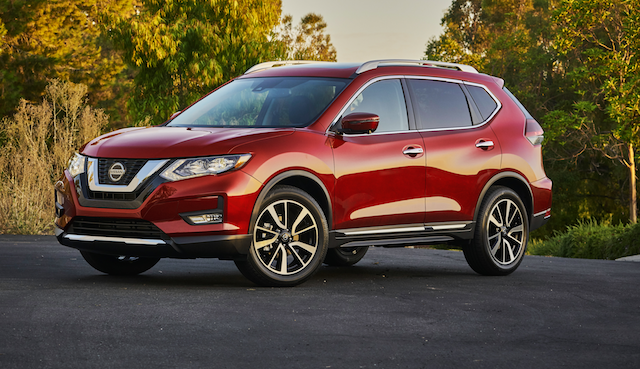
The new Nissan Rogue that arrived in 2013 was all-but-identical in size and drivetrain spec to the one it replaced. But it represented a big step forward, not least in the way it looked. This time around, the Rogue was less a crossover and more a full-fat SUV, with a tougher, more upright stance in line with rivals such as the Honda CR-V and the Toyota RAV4. It also packed a lot more high-tech convenience and safety features, felt more premium, and remains the only Rogue offered with seven seats as an option. All versions had reclining second-row seats and ‘Divide-N-Hide,’ a system of folding panels that allows you to organize, or hide, items in the trunk.
The model lineup is straightforward: a 2.5-litre engine with 170 horsepower and 175 lb-ft of torque was the only power option, mated to Nissan’s ‘Xtronic’ CVT transmission and either FWD or AWD. The fuel economy rating was pretty average, ranging from 8.2 to 8.7 L/100 km combined depending on the model. The core trim levels were Rogue S, Rogue SV, and Rogue SL. Even entry-level S included a rear-view camera and NissanConnect, which integrated a range of apps into the infotainment system (including navigation on higher trims). Nissan Rogue SL models and above have dual-zone climate control, power driver’s seat adjustment, and Sirius satellite radio.
Available features include a power liftgate and Nissan’s “Intelligent around view monitor,” which combined the view from external cameras to show a bird’s eye view of the car on the touchscreen display — a real boon when parking in tight spaces. One special-edition model worth mentioning is the Rogue One Star Wars Limited Edition, a special-edition model introduced in 2016 as a tie-in with the Star Wars movie Rogue One: A Star Wars Story. May the force be with you if you buy one of those.
An update for the 2017 model year included some minor cosmetic changes, such as a new grille and revised tail lights. A bigger development for the 2018 model year was the introduction of ProPilot Assist as an available feature. This semi-autonomous driving feature helped to accelerate, brake, and steer the car on the highway. At the same time, automatic emergency braking and a blind spot warning system became standard for all models. Nissan also dropped the seven-seat option for the 2018 model year.
Despite Nissan’s expertise with CVT technology, the Xtronic transmission the 2013-2020 Rogue model years can be problematic. Some owners have cited problems with shuddering or noise, along with total failure of the transmission, despite comparatively low mileage. In 2024, Nissan agreed to pay more than $277 million to settle a class action lawsuit related to defective Xtronic transmissions.
Its popularity means there is a huge number of used Nissan Rogues available. That means you can afford to be choosy. We’d recommend at least $10,000 as a starting point, which will get you a low-trim model with less than 150,000 kilometres on the odometer. Better still, if you can stretch to at least $15,000, you can get a higher-spec, post-facelift model.
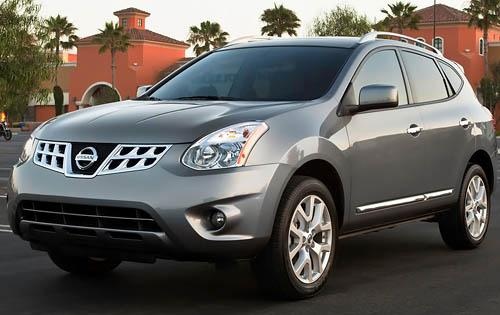
First Generation (2007-2013)
The first Nissan Rogue was an instant sales hit, proving that Nissan’s hunch was on the money. Buyers wanted a budget-friendly family car that was a touch more SUV-like than the average hatchback or sedan.
Choice isn’t something that you got a lot of with the first-gen Rogue. The only engine option was a 170-horsepower 2.5-litre, combined with Nissan’s Xtronic CVT. It had reasonable performance, although some rival cars have more powerful options, and the fuel economy rating is nothing special. You can choose between front-wheel drive or all-wheel models, with the majority being sold with AWD.
First-gen Nissan Rogue trim levels in Canada were Rogue S and Rogue SL, while a mid-trim SV was added in later model years. Each one had a decent standard of equipment for the time, with safety features such as front, side and curtain airbags. Available features included a Bose premium audio system, Bluetooth, xenon headlights, and cruise control.
A facelift for the 2011 model year brought some design tweaks and updated features, such as a rear-view camera and new 18-inch aluminum-alloy wheels.
If you’re in the market for a used Rogue, then transmission problems are the main thing to look out for. In every year of the first-generation Rogue’s production run, this is by a long way the top-ranked problem cited by Rogue owners on carcomplaints.com. They complain of poor performance, whirring noises, and outright transmission failure, so keep an eye out.
As a new car, the MSRP for the Rogue started at $25,000 in Canada, but you can pay as little as $5,000 now. If you want a car with AWD and more features, though, you should budget $8,000 to $10,000 for a higher-trim model with less than 200,000 kilometres on the odometer.
Related Topics