The Mitsubishi Outlander heralded the brand’s entry into the compact SUV market in 2003 and has undergone significant changes in the subsequent decades. This model stands out from other SUVs in its class with a third row of passenger seating and, at times, unique styling.
The brand has endured some instability over the past few decades, with partnerships and controlling stakes held at various times by Daimler-Chrysler and, more recently, Nissan and Renault. This has led to Mitsubishi being surpassed by other automakers coming up during that same time, most notably the Korean brands Hyundai and Kia.
Mitsubishi has found some success in Canada with the Outlander, especially the most recent generation that shares a platform and some technology with the latest Nissan Rogue. The Mitsubishi Outlander PHEV has been a particular standout in our market and has been the best-selling plug-in hybrid off and on for the past few years. However, in its gas-only form the Outlander has never been able to mount a challenge for top rivals such as the Honda CR-V or the Toyota RAV4, held back in part by Mitsubishi's relatively small dealer network.
Mitsubishi Outlander Buying Guide: Cost, Reliability, and the Best Years to Buy
- Frequently Asked Questions
- Mitsubishi Outlander Pros and Cons
- Mitsubishi Outlander generations
- Fourth generation (2022 - present)
- Third generation (2014 - 2021)
- Second generation (2007 - 2013)
- First generation (2004 - 2016)
Frequently Asked Questions
Which Mitsubishi Outlander years are the best?
The current fourth-generation Mitsubishi Outlander is easily the best. Both the gas and plug-in hybrid models, benefit greatly from contemporary technology, safety, and engineering. With help from Nissan, this Outlander has a lot of the features you'd expect in a compact SUV. However, it remains an also-ran among its strongest rivals.
Which Mitsubishi Outlander years are the worst?
We suggest avoiding the first-generation Outlander, which ran from 2003 to 2006. In addition to an anemic four-cylinder engine, it was also plagued with some rather alarming recalls and outdated brakes. It's primitive by today’s standards, and even when it was new it trailed the competition.
Is the Mitsubishi Outlander a good deal?
If you’re in the market for a plug-in hybrid, the Mitsubishi Outlander PHEV can be an excellent deal as a used vehicle in Canada. Now that EV rebates are being reduced across the country, Canadians will save $10,000 to $15,000 or more by buying a two to three-year-old Outlander PHEV versus buying new. Given that an Outlander PHEV will continue to save its owner money at the pumps through electric driving, there’s solid value potential here.
Otherwise, if you're looking for a current-generation gas-powered Outlander SUV on the used market, you’ll save compared to what you’d spend on an equivalent Honda CR-V or Toyota RAV4. Unfortunately, that's because the Mitsubishi depreciates faster, so you'll also likely see a lower return when you sell it.
Mitsubishi Outlander Pros and Cons
Pros:
- Third-row seating availability
- Standard all-wheel drive on later models
- Strong warranties
Cons:
- Weak performance from four-cylinder models
- Not as polished or refined as contemporaries
- Accelerated depreciation
Mitsubishi Outlander generations
Fourth generation (2022 - present)
The current Mitsubishi Outlander debuted as a 2022 model that stood out among the compact SUV class by offering a third row of seats as standard. The new car was also a departure from the previous generation as it was built on a platform shared with the Nissan Rogue, introduced a year earlier.
From the outside, there’s barely a trace of the Outlander’s Nissan origins as it has a more substantial presence. The front is upright and blocky with thin LED accent lights where the headlights would usually go and large cutouts in the corners below where the actual headlights reside. The Outlander's body panels have been restyled, giving it a brawnier appearance than the Nissan or the previous Outlander.
The Outlander's interior is also unique, though there are some similarities here to the Nissan Rogue, particularly its dashboard displays, steering wheel, and some switches. The front seats are similar in shape to those of the Rogue, but the upholstery and styling are different. Compared with the third-generation model, this Outlander is noticeably more modern with a thinner, more horizontal dashboard design, a larger infotainment touchscreen, and an available digital instrument panel. The Outlander's pair of third-row seats is notably very small and suitable only for young children. Even with the limited space, those seven seats prove convenient for school carpools and short trips.
For 2022, the fourth-gen Outlander launched only in gas-powered form, equipped with a 2.5-litre four-cylinder engine with specs of 181 horsepower and 181 lb-ft of torque. In Canada, a continuously variable transmission (CVT) sends power to standard all-wheel-drive (AWD), which in this case is Mitsubishi’s top Super All-Wheel Control system, or S-AWC.
Performance is nothing to write home about: the Outlander needs almost 10 seconds to hit 100 km/h. It’s noticeably slower than most rivals, which beat the Outlander to that mark by roughly two seconds. The Outlander performs adequately on a typical commute, favouring a comfortable ride quality instead of sporty handling. That said, the Outlander doesn't feel out of sorts on a twisty mountain road. The cabin also remains pleasantly quiet for the most part, though the engine is rather loud when taxed (which is often).
In its inaugural year, the fourth-generation Outlander was available in Canada in seven trims: ES, SE, LE, LE Premium, SEL, GT, and GT Premium. Standard feature highlights for the base ES trim included 18-inch alloy wheels, heated front seats, dual-zone automatic climate control, an eight-inch infotainment touchscreen, and Apple CarPlay/Android Auto phone integration. Standard safety features included forward collision warning with automatic emergency braking, blind-spot monitoring with rear cross-traffic alert, lane departure warning, reverse automatic braking, and rear parking sensors.
The SE upgraded to a hands-free power liftgate, keyless entry, a panoramic sunroof, a wireless charging pad, LED fog lamps, a leather-wrapped heated steering wheel, and three-zone climate control. Features on LE included 20-inch alloy wheels, Mitsubishi Connect services, a nine-inch touchscreen, a surround-view camera, and adaptive cruise control. The SEL trim added quilted leather seats, heated rear seats, a driver’s seat memory function including mirrors, and a 12.3-inch digital instrument panel.
The GT trim tacks on a 10-speaker Bose audio system, rear sunshades, and additional driver assistance technologies including Mi-Pilot Assist lane centring, front parking sensors, and a head-up display. GT Premium upgrades the seating to semi-aniline leather. Note the Outlander Plug-in Hybrid sold in 2022 was a carry-over model from the third generation.
The big news for 2023 was the arrival of the new Outlander PHEV. With a 2.4-litre four-cylinder engine using the fuel-efficient Atkinson cycle, along with two electric motors and a 20-kWh battery, it produces a total system output of 248 hp and 332 lb-ft of torque while allowing up to 61 kilometres of electric-only driving. The single-gear transmission delivers power to standard S-AWC AWD in Canada. Initial trims were ES, LE, SEL, and GT, which were similarly equipped to their gas-only equivalents.
In 2025, Mitsubishi gave the gas Outlander a light styling refresh, a reorganized centre console, new suspension tuning that promised a smoother ride, additional sound insulation, and a larger 12.3-inch infotainment touchscreen. This refresh will be applied to the Outlander PHEV beginning with the 2026 model year.
Natural Resources Canada estimates fuel consumption for the gas Mitsubishi Outlander at 9.7 litres per 100 kilometres in the city, 7.9 on the highway (which drops to 7.7 as of the 2025 model year), and 8.9 in combined driving (or 8.8 as of 2025). These figures are slightly higher than the gas-only Honda CR-V and Toyota RAV4. The Outlander PHEV delivers 61 km of electric-only range while averaging 9.0 L/100 km combined when running in hybrid mode. It’s important to note the Outlander PHEV is less efficient than the gas-only model when not running in electric mode, so owners need to plug the vehicle in regularly to see fuel economy benefits.
Crash tests conducted by the U.S. National Highway Traffic Safety Administration (NHTSA) resulted in a five-out-of-five-star rating for side impact tests, and four stars for overall, frontal, and rollover protection. The Insurance Institute for Highway Safety (IIHS) was more generous with its ranking, awarding the Outlander its highest score of "Good" in all evaluations and naming it a Top Safety Pick+, the Institute's highest honour. However, in 2023 this was downgraded to a second-best Top Safety Pick.
In the initial 2022 model year, recalls were issued for the Outlander's fuel pump, roof pillar weld, rearview camera, and child restraint belts. All were corrected that year except for the rearview camera, which was addressed in 2023. This relatively trouble-free track record and a generous 10-year/160,000-kilometre powertrain warranty helped to keep Outlander prices strong on the used market, typically losing about 33 percent of its original value over three years.
Buying a 2022 or 2023 gas-only Mitsubishi Outlander will save you roughly $10,000 on average versus buying new, while savings on an Outlander PHEV can be as much as $15,000. However, Mitsubishi Canada’s 10-year, 160,000-kilometre powertrain warranty is not transferrable to a second owner, so a used vehicle will be covered only by the automaker’s five-year, 100,000-kilometre new vehicle warranty. If you plan to keep your Outlander for a long time, you may prefer to pay the premium and buy new to benefit from Mitsubishi’s powertrain warranty, which is unusually generous relative to the rest of the industry.
Third generation (2014 - 2021)
The third-generation Mitsubishi Outlander debuted in the 2014 model year. For a good chunk of its past, the Outlander adopted styling cues from Mitsubishi's Lancer and Lancer Evolution sedans, giving it a uniquely sporty personality in an otherwise conservative SUV class. However, unlike its predecessors, the third-gen Outlander looked more like a conventional compact SUV.
The Outlander's initial styling had rounded corners and somewhat awkward frontal design elements that drew unflattering comparisons to the Grumpy Cat online meme of the time. A mere two years later, the exterior underwent a complete makeover. With a bold converging grille and significantly sharper design language all around, the styling overhaul returned the Outlander to its sporty past, even though the Lancer was only a memory by then. The interior was far less polarizing and remained that way for the entire generation.
The 2014 Outlander was offered in three trim levels. The ES was powered by a 2.4-litre four-cylinder engine that produced 166 horsepower and 162 lb-ft of torque. A continuously variable transmission (CVT) sent power to the front wheels on the base trim, while all-wheel drive (AWD) was optional on the LE and standard for SE and GT, the latter getting an upgrade to Mitsubishi’s Super All-Wheel Control (S-AWC) system. These trims also received the more powerful 3.0-litre V6 engine that was good for 224 hp and 215 lb-ft of torque, along with a six-speed automatic transmission and a third row of seats.
The base four-cylinder was noticeably underpowered for the size and weight of the Outlander, requiring over nine seconds to reach 100 km/h. In the process, the engine and CVT combination resulted in a loud and unrefined droning that made it feel even slower. The V6 was a better choice, and almost two seconds quicker to 100 km/h. Neither were particularly sporty on a twisty road, but they were adequately poised.
The base ES trim’s standard features included 16-inch alloy wheels, heated front seats and side mirrors, automatic climate control, Bluetooth, cruise control, and other features. The SE added keyless entry and side mirrors with turn signal repeaters. The GT trim received 18-inch alloy wheels, xenon headlights, a power driver’s seat, a sunroof, a nine-speaker stereo system, rain-sensing wipers, and a power liftgate.
The aforementioned major styling refresh arrived in 2016 and, for 2017, Apple CarPlay and Android Auto were made available. In 2018, the FWD drivetrain was discontinued for the entry-level trim. More importantly, this year marked the introduction of the first Mitsubishi Outlander PHEV. Its 117-hp 2.0-litre four-cylinder engine, combined with two 80 hp electric motors and 12-kWh battery pack, allowed for up to 35 kilometres of electric-only driving. Bolstered by the generous electric vehicle rebates that were available at the time, the Outlander PHEV was the best-selling plug-in hybrid vehicle in Canada by the following year.
The third-generation Outlander bowed out at the end of the 2020 model year, although the plug-in hybrid continued in Canada for another two years.
Natural Resources Canada estimated the four-cylinder Outlander at between 9.7 and 9.9 L/100 km in the city, 8.1 on the highway, and 9.0 to 9.1 in combined driving, depending on model year. The V6 was rated at 11.5 to 12.0 L/100 km city, 8.4 to 8.8 highway, and 10.1 to 10.6 combined. These estimates are about average for SUVs of this era.
The U.S. National Highway Traffic Safety Administration (NHTSA) awarded the third-generation Outlander with AWD a five-out-of-five-star rating in overall and side impact tests, and four stars for frontal and rollover protection. The front-wheel drive (FWD) model received four stars in overall ratings. The Insurance Institute for Highway Safety (IIHS) awarded the Outlander its highest score of "Good" in all evaluations and named it a Top Safety Pick+, the Institute's highest honour, though in 2018 it was downgraded to a second-best Top Safety Pick.
At its initial 2016 launch, the Outlander was issued recalls for the suspension, engine stalls, door latches, parking brake, wipers, and liftgate. It was also recalled for its seat belt buckles, which persisted for much of the production run. In later years, recalls were also issued for the frontal collision warning, overall safety systems, and engine stalling problems, and the rear seat assembly. These recalls likely contributed to the third-generation Outlander's below-average value retention over the years, along with its mid-pack ranking among other compact SUVs of the time.
As of this writing, a third-generation Mitsubishi Outlander gas with roughly 100,000 kilometres on the odometer costs $15,000 to $21,000 on average, while those pushing 200,000 kilometres can be found priced at $10,000 or less. Prices are similar for Mitsubishi Outlander PHEVs of this era, with some lower-mileage examples priced closer to $24,000.
Second generation (2007 - 2013)
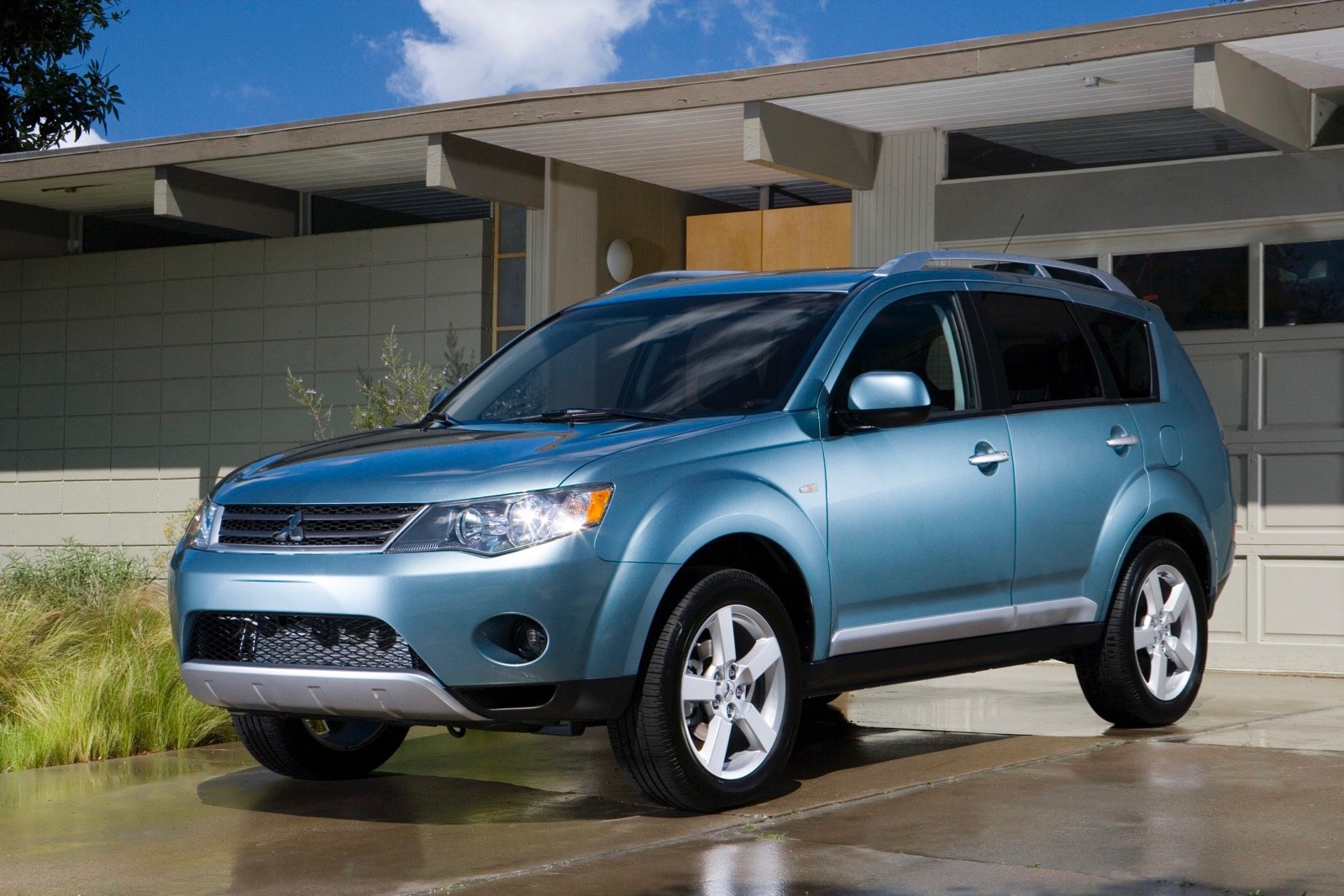
The second-generation Mitsubishi Outlander went on sale in 2007 and started life as a rather generic-looking SUV. It overlapped with a period when Daimler-Chrysler held a controlling stake, and as a result, the Outlander shared platforms with the unremarkable Jeep Compass and Dodge Caliber of the time.
Inside, the Outlander was a carbon copy of the Mitsubishi Lancer sedan, offering a sportier cockpit than that of rivals. The cabin was awash in hard plastics, which were common at the time but flimsier than those seen in the competition. This Outlander also featured a handy split tailgate that made loading bulky objects easier and provided a convenient place to sit while stationary.
In its inaugural year, the second-gen Outlander was offered in Canada in LS, and XLS trims. All models were powered by a 3.0-litre V6 engine that produced 220 horsepower and 204 lb-ft of torque. It was mated to a six-speed automatic transmission, and buyers could choose from front- or all-wheel drive (AWD) on the base model, while AWD was standard on the XLS trim. On the road, the Outlander earned praise for its relatively sporty handling that didn't come at the expense of comfort.
For 2008, a new and more affordable ES trim with a four-cylinder engine was introduced. This 2.4-litre engine produced 168 hp and was paired with a continuously variable transmission (CVT). There were fewer changes in 2009, with heated seats becoming standard and a rearview camera optional on the top trim.
A turning point for the Outlander came in 2010 courtesy of a major redesign that echoed the racy Lancer sedan. Behind its large trapezoidal grille, the V6 engine's output was increased to 230 hp and 215 lb-ft of torque. A more advanced AWD system known as Super All-Wheel Control (S-AWC) was added to the XLS trim. The interior remained largely the same as before, but the instrument panel gained a new LCD information display and real-time traffic was added to the navigation system.
Later model years saw little in the way of change. In 2012, the rearview camera display moved to the rearview mirror.
Initially, the front-drive Outlander's V6 was estimated to return 13.5 L/100 km city, 9.6 on the highway, and 11.8 in combined driving. AWD increased those estimates to 13.7 L/100 km city, 10.1 highway, and 12.1 combined. When the four-cylinder was added, it was rated at 11.6 L/100 km city, 9.4 highway, and 10.6 combined, while AWD increased that to 11.8 city, 9.5 highway, and 10.8 combined. By the end of this generation, fuel economy had improved to 9.4 combined with FWD and 9.5 combined AWD with the four-cylinder engine, and 11.0 combined for the V6.
The second-generation Outlander benefited from excellent safety scores. The U.S. National Highway Traffic Safety Administration (NHTSA) awarded it five out of five stars across all crash tests and four stars in rollover evaluations. The Insurance Institute for Highway Safety (IIHS) gave the Outlander its highest "Good" score in all tests except roof strength, where it earned a second-best "Acceptable" mark. For the 2012 model year, NHTSA downgraded its scores to four stars.
This generation included recalls for its sunroof, windshield wipers, engine drive belt, suspension arm corrosion, brake lights, transmission and steering leaks, seatbelt tensioner, and a wiring harness for the seats. These issues persisted throughout the production run and also expanded to include recalls related to the parking brake and liftgate struts. These continuing problems may have contributed to the Outlander's less-than desirable value retention, as it depreciated at a quicker rate than top rivals.
Few Outlanders remain in Canada from the second generation, but the survivors can be had for cheap. Expect to pay between $4,500 and $9,500, with the low end of the range being older models with 200,000 kilometres or more and the higher end being newer models with up to 150,000 kilometres.

First generation (2003 - 2006)
The first Mitsubishi Outlander debuted in 2003 with an unusual split grille that drew inspiration from the Lancer and Galant sedans, albeit with a blockier style. The Outlander borrowed the Galant's 2.4-litre four-cylinder engine that produced a paltry 140 horsepower and 157 lb-ft of torque. A four-speed transmission didn't help matters. Front-wheel drive was standard, with all-wheel drive (AWD) available as an option.
It may sound antiquated now, but the Outlander was originally offered with rear drum brakes, with anti-lock brakes offered at additional cost. This was common for other vehicles at the time. It was initially available in LS and XLS trims.
In 2005, some of the Outlander's power deficit was addressed with a boost to 160 hp, and an available manual transmission on the base trim reduced the entry price. Thankfully, disc brakes became standard that year as well. A new Limited trim level topped the line-up, offering leather seat upholstery, heated front seats, and other luxuries. 2005 was the year Mitsubishi Canada first introduced its 10-year, 160,000-kilometre powertrain warranty, which led the market for two decades.
Changes were light for 2006. A new SE trim was added, and side airbags and antilock brakes were made standard for all models.
Fuel economy estimates ranged from 10.9 to 11.5 L/100 km combined for FWD models with the manual transmission offering the best ratings, while AWD models averaged between 11.7 and 12.1 L/100 km combined depending on model year. In U.S. National Highway Traffic Safety Administration (NHTSA) crash tests, the Outlander was awarded four out of five stars and three stars in rollover tests. In Insurance Institute for Highway Safety (IIHS) tests, it earned the top "Good" score in frontal collisions, but the lowest score of "Poor" in side impacts.
The most serious recalls involved a possible stuck throttle, while less alarming issues were limited to safety-related electrical issues and trailer hitch wiring. These were addressed about halfway through the production run, but a recall for suspension component corrosion persisted. Not surprisingly, Outlanders of this era depreciated at a quicker rate than rival SUVs.
First-generation Outlanders were prone to rust, so few are left on Canadian roads. Surprisingly, the sub-200,000-kilometre units available as of this writing were on the pricier side for this era at $7,000 to $8,000, but higher-mileage units were typically priced at $5,000 or less.