As Mitsubishi’s compact four-door sedan, the Lancer has been a common nameplate in Japan and around the world since the 1970s. Previously sold in the Canada as the Plymouth Cricket and Plymouth Colt, it wasn’t sold under the Mitsubishi badge until 2002 and the model’s eighth generation.
Mitsubishi Lancer Buying Guide: Cost, Reliability, and the Best Years to Buy
Search for Mitsubishi Lancer
See all


The Lancer was an economy compact sedan, smaller than the midsize Galant of the time. Thanks to the World Rally Championship and the Gran Turismo video game franchise, the Mitsubishi Lancer Evolution earned a legendary status in the 1990s. While the conventional model is a far cry from that, you can’t get to a Lancer Evo without the stepping stone of an everyday model.
Aimed at the Honda Civic, Toyota Corolla, and Subaru Impreza, the Mitsubishi Lancer was an interesting and often cheaper alternative to its fellow Japanese rivals.
Mitsubishi Lancer Buying Guide: Cost, Reliability, and the Best Years to Buy
- Frequently Asked Questions
- Mitsubishi Lancer Pros and Cons
- Mitsubishi Lancer Generations
- Ninth Generation (2008-2017)
- Eighth Generation (2002-2007)
Frequently Asked Questions
Which Mitsubishi Lancer years are the best?
The ninth generation from 2008 to 2017 was a huge improvement over the previous generation, both in terms of standard equipment and safety gear (it had lots of airbags). The later 2013 to 2017 model years are the best of the bunch, with the Ralliart providing an Evo-light experience at a fraction of the cost.
What are the worst Mitsubishi Lancer years?
The early 2002 to 2004 model years were very cheap, and all trims used an anaemic 120-horsepower four-cylinder engine. They were of good value, but they’re not particularly fun to drive, they are not well-equipped, and they are overshadowed by later versions.
Is a used Mitsubishi Lancer a good deal?
Yes, it can be a great deal. The Lancer has always been economical, and certain versions draw on the brand’s motorsport heritage. The ninth generation was a big step up, and even the base models saw improvements.
Mitsubishi Lancer Pros and Cons
Pros:
- Fun to drive
- Stylish
- Cheap
Cons:
- Basic interiors with hard plastics
- Underpowered drivetrains
- Not an Evolution
Mitsubishi Lancer Generations

Ninth Generation (2008-2017)
Mitsubishi took a massive step forward with the launch of the ninth generation Lancer in 2008. Based on the RISE platform shared with the Outlander, the new Lancer was markedly improved over the economy-focused eighth generation.
In Canada, it was initially available in three trims: DE, ES, and GTS. All were equipped with a 2.0-litre four cylinder motor making 152 horsepower and 146 pound-feet of torque. All models were front wheel drive (FWD) and available with either a five-speed manual transmission or a continuously variable transmission (CVT). The Lancer GTS got paddle shifters with its CVT and evoked the Lancer Evo with sharp handling thanks to unique suspension tuning and 18-inch alloy wheels.
Inside was where you could see and feel the biggest improvements of the modern RISE platform. Build quality, space, and the overall layout were much better than in the eighth generation. A seven-inch touchscreen navigation system and a Rockford Fosgate sound system with Bluetooth connectivity were either standard or optional, depending on the trim level.
The 2009 model year saw the sporty Ralliart trim launch, filling the upper end between the GTS and the Evo X GSR. The Lancer Ralliart was aimed squarely at Subaru's WRX. It got a four-cylinder turbocharged engine producing 237 horsepower, a six-speed dual-clutch automatic transmission, and an all-wheel drive (AWD) system derived from its Evo X big brother. While the Ralliart impressed, reviews at the time considered it more of a fancy Lancer rather than the Evo-light the spec sheet implied. However, with an advanced AWD system, aggressive headlamps, fog lights, and bucket front seats, the Ralliart gave the impression of an Evo from behind the steering wheel without the price tag.
Meanwhile, the Sportback body style launched in 2009, and the GTS received a new, more powerful 2.4-litre engine producing 168 horsepower and 167 pound-feet of torque.
The GT trim was renamed SE in 2010, while electronic stability control became standard and some features were added and moved around between trims.
For 2011, the Lancer range saw another update with the addition of the SE Sportback model, which became that body style’s base trim. The 2.0-litre engine was retuned for better fuel economy, electronic power steering and brakes became standard, and the GTS trim was discontinued. In 2012, a new SE sedan launched with Mitsubishi’s All-Wheel Control AWD, and the Ralliart Sportback was discontinued. In 2013, Mitsubishi added a GT trim with AWD with the upgrade engine and a sportier suspension.
Additional visual updates were made annually until Mitsubishi discontinued the Lancer following the 2017 model year. The Lancer was cancelled as the brand turned its focus toward SUVs.
The ninth-generation Lancer is generally considered reliable, but there are some common problems to be aware of. Both the automatic transmissions—the Ralliart’s DCT and the standard CVT—require regular servicing to avoid costly repairs and replacements, especially the former’s dual-clutch transmission. Timing chains can be problematic on 2008 to 2012 models and may need replacing.
Pricing depends heavily on condition and trim. There are some truly bargain-basement units on the Canadian used car market, but cars with reasonable odometer readings in good condition start at about $6,000. Expect to pay $14,000 to $17,000 for a later model year with all-wheel drive and a lower odometer reading. The all-wheel drive Ralliart commands a premium, with prices hovering around $20,000.
Eighth Generation (2002-2007)
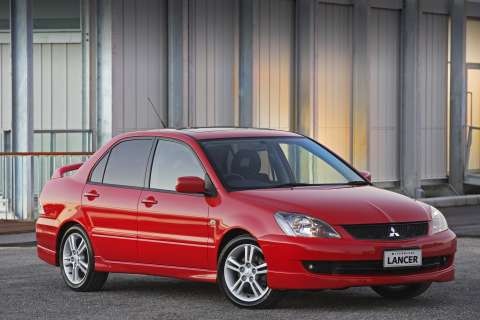
The first Lancer to be sold in North America as a Mitsubishi, the eighth generation, hit our shores in 2002 as a replacement for the Mitsubishi Mirage, and it was a huge improvement. The new Lancer was longer, wider and stiffer than the Mirage, giving it more space, a longer wheelbase, and better performance.
Mitsubishi launched the Lancer in three trim levels: ES, LS, and the O-Z Rally Edition. All Lancer models were equipped with the same 2.0-litre four-cylinder engine producing 120 horsepower and 130 pound-feet of torque, and either a five-speed manual or a four-speed automatic transmission.
Its economy car roots meant the entry-level Mitsubishi Lancer ES model was very basic. Standard equipment included 14-inch steel wheels and a 100-watt four-speak stereo system. Stepping up to the O-Z rally edition got you 15-inch alloy O-Z wheels, an optional rear spoiler, and an optional antilock braking system (ABS) system. Despite these shortcomings, the Lancer earned praised for its smooth ride and confident handling.
For 2004, Mitsubishi introduced a significant mid-cycle refresh, bringing the corporate look to the Lancer that was first found on the Lancer Evolution in 2003. The Lancer Sportback variant launched in 2004 for drivers looking for a little more space and the practicality of a station wagon with a large hatchback trunk.
To close the gap between a regular model and an Evo—which at this point was not yet available in Canada—Mitsubishi also launched the Ralliart trim in 2004. It was equipped with a new 2.4-litre powerplant with Mitsubishi's MIVEC variable valve timing. The result was 162 horsepower and 162 pound-feet of torque, a massive improvement over the base powertrain's 120 horsepower but still well short of the Evolution's 276 horsepower. To reinforce the Ralliart's sporting intent, 16-inch alloy wheels and bigger brakes were standard equipment.
Reliability was comparable to the Honda Civics and Toyota Corollas of the era. The main problems to look out for on this generation are all maintenance-based. Because the Lancer was always cheap and affordable, finding an example with good maintenance records can be a challenge.
Very few examples of the eighth-generation Mitsubishi Lancer have managed to survive Canadian winters. If you can find one worth buying, expect to pay between $5,000 and $10,000.
Related Topics:


by Stephanie Wallcraft
Stephanie Wallcraft is a multiple award-winning professional automotive journalist based in Toronto, Ontario, Canada. In addition to CarGurus Canada, her byline has appeared in major Canadian publications including Toronto Star Wheels, Driving.ca, and AutoTrader.ca, among others. She is a Past President of the Automobile Journalists Association of Canada and was named 2024 Canadian Automotive Journalist of the Year.
The content above is for informational purposes only and should be independently verified. Please see our Terms of Use for more details.


