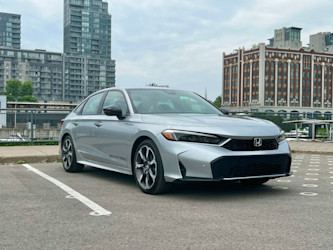
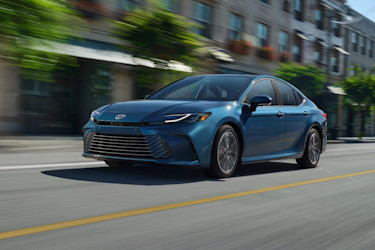
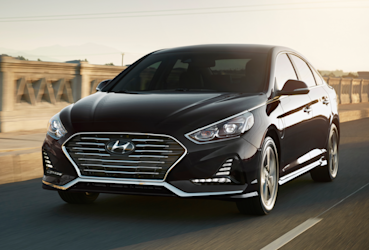
The Kia K5 is the Korean carmaker's entrant in the midsize sedan class. The K5 name has been around since 2010 in its home market and China, but the car didn't reach North America until 2021 when it replaced the Optima. It followed the Optima's lead by offering an attractive and affordable alternative to established class stalwarts including the Honda Accord, the Toyota Camry, and the Nissan Altima.
As is customary with many Kia vehicles, the K5 shares its platform with an equivalent Hyundai, in this case the Sonata. From 2000 to 2009, the Kia Optima was nearly identical to the Sonata, but the big change happened with the 2010 redesign. Under the direction of former Audi design boss Peter Schreyer, the Optima developed its own personality with more appealing and cohesive exterior styling.
Other Kias have received the same treatment, elevating the brand from an afterthought to a class leader. It represents one of the most impressive automotive turnarounds for any manufacturer and has forced rivals to up their game in a similar manner.
The Kia K5 didn’t last long in Canada. As sedans continue to decline in popularity, it was discontinued after the 2024 model year. The smaller Kia K4 arrived for 2025 and simultaneously replaced both the K5 and the Forte, becoming the brand’s only sedan offering in Canada. As for the Kia K5, it can present a good value on the used vehicle market. In this guide, we’ll go over what to look for when buying a used Kia K5 in Canada and how much you can expect to pay.
Kia K5 Buying Guide: Cost, Reliability, and the Best Years to Buy
Frequently Asked Questions
Which Kia K5 years are the best?
The Kia K5 hit the ground running when it debuted in 2021 and earned class-leading status among critics. It has since seen only minor changes that mostly amounted to a few additional features and shuffling equipment between trim levels. Most examples on the used car market in Canada are therefore roughly equivalent to one another.
Which Kia K5 years are the worst?
With its relative youth and the lack of significant changes over most of its production run, there isn't a particular model year that stands out from the rest. Regarding official recalls, the inaugural 2021 K5 had the most, which is common for almost any vehicle. These involved a possible fuel leak, an unexpected loss of engine power, and some power steering and airbag issues. These have been incrementally addressed over the years and were fully resolved by 2024.
As long as a K5 has been checked for recall resolutions, we'd have no issue considering it a solid used vehicle pick. We suggest confirming the results with a Kia dealer as well as checking the vehicle identification number (VIN) on the CARFAX Canada website.
Is a used Kia K5 a good deal?
Based on available data, the Kia K5 has maintained high scores for reliability since its North American debut. Most used K5 models can be purchased in Canada today for roughly $10,000 less than they cost when new. Since they were economically priced to begin with and they’re often more affordable than equivalent Honda Accord or Toyota Camry models, the Kia K5 is often a very good deal as a used car.
Kia K5 Pros and Cons
Pros:
- Stylish design
- Fun to drive
- Excellent value for the money
Cons:
- No hybrid option
- GT trim isn't as sporty as advertised
- Larger wheels negatively affect comfort
Kia K5 Generations
First Generation (2021-2024)
The Kia K5 is similar in size to the fourth-generation Optima it replaced. The Optima was already one of the sportier-looking sedans in its class, but the K5 took it even further. Narrow LED headlights peer out from an inset grille, partially covered by the brow of the hood, giving the front of the K5 a purposeful and almost sinister personality. At the rear, taillights with available LED “dashes” span the width of the deck lid.
The profile is equally sporty thanks to a sleek, fastback-like roofline. Despite appearances, the trunk opens like a standard sedan rather than a hatchback. Rear-seat space is adequate for adults, but the panoramic sunroof eats into headroom, and passengers need to mind the lower roof when they’re getting in and out.
The 2021 to 2024 K5s featured analog gauges and an eight-inch infotainment touchscreen, with a larger 10.25-inch available. The climate controls below were fairly traditional with physical buttons and knobs. Interior materials are comparable to other sedans in the class, benefitting from plenty of soft-touch surfaces and a sturdy construction. There are still some hard plastics, but they're located in less obvious areas of the cabin and well textured to match the rest of the surfaces. Unlike some sedans, genuine leather upholstery isn’t available, but the synthetic substitute is convincing enough.
The trunk can hold up to 433 litres of cargo, which is larger than average for the class. Its wide opening and low height make it easy to load bulky items, while remote seatback releases simplify expanding that space into the rear seats.
The K5 was available with two engines. The base model had a 1.6-litre turbocharged four-cylinder engine that produced 180 horsepower and 195 pound-feet of torque. An eight-speed automatic transmission sent power to standard all-wheel drive (AWD) on all trims but the top GT, which comes with front-wheel drive (FWD), an eight-speed dual-clutch transmission with paddle shifters, and a 2.5-litre turbocharged engine that increased specs to 290 hp and 311 lb-ft of torque.
The base engine wasn't impressive, but it was more than adequate for most drivers. It took about eight seconds to accelerate to 100 km/h, which is expected of most midsize sedans. Handling isn't quite as sporty as the K5's styling suggests, but it corners with confidence and the ride is comfortable.
The GT may seem like the choice for spirited drivers, reaching 100 km/h in only six seconds, but that doesn't tell the whole story. It's not available with AWD, so all that power tends to overwhelm the front tires. The sport-tuned suspension allows for a sharper driving experience, but the front wheels spin freely the moment you start feeding in more power, forcing you to wait until you're pointed straight ahead to get on the accelerator.
As for fuel economy, the Kia K5 is about average for the class. The base engine had a Natural Resources Canada estimate of between 8.2 and 8.3 litres per 100 kilometres combined, depending on the model year. The more powerful GT was estimated at 8.7 L/100 km combined. There is no hybrid option with the K5 as there is with some competitors.
In its debut year, the 2021 Kia K5 trim levels in Canada included the LX, EX, GT-Line, and GT. The base LX featured cloth upholstery, heated front seats, a heated steering wheel, wireless Apple CarPlay and Android Auto, dual-zone climate control, and 16-inch alloy wheels.
Available features equipped in higher trims included a panoramic sunroof, ventilated front seats, Syntex synthetic leather upholstery, a wireless phone charger, adaptive cruise control, a larger infotainment touchscreen, and a Bose premium audio system. The K5 GT-Line gave buyers a sportier-looking alternative without the top GT's engine upgrade, with gloss black exterior body styling elements such as a rear spoiler and larger wheels. Along with the engine upgrade, the GT added stronger brakes, firmer suspension, front sport seats, and styling themes similar to the GT-Line. No meaningful changes were made to the K5 during its Canadian run.
As is customary with modern vehicles, Kia K5 models have been equipped with all the typical advanced safety features. These included frontal collision warning with automatic emergency braking and pedestrian detection, lane-keep assist, and blind-spot monitoring. Optional features include rear cross-traffic alert, rear parking sensors, and adaptive cruise control.
The Kia K5 received a five-out-of-five overall safety rating from the U.S. National Highway Traffic Safety Administration (NHTSA), with four stars for frontal crash and rollover protection. The Insurance Institute for Highway Safety (IIHS) also awarded the K5 its highest score of "Good" in all crash tests except for the updated side impact test, where it scored a second-worst "Marginal" rating. Despite this, the 2021 and 2022 K5 were named a Top Safety Pick+, the Institute's highest honour. The IIHS added an updated moderate frontal overlap test in 2023 in which the K5 was rated the lowest score of "Poor."
On average, buying a used Kia K5 in Canada will cost $10,000 less than original new vehicle prices. This equates to prices between $23,000 and $30,000 on average for cars with fewer than 80,000 kilometres on the odometer, with lower trims being more affordable and GT models topping out that range. Equivalent Honda Accord and Toyota Camry models typically cost roughly $5,000 more, making the Kia K5 a great value.