Midsize sedans aren't a booming segment anymore, as many former midsize sedan buyers (usually small families) have defected to crossovers like Hyundai’s own Tucson and Santa Fe. Still, the Sonata has been more than able to hold its own since entering its eighth generation in 2020. It does not offer all-wheel drive, but there are basic and performance variations and the model got a natty-looking refresh in 2023.
Getting to this point hasn’t always been smooth sailing, however. Early Sonatas weren’t terrible designs but they were poorly made, and 1990s Sonatas are as rare as unicorns today and of no real interest to collectors. After the 1997 Asian Financial Crisis nearly broke the Korean auto industry, Hyundai got much more serious about quality and design, and the Sonata improved by leaps and bounds in the mid-2000s. But even then, quality concerns lingered, and in more recent years, a design flaw left hundreds of thousands of 2010s-era Sonatas vulnerable to easy theft.
As a used car, the Sonata is generally cheaper than the Accord, Camry, or rivals like the Mazda6, Subaru Legacy, or Volkswagen Passat, and priced more evenly with the Chevrolet Malibu and Nissan Altima. It can be a decent deal, but it’s not the most reliable entry in the class, and the theft concern has become a real problem in certain years.
To help guide your search, we’ve broken down most of the Hyundai Sonata’s generations here and included some information about what to watch out for and what to pay. We’ve left off the car’s first three generations as they’re almost extinct from our roads.
Hyundai Sonata Buying Guide: Cost, Reliability, and the Best Years to Buy
Frequently Asked Questions
Which Hyundai Sonata years are the best?
The newest ones. 2020 and newer Sonatas are better made than any previous generation, have more features, and aren’t vulnerable to theft in the way their two immediate predecessor generations are. These late-model Sonatas are the best combination of quality, features, and value in the model’s history. Among older Sonatas, the fifth-generation models built from 2004 to 2009 also stand out for durability and quality. They’re still not as well-built as a Toyota Camry of the same era, but they hold up well and are generally low maintenance.
What are the worst Hyundai Sonata years?
They’re a good deal now, but the seventh-generation Sonata, built from 2015 to 2019, stands out as a model to avoid. Outlets like Consumer Reports give these years very poor marks for reliability, with complaints centred around powertrain and brake system issues. Beyond that, they’re also very vulnerable to theft (along with the previous 2010 to 2014 models), which can not only mean taking extra measures to protect your vehicle that wouldn’t have to happen in a similar car but also high insurance rates or difficulty getting insured. 2011 through 2014 models don’t fare much better.
Is a used Hyundai Sonata a good deal?
Yes and no. The Sonata’s low prices and generous standard equipment mean it’s a lot of car for the money. That’s good. But its so-so reliability record is one reason why those prices are so attractive. The models in the best position to be good deals now, the ones roughly 5 to 12 years old, are also not the best generations of the car. The Sonata can be a good deal, though, and the prices are very tempting. Newer models are also genuinely a good value. But it’s essential to research and inspect carefully.
Hyundai Sonata Pros and Cons
Pros:
- Lots of features for a low price
- Long warranty, striking style
- Generous tech
- Great fuel economy and safety ratings
Cons:
- Dull driving dynamics, weak base engines
- Polarizing styling
- So-so reliability in some years
- Theft vulnerability in some years
Hyundai Sonata Generations
Hyundai Sonata 8th Generation (2020-Present)
The eighth generation Hyundai Sonata debuted for the 2020 model year. Its curvaceous, muscular styling was a dramatic departure from any previous Sonata, especially the ovoid, opinion-splitting models immediately preceding it. This new Sonata looked more like something Hyundai’s luxury brand, Genesis, might have come up with, with lighting signatures that faded into the hood and a low-slung, fastback shape.
Under the skin, the car is just as sophisticated as the look. There were gas and hybrid models to suit many budgets (although the hybrid has not yet reappeared in Canada following the Sonata’s 2024 refresh). You’ll find ample room in the back and trunk, a pretty interior, and lots of tech and safety features. At first, the eighth-gen Sonata came in Preferred, Sport, Luxury, and Ultimate trims, and a sportier Sonata N-Line model joined in late 2020. There isn’t a full N model as on the Elantra or Veloster, but with 290 horsepower, the N-Line is pretty quick for a midsize family sedan.
There are four basic powertrains, and all eighth-generation Sonatas are front-wheel drive. The base engine is a 2.5-litre four-cylinder engine making 191 horsepower and 181 pound-feet of torque. A 1.6-litre turbocharged four-cylinder making 180 horsepower and 195 pound-feet of torque was initially offered in mid trims in Canada. Both engines use a conventional eight-speed automatic transmission. The N Line’s 2.5-litre turbo four is the top gas-only engine, with 290 horsepower and 311 pound-feet of torque. This engine is mated to an eight-speed dual-clutch automatic.
The fourth Sonata powertrain is the Hybrid, which in this generation was available in Canada from 2020 to 2023. It mates a 2.0-litre four-cylinder engine with a pair of electric motors to produce 192 system horsepower. It’s mated to a continuously variable automatic transmission (CVT). Though it’s certainly not the quickest of the Sonatas, it’s definitely the most efficient, with fuel economy ratings of 5.0 litres per 100 kilometres combined. Most gas-only Sonatas range between 7.7 and 8.8 L/100 km combined.
Standard features include an 8-inch touchscreen, Apple CarPlay and Android Auto, USB ports, and more. The long list of standard safety tech includes adaptive cruise control, lane keep assist, blind spot monitoring, rear seat reminders, driver-attention warnings, and automatic emergency braking with pedestrian detection. There are also many available tech, luxury, and safety features. Heated front seats and a heated, leather-wrapped steering wheel are standard. Various upgrades include a Bose audio system, a panoramic sunroof, and 18-inch alloy wheels (upgraded from the standard 17s). On the safety side, optional extras include parking assist, a head-up display, and parking sensors.
For 2024, Hyundai gave the Sonata a major refresh with new front and rear styling. The automaker also dropped the 1.6-litre turbocharged version and the hybrid powertrain in Canada. Inside, the dashboard was completely redesigned to integrate a pair of 12.3-inch screens, wireless CarPlay and Android Auto, and a different style of gear selector, one inspired by the electric Ioniq 5.
These Sonatas are the best ever, with good reliability and safety rankings and more standard equipment than any previous models. They also look good and have above-average interior and trunk space (though less than the Honda Accord). It isn’t as sporty to drive as it looks, but the Sonata is a relaxing, well-equipped cruiser. By the time these cars debuted in late 2019 Hyundai had also solved the easy theft problem of the previous model, so these are not affected by that same malady.
Well-equipped eighth-generation Sonatas in good condition with under 100,000 kilometres on the clock start at around $19,000, but if you shop around, you can even find late-model N-Line versions for under $25,000. They’re all good deals.
Hyundai Sonata 7th Generation (2015-2019)
The seventh-generation Hyundai Sonata debuted at the 2014 New York Auto Show. Although its styling evolved from the previous model, it was much more conservative-looking inside and out, as Korean customers hadn’t liked the previous iteration’s “Fluidic Sculpture” design. Hyundai kept using that name, but the look was more muted this time. The format remained the same, however, and in typical old-school Hyundai fashion, it was meant as a tech-forward and efficient sedan that piled on the features but still came with an affordable price tag.
Notably, the hybrid Sonata did not debut with the other versions, and the seventh-generation Hybrid only appeared in the 2016 model year. If you’re shopping for a 2015 Hybrid, see the previous generation for more details.
When it first appeared, the seventh-gen Sonata used two powertrains. The Sonata GL, GLS, Sport, Sport-Tech, and Limited trims retained the 2.4-litre four-cylinder engine, making 185 horsepower and 178 pound-feet of torque. The 2.0T and 2.0T Ultimate—ancestors of today’s Sonata N-Line—used a turbocharged 2.5-litre four with 245 horsepower and 260 pound-feet. Both used a conventional six-speed automatic and were front-wheel drive.
Hyundai introduced two seventh-generation Hybrids for 2016, a conventional one and a plug-in hybrid (PHEV). The standard Hybrid mated a 2.0-litre four-cylinder engine with a 38 kW permanent magnet electric motor for 193 system horsepower, driving the front wheels through a six-speed automatic transmission. The PHEV used the same basic hardware but added a big battery pack, and at the time it delivered awe-inspiring numbers: 2.4 litres-equivalent per 100 kilometres and up to 43 kilometres of fully electric range. The PHEV version may have been too far ahead of its time and too costly, as it proved to be a very slow seller, and Hyundai did not continue it after this generation.
As usual, standard equipment was generous, though it greatly improved over the years. In 2015, a tiny 3.5-inch LCD screen, alloy wheels, Bluetooth, and a tilt-and-telescope wheel were all standard, with 5- and 8-inch infotainment screens and many more features optional, including leather upholstery, navigation, blind spot monitoring, and more.
After the Sonata’s 2018 refresh, 7- or 8-inch touchscreens replaced the smaller versions and the safety equipment offerings had grown to include lane departure warnings, adaptive cruise control with stop and go, parking sensors, and a variety of other gear. Along with its robust crash structure and seven standard airbags, this helped the seventh-generation Sonata earn Top Safety Pick or Top Safety Pick+ designations from IIHS every year it was on sale.
In addition to new tech and safety features, Hyundai also improved the car’s interior quality and materials, making it feel more expensive and premium than its price tag suggested. Later in the model run, the optional 8-inch touchscreen offered Apple CarPlay and Android Auto.
While the seventh-generation Sonata is affordable, well-equipped, and comfy, two issues should concern used buyers. The first is engine trouble. While some outlets like RepairPal and J.D. Power give these cars decent reliability ratings, Consumer Reports does not and gives the 2017 and 2018 models well below-average reliability ratings. The issues centre around excessive oil consumption and premature wear in the “Theta II” engine family (2.0 and 2.4 litres) but are not limited to those models.
The second issue is theft vulnerability. Many 2010s-era Hyundai models with physical keys have a particular vulnerability to getting boosted, and this is one of them. That can mean high insurance premiums and taking many physical precautions against theft, like the old-school Club.
Thanks to these issues and the Sonata’s friendly price when it was new, this is a cheap machine today. The gas-powered Sonatas from this era run from roughly $10,000 to $20,000, though higher-kilometre units may cost significantly less and newer high-trim versions might cost more. The same is true of hybrids, so while they’re much harder to find, they’re a better buy dollar-for-dollar. The PHEV, much rarer than the others, is also much more expensive, with most examples fetching $18,000 to $23,000, which is enough to buy you a better-equipped eighth-gen model even if you won’t use the electric range.
Hyundai Sonata 6th Generation (2011-2014)
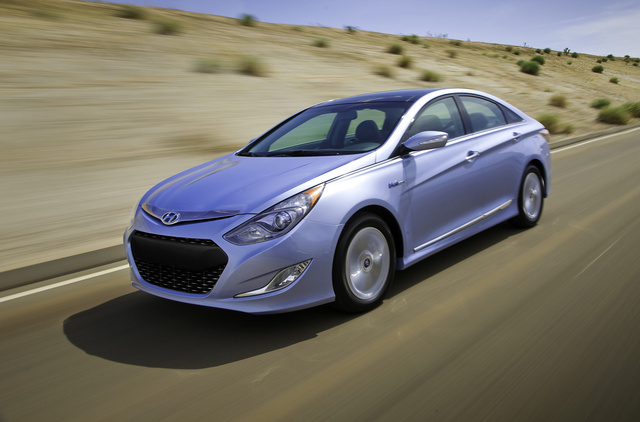
The radically restyled sixth-generation Hyundai Sonata debuted for the 2011 model year at the 2009 Los Angeles Auto Show. The wild styling, which Hyundai called “Fluidic Sculpture,” looked like a rolling cough drop with sharp creases. Still, it yielded a very aerodynamic drag coefficient of just .28. It was a bold choice, with some consumers loving the new look and others hating it. Still, it was certainly not as bland as previous Sonatas. The bold new styling also heralded a major interior upgrade and lots of new technology. In mid-2011, the gas models were joined by the first-ever Sonata Hybrid.
Hyundai offered this generation of Sonata in three basic gas-model trims: the GL, GLS, and Limited. The base engine was a 2.4-litre “Theta II” four-cylinder engine, which was more powerful and fuel-efficient than the previous standard engine. It made 198 horsepower and 184 pound-feet of torque. A six-speed manual transmission was standard on the GL, and a six-speed automatic transmission was optional. GLS and Limited models were automatic only. A 274-horsepower 2.0-litre turbocharged engine was added to the options list in base and Limited forms, also with a standard six-speed automatic transmission.
The Hybrid mated the 2.4 to an electric motor for a total of 206 system horsepower, and it could burn as little as 6.4 L/100 km combined. By comparison, the gas-powered Sonatas could only manage 9.0 to 9.1 L/100 km combined, or 8.6 with the manual transmission. Though Hyundai redesigned the Sonata in 2015, the Hybrid continued unchanged for that year.
While the exterior drew most of the attention, Hyundai also completely revamped the interior with nicer materials and a more dramatic design featuring a prominent centre stack. The downside of the redesign was that it had a considerably smaller back seat than before, with rear legroom falling by almost 7.5 centimetres. Passengers could, at least, enjoy some new and luxurious features like a double sunroof with a pane that opened over the rear passengers.
The infotainment system was basic, but an 8-inch screen could be had on the Limited trims. Additional packages could add navigation, complete with lane guidance and turn-by-turn directions. Active safety systems were also still scant. Even so, the Sonata’s systems and structure earned it a “Top Safety Pick” designation from IIHS from 2011 to 2013.
Unfortunately, the sixth-generation Sonata has many of the same issues as the seventh. It’s theft-vulnerable and makes extensive use of the trouble-prone Theta II engines. Not every engine is a bad one, but the model doesn’t rank very well for reliability as a result. While Consumer Reports gives this generation better marks than the seventh, not all outlets agree, and the 2011 model draws more complaints than any other on CarComplaints.com, with engine problems far and away the main culprit.
Sixth-generation Sonatas in good condition, with fewer than 150,000 kilometres on the odometer, typically cost between $8,000 and $15,000, with hybrid models commanding about 15%-20% more than that. These are temptingly cheap, comfortable, and often well-equipped, but all but the very last ones are entirely out of warranty or CPO range now, and the engine and theft issues are big hurdles to overcome. Cars with documented maintenance are a better bet than whatever’s on the lot.
Hyundai Sonata 5th Generation (2006-2011)
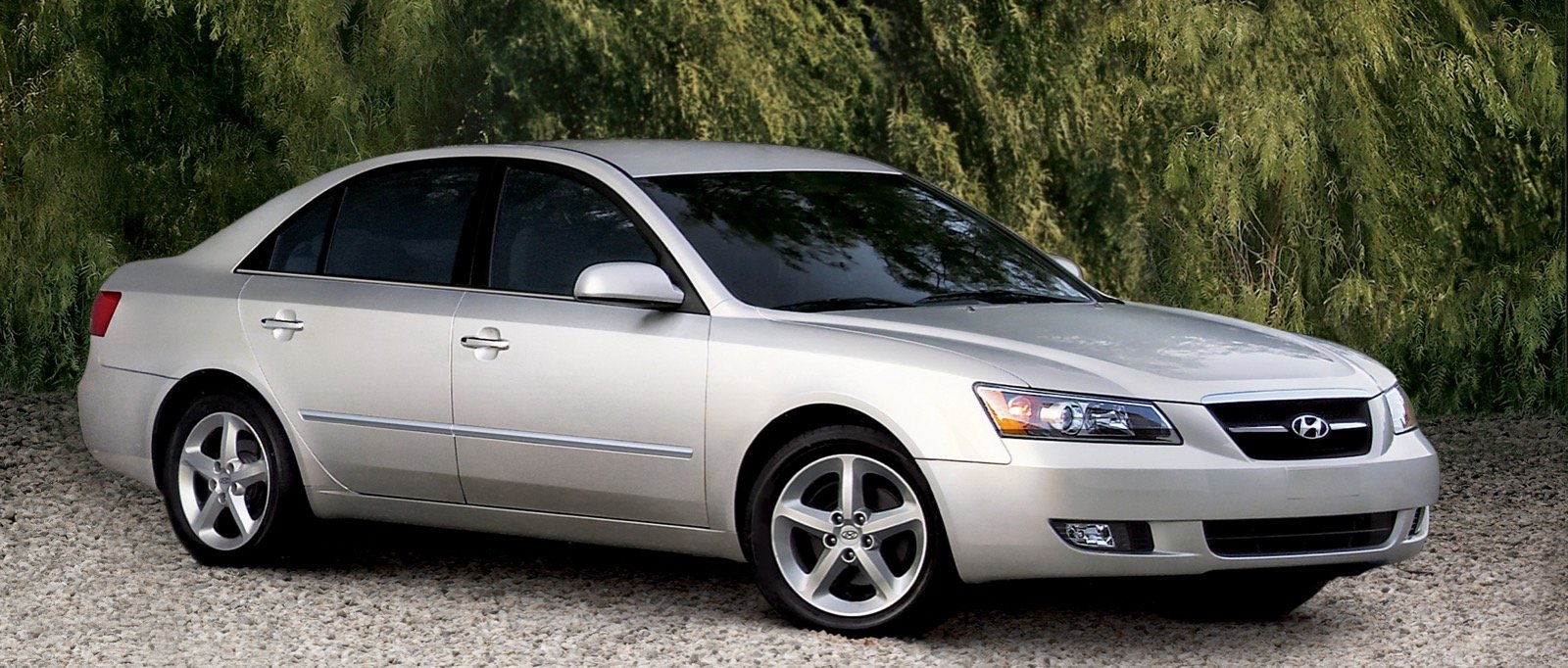
The fifth-generation Hyundai Sonata was the first to be built in the U.S., in Alabama, where Hyundai still makes them today. New for the 2006 model year, it was bigger and more conservatively styled than its fourth-generation predecessor, to the point of being rather plain. But it was also the highest-quality and roomiest version built up to that time.
There was no hybrid model then. Initially, only the GL trim was offered, which could be optioned up with a variety of packages. By 2007, the GLS model had been added. From 2006 to 2009, all trims had a standard 2.4-litre four-cylinder engine that made 162 horsepower and 164 pound-feet of torque, but they could also be ordered with a 3.3-litre V6 making a much beefier 234 horsepower and 236 pound-feet.
A five-speed manual was standard on the four, with a four-speed automatic optional. V6 models only used a five-speed automatic, and all fifth-generation Sonatas were front-wheel drive.
Though the equipment list doesn’t seem so impressive today, this car came with stability and traction control, power heated side mirrors, a leather-wrapped steering wheel, satellite radio compatibility, and keyless entry with an alarm system. Heated front seats were standard in Canada in later years. Leather seats, power front seats, and various other conventional luxuries were optional. The interior was just as plain as the exterior, though not an unattractive design, and it had lots of room, particularly in the back, with 950 millimetres of rear legroom and a big 461-litre trunk.
While pretty basic compared to later Sonatas, this model earned a good reputation for reliability and affordability. It isn’t plagued by some of the later engine and theft issues, and it’s a bargain today, an ideal candidate for cheap basic transportation. Owner complaints about this generation of Sonata tend to centre on paint quality and brittle plastic interior and exterior bits. These maladies don’t really affect the operation of the car.
This generation of Sonata is becoming less common on Canadian roads, but you can pick up a nice example for anywhere from $3,000 to $7,000. A deal for sure, and probably a safer bet than a fancier sixth-generation model.
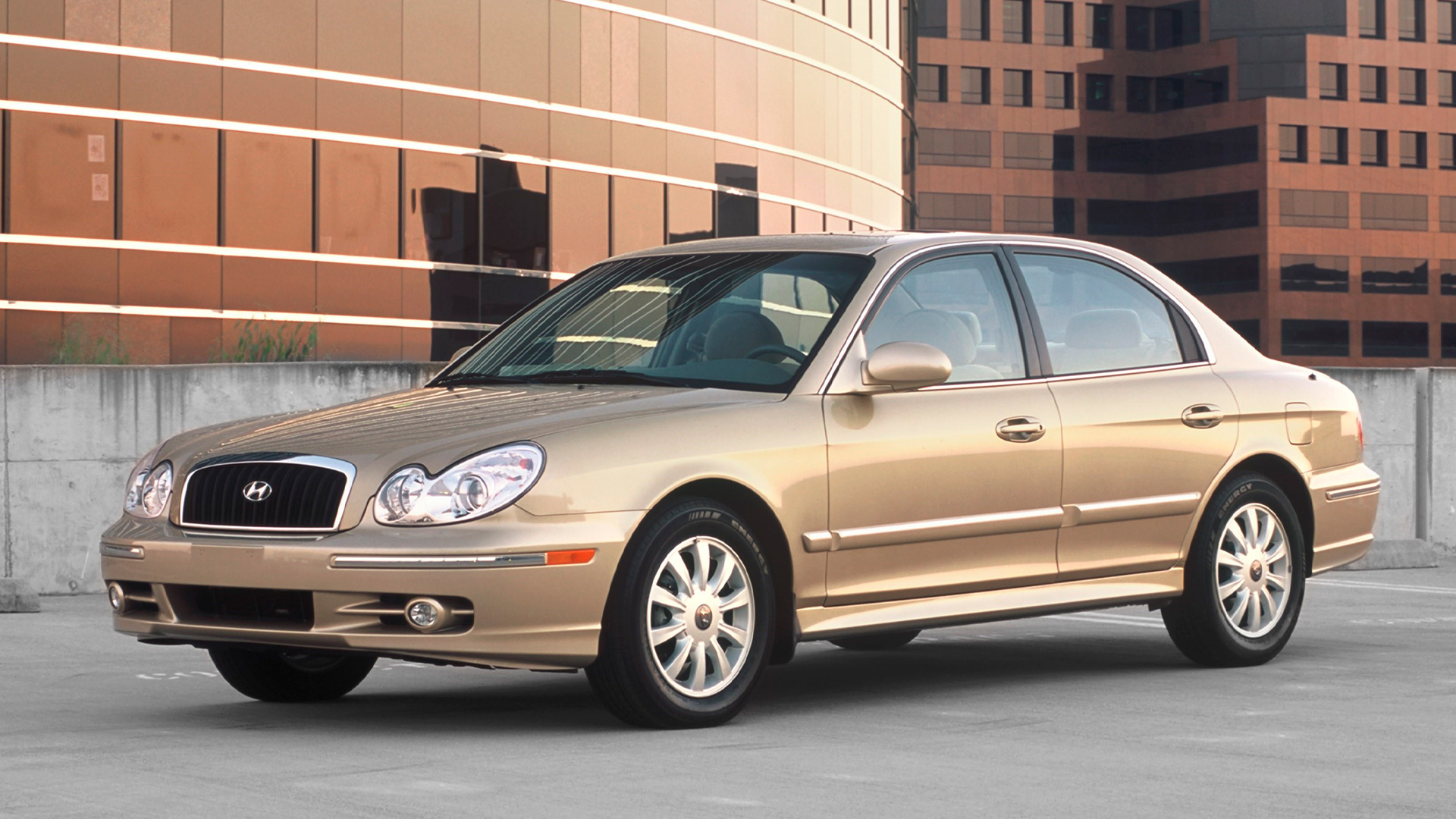
Hyundai Sonata 4th Generation (1999-2005)
The fourth-generation Hyundai Sonata is rare now, but still a decent set of very basic wheels. This version of the long-running sedan was also the first to benefit from the changes in engineering and production the automaker had made in the wake of the 1997 Asian Financial Crisis and its unexpected merger with Kia. Hyundai's “Y4” platform was shared with the Kia Optima, and the Sonata and Optima (and now K5) have been close kin ever since.
This Sonata debuted for the 1999 model year, but it was hurriedly facelifted in 2001. Its eccentric styling looked quite odd when new, but it has aged better than expected. While the exterior is distinctive, the interior is not, and it’s filled with cheap plastic and fake wood, but it’s comfy and reasonably roomy in both rows, with a good-sized, 400-litre trunk.
Four- and six-cylinder engines were offered as in the later fifth-generation models. The standard powerplant was an earlier version of the same 2.4-litre unit that would power the fifth-generation model, but with 138 horsepower and 147 pound-feet of torque.
A 2.7-litre V6 was standard on the higher trims, with 170 horsepower and 181 pound-feet of torque. Most Sonata models came with a four-speed automatic transmission, and the majority of fourth-generation Sonatas that survive today are V6-powered.
While well-equipped for the time, the fourth-generation Sonata is basic by today’s standards. Our climate has rendered this version of the Sonata nearly extinct, and you’re more likely to find one in Canada’s fair-weather areas such as B.C.’s Lower Mainland. But if you come across one and all you’re looking to do is commute, it’s a very cheap machine with a decent reliability record. These typically sell for about $5,000 to $6,000. Even the best ones shouldn’t cost more than that.
Related Topics