They’re out of fashion today, but in the 1990s and 2000s, roadsters were all the rage. The Honda S2000, which first appeared as the SSM (“Sports Study Model”) concept car way back in 1995, was one of the most interesting and fun of the breed. Honda has a long and proud tradition of both racing and creating innovative performance cars, and while the company was much better known in the 1990s for Accords, Civics, and CR-Vs, the S2000 was actually a follow-up to some of its earliest and most exciting cars.
The very first Honda car was a sporty roadster, the S360 in 1962. Honda didn’t end up building that little car, but a year later it unleashed a series of tiny, high-revving roadsters that ran from 1963 to 1970, the S500, S600, and S800, each one with a larger and more powerful engine. The cars, whose tiny engines could rev up to 9,500 rpm (a number unequaled for many years by any other production cars), helped establish the company as an engineering force in cars as well as bikes, but were soon overshadowed by mainstream cars like the Civic.
30 years later, the company picked up that baton with the S2000. It was a Honda engineer’s dream project (specifically Honda engineer Shigeru Uehara, who had also led the development of the Acura NSX ten years earlier) as the car brought speed, handling, and aerodynamics together in a way that not many other vehicles did. It also kept true to Honda’s philosophy of high-revving naturally aspirated engines since no turbochargers or superchargers would be used.
The result was a truly fun to drive and raw sports car, one with handling and steering that seemed to respond to the driver’s very thoughts, and which could rev to infinity like a Honda F1 car—or at least to 9,000 rpm, an incredibly high number in 1999 when the car first appeared.
The S2000 had a decent run on the market, selling between 2000 and 2009 in North America, but declining interest in roadsters and the great recession put the car to bed. One last gasp, however, came forth from the factory: the Honda S2000 CR (“Club Racer”), a lightweight, track-optimized special. Only 699 were made, and they’re all worth a small fortune now.
Though it’s been off the market for more than a decade, the S2000 is still a popular car. Used car shoppers may also consider the Mazda MX-5, Subaru BRZ, Toyota GR86, BMW Z3 and Z4, and the Mercedes-Benz SLK. Other, larger two-seat cars like the Mercedes-Benz SL, Nissan Z, and Jaguar F-Type are typically much more expensive and not as lithe. The S2000 comes only as a rear-drive car, and only as a six-speed manual. There are no compromises here.
Honda never made an S2000 Type R, but the car’s charming high-redline VTEC engine and incredible fun factor, regardless of model year, make it one of the most engaging Japanese cars ever made. It’s also among the most reliable sports cars you can choose, and well known for durability. The only caveat is that because this car’s engine is so stressed, proper maintenance is vital. Timing chain tensioners should be replaced every 60,000 kilometres, and all S2000s have an appetite for consuming their engine oil, so the level needs to be regularly checked.
Though the basic design was on the market for a decade, there were two eras of S2000, and we’ve broken them both down here with a little advice about what to watch out for and how much to pay.
Honda S2000 Buying Guide: Cost, Reliability, and the Best Years to Buy
Frequently Asked Questions
Which Honda S2000 years are the best?
The S2000 is a very reliable car if maintained properly and consistently, and that’s true more or less regardless of the year. The 2005 to 2009 models, however, have a little more torque (but a lower redline) and a slightly softer suspension, which makes them easier to live with as daily drivers. They’re also just newer, which means less chance of rust and less wear and tear over time.
What are the worst Honda S2000 years?
There are no truly bad versions of this car, but both the 2000 and 2004 models, the first year overall and the first year of the updated “AP2” design, had more bugs than average, and the 2000 had the largest number of recalls and technical service bulletins. Most of those issues should be sorted out by now, however. It’s more important to check thoroughly for known issues, like weak timing chain tensioners and worn-out engines that have been starved of oil. The S2000 has a very high oil consumption rate for a modern car.
Is a used Honda S2000 a good deal?
The S2000 is a fast-appreciating classic car now, despite the fact that the newest ones are still only about 15 years old. What constitutes a “good deal” on such a car is a different calculus than the value you might find in a daily driver. The S2000 is still affordable, and it’s both lots of fun and rock reliable. In contrast to fancier roadsters that aren’t as lithe or as technologically interesting, like the later BMW Z4 or Mercedes-Benz SLK models, it’s a good value proposition, and if you take care of your S2000, its value will probably only increase with time.
Honda S2000 Pros and Cons
Pros:
- Fast and Furious in the metal
- Telepathic handling and cornering
- High-revving VTEC engine
Cons:
- Basic interior
- Almost no storage space
- Some examples have been abused
Honda S2000 Generations
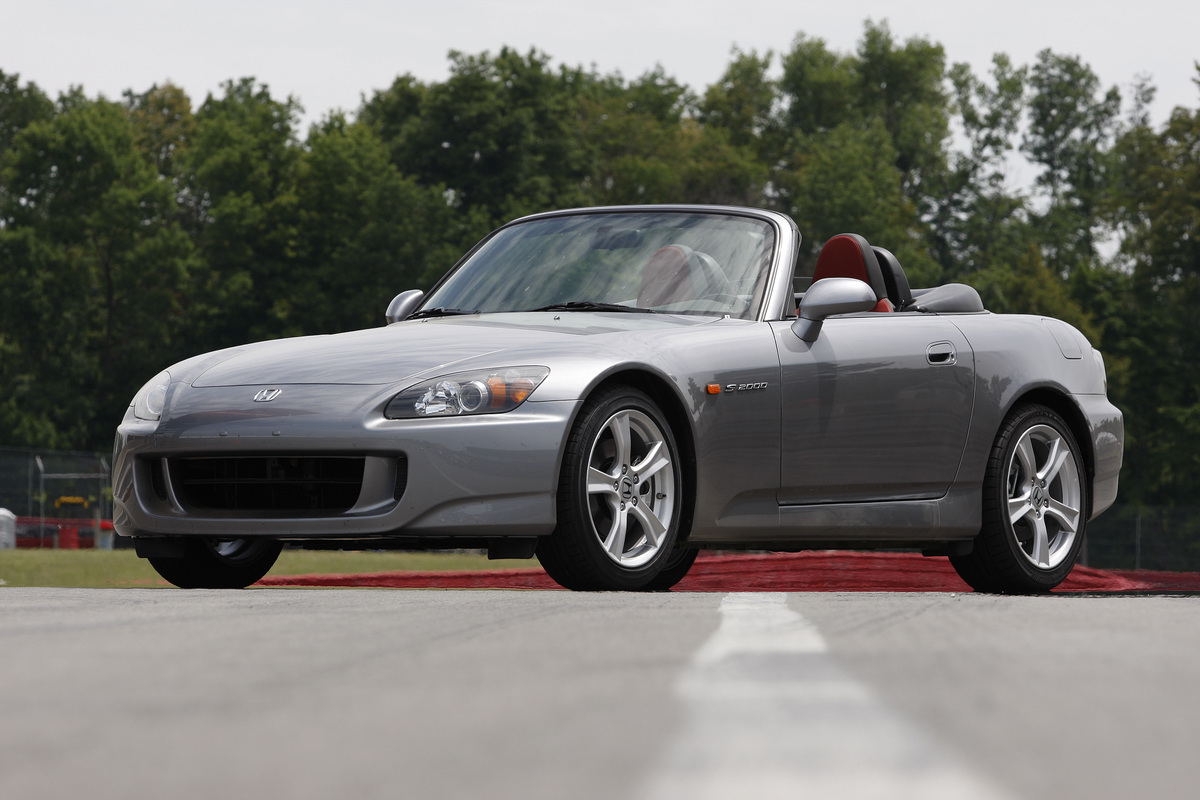
Honda S2000 AP2 Generation (2004-2009)
While there are technically two generations of S2000, the second-gen model is really just a big update of the first. Called “AP2,” these later cars were built in Suzuka, Japan, rather than at Honda’s R&D plant in Tochigi, and introduced multiple updates and upgrades for the cars, including larger wheels, revised suspension, an updated subframe, and more. The cars also got a significant facelift, with new taillights, revised bumpers, new headlights, and updated exhaust outlets.
Honda massaged the S2000’s powerplant, increasing displacement to 2.2 litres by increasing the stroke. This helped torque climb to 162 pound-feet, but horsepower remained steady. The six-speed manual box got revised gearing with shorter ratios for the first five gears and longer legs for the sixth. The additional torque is something you can only faintly feel, but it does help, and the redline is slightly lower on this engine at 8,200 rpm as a result.
Honda’s improvements to the AP2 generation S2000 didn’t make an insane difference in acceleration, but handling got a significant improvement. Oversteer, which is when the rear wheels lose traction and rotate in a turn, was minimized, and the car’s traction control lets just enough movement through for the driver to have fun without losing the rear end in corners. The ride is a little more compliant too, as this car’s firm suspension damping means plenty of bumps are transmitted into the cabin on rough pavement.
In 2008, Honda released a track-oriented S2000 Club Racer, or S2000 CR. The car featured a reduced curb weight, thanks to normally standard features being shifted to options. The car left the factory without a stereo or air conditioning, and Honda removed the soft top option in favour of a black hardtop. Rather than a folding design with a soft rear window, it got a removable top. Though the S2000 never got a Type R, this is essentially the same format that Honda applied to Type R models—lighter, stripped down, and faster.
By the time of the AP2, it was clear that the S2000 was a future classic, so many of these later cars have been looked after and properly maintained, but records are still important to have. They’re not cheap, however, and prices have been trending upward for a decade. A good AP2 S2000 starts at around $35,000 Canadian, but most sell for between that and $50,000. Very low kilometre ones will fetch more, and it’s possible to see them as high as $55,000.
The S2000 Club Racer is in a world of its own now. You’ll most likely need to shop south of the border if you’re determined to get one, and they routinely cost into six figures. One low-kilometre S2000 CR sold for $200,000 at auction in 2022.
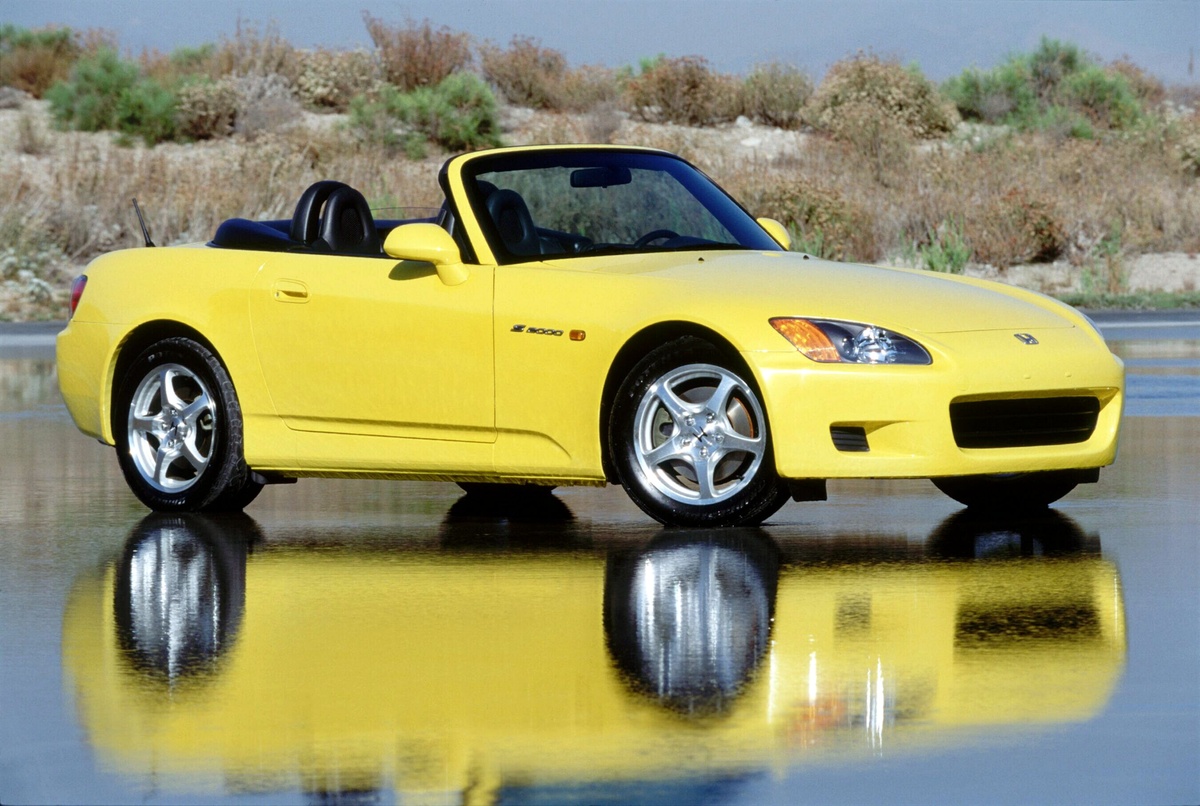
Honda S2000 AP1 Generation (2000-2003)
The Early S2000 wore the AP1 chassis designation, and when it was new it made headlines for its uncompromisingly sporty design. It was cooked up in a research and development laboratory by Shigeru Uehara and a team of enthusiast-minded engineers, with only a little thought for how it might be marketed and who might buy it. The goal was to produce a nearly perfect sports car, with the ideal combination of power, handling, and weight distribution. They succeeded, but what generated the most ink was the engine.
The S2000 came powered by a 2.0-litre four-cylinder engine that made up to 247 horsepower and could rev to 9,000 rpm. At the time, this was purely the domain of race cars, and only a few cars—all exotics like the Ferrari La Ferrari, Porsche 911 GT3 RS, and Porsche 918 Spider—have since surpassed it. The engine weighed only 148 kilograms (326 pounds), less than the 1.6-litre engine of the contemporaneous Civic, and had the highest specific output per displacement of any engine in a naturally aspirated production car until 2010.
A six-speed manual transmission was the only option, and the cars were rear-wheel drive (RWD) exclusively, making them an excellent platform for tuning and third-party development. The first-generation Honda S2000 also made a great platform for bodywork and customization. Beyond wringing everything possible out of the VTEC engine, tuners looked to custom hardtops and soft tops, upgraded drivetrain components, a larger spoiler, and even turbos. Honda slapped on sticky Bridgestone Potenza tires at the factory as well.
With all the hype around the car now, it’s easy to imagine it offered a ton of great luxury features and high-end tech, but the truth is that Honda focused almost solely on performance, handling, and precision. The cars got 16-inch wheels with Bridgestone performance tires, independent rear suspension, a Torsen limited-slip differential, and double wishbone suspension, but was otherwise very basic.
The interior is minimal and usually black, though blue, red, and tan interior schemes were optional. There were few frills of any kind other than a nifty digital dashboard and cruise control, though buyers could order a CD changer, seatback pockets, or a hardtop. This is a car about driving and nothing else.
Since they were produced in larger numbers, it’s a little easier to find an AP1 than an AP2, but the prices aren’t that different. A good AP1 starts at around $30,000 and can go just as high as the non-CR AP2s if it’s in good enough condition.
Many early cars have been modified, but out of the box the stock S2000 was very reliable. The first-year cars had some teething troubles, but in general, there isn’t much that can go wrong on the S2000 other than neglecting its high-strung engine. Check the oil every 1,500 kilometres and change it frequently, make sure timing chain tensioners are renewed early (aftermarket units that are tougher than the factory tensioners are widely used now), and check for accident damage and rust.
Related Topics: