More than 15 years after its exit from the North American car market, the Honda Element remains an intriguingly capable and practical little box on wheels that’s fun and efficient in equal measures. The Element received a few changes over its nine-year run, with significant updates for the 2007 and 2009 model years. It was built on the same platform used for Honda vehicles such as the CR-V crossover. While the Element and its CR-V sibling are both utility vehicles, the former’s unique design—with its barn-door tailgate and configurable interior—set it apart from mainstream crossovers.
Honda Element Buying Guide: Cost, Reliability, and the Best Years to Buy
Search for Honda Element
See all


Honda previewed the production Element when it introduced the Model X Concept at the Detroit Auto Show in 2001. At the time, Honda said its team of designers included members who “surfed, rode mountain bikes, went rock climbing, kayaking, and much more.” The Element that hit the market for the 2003 model year adopted a similar theme with features such as a flat floor, reverse-opening rear doors that created a sizable entry point, rear seats that folded flat into a bed, waterproof seat surfaces, and a removable skylight.
Honda Element Buying Guide: Cost, Reliability, and the Best Years to Buy
- Frequently Asked Questions
- Honda Element Pros and Cons
- Honda Element Generations
- First Generation (2003–2010)
Frequently Asked Questions
Which Honda Element years are the best?
There are no unreliable model years. When it was first launched in 2003, the Element had a few teething pains, including malfunctioning door locks and problems with the keyed ignition. Those issues were quickly rectified, and by 2004 they were fixed in production. Repairpal.com, CarComplaints.com and J.D. Power all rank the Element highly for reliability.
There are some potential trouble spots to look for if you’re shopping for a used Honda Element. Make sure the keys work in all locks and the ignition, and look for signs of leaks from the engine, the transmission, and the rear differential. Listen for noises while accelerating and turning, which could be a sign of axles or differentials that need maintenance or replacement.
The Element was heavily updated for the 2007 model year with a bit more power, a five-speed automatic to replace the previous four-speed unit, and revised seatbelts that didn’t get in the way while loading and unloading. All the above made 2007-2011 Honda Element models more desirable than earlier versions.
What are the worst Honda Element years?
If you’re going to avoid a specific model year, the 2003 Honda Element has received more complaints from owners online than any other. Generally, though, the Element is a reliable and durable used car.
Is a used Honda Element a good deal?
A used Honda Element can be a good deal, assuming it has been well cared for. In Canada, it’s rare to find a used Honda Element listed for more than $10,000 at CarGurus.ca. On the other hand, it’s rare to find used Elements at all in Canada since they’re susceptible to rust, and those you will find typically have more than 200,000 kilometres on the odometer.
The Honda Element is best suited for owners who plan to make use of its versatile interior. It’s not as efficient as some similarly priced crossovers—including Honda’s own CR-V—and only has seatbelts for four occupants.
Honda Element Pros and Cons
Pros
- Uniquely versatile cabin
- Plenty of cargo space
- Manual transmission available
Cons
- Pedestrian performance
- Only seats four
- Underwhelming fuel economy
Honda Element Generations
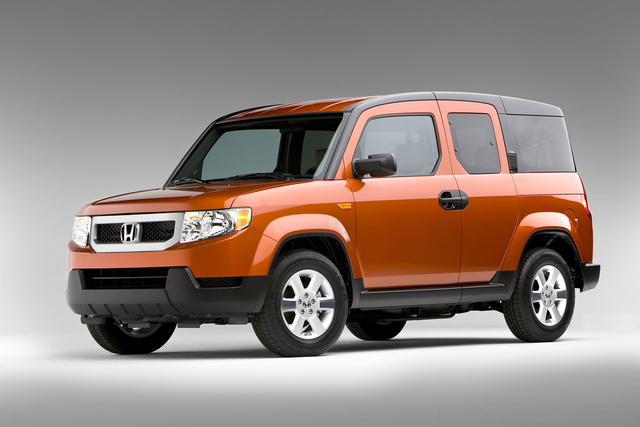
First Generation (2003-2010)
The 2003 Honda Element hit the Canadian market shortly before the introduction of the Scion xB, a Toyota spinoff and another boxy Japanese import known for its unique styling and surprisingly spacious interior. The Nissan Cube and the Kia Soul continued the box-on-wheels trend a few years later. Of all the squared-off crossovers of the 2000s, the Element was arguably the most interesting with rear seats that could recline, fold flat, or be removed entirely.
When it was introduced for the 2003 model year, the Honda Element featured a reliable 2.4-litre i-VTEC four-cylinder engine that produced 160 horsepower and 160 pound-feet of torque (bumped to 166 horsepower and 162 lb-ft from 2007 to 2010). A five-speed manual transmission came standard, and a four-speed automatic transmission was optional. Also on the options menu was an all-wheel drive system that Honda called Real Time 4WD. Though marketed as a four-wheel drive system, the Element—which had just 17.5 centimetres of ground clearance—wasn’t positioned as an off-road warrior but pitched to the adventurous crowd that surfed, biked, and camped. The Element rode on the CR-V platform, derived from the compact Civic.
In its most efficient form, the 2003 Honda Element was rated by Natural Resources Canada at 11.9 litres per 100 kilometres in the city, 9.7 on the highway, and 10.9 combined. With a manual transmission, it used 12.5 L/100 km city, 10.1 highway, and 11.4 combined. The AWD versions averaged 12.5/10.4/11.5. Ratings stayed similar throughout the Element’s time of the Canadian market.
From 2003 to 2006, the Honda offered its funky four-seat crossover SUV in base and Y Package forms. All Elements came with power windows and door locks, air conditioning, cruise control, a CD player, and waterproof front seats. The Y Package added waterproof rear seats, remote keyless entry, an upgraded audio system, and alloy wheels.
The 2007 Honda Element saw the trim walk change to LX, EX-P, and SC trim levels. The latter had a sporty look and lowered suspension. At the same time, the engine picked up some extra horsepower, and a five-speed automatic replaced the older four-speed unit. The Element SC was only offered in front-wheel drive form, but AWD was still optional for the EX-P. For the 2007 model year, redesigned seatbelts made it easier to access the rear seats, and stability control and side airbags were standardized. Each Element trim level received its own centre console, with the EX model boasting a built-in cooler.
The 2009 Honda Element received a styling update that included a grille more like the that of the larger Pilot SUV. Element SC and EX models got an optional navigation system and a backup camera. In 2010, Honda offered the Element with a Dog-Friendly package that, well, made it friendly for doggy transport duties. In Canada, 2010 was the final model year for the Honda Element, while it continued in the United States for one more year before being discontinued there after 2011.
Today, Honda Element owners have access to a wealth of aftermarket accessories that can be used to make the crossover SUV into a small camper with a roof-mounted tent or a mini adventure utility vehicle with a lifted suspension setup. A well-cared for Honda Element is a solid used car for potential owners who aren’t bothered by its four-seat configuration and can put its practical interior layout to good use.
Used Honda Elements have become rare in Canada as the undercarriage area is prone to rust. If you find one, you’re unlikely to need to pay more than $10,000. Expect any used Element to have 200,000 kilometres or more on the odometer, and be sure to inspect carefully for signs of rust or neglect before buying.
Related Topics


by Stephanie Wallcraft
Stephanie Wallcraft is a multiple award-winning professional automotive journalist based in Toronto, Ontario, Canada. In addition to CarGurus Canada, her byline has appeared in major Canadian publications including Toronto Star Wheels, Driving.ca, and AutoTrader.ca, among others. She is a Past President of the Automobile Journalists Association of Canada and was named 2024 Canadian Automotive Journalist of the Year.
The content above is for informational purposes only and should be independently verified. Please see our Terms of Use for more details.


