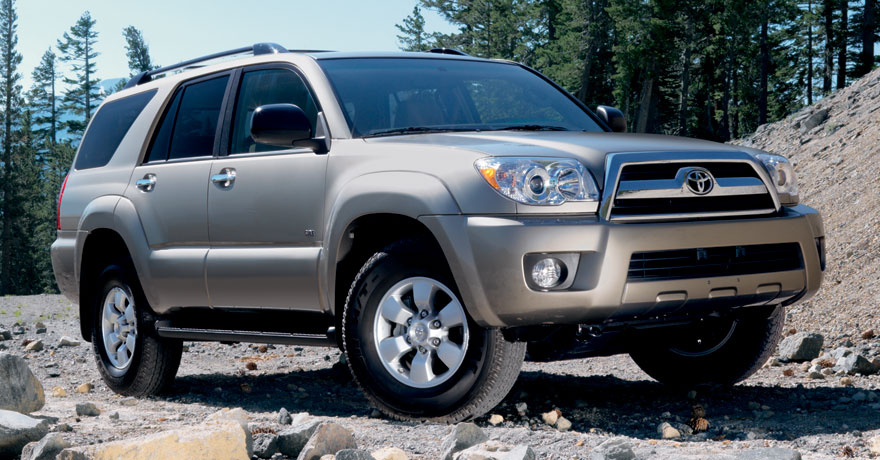
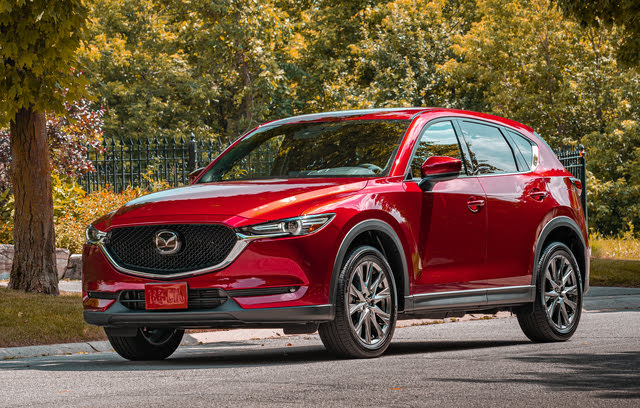
The GMC Terrain is a comparatively recent entry into the burgeoning compact sport utility segment, having debuted in 2010. The Jeep Cherokee dates all the way back to 1984, but many of today’s crop of car-like utility vehicles can trace their history to the mid-1990s, when the Honda CR-V and the Toyota RAV4 first emerged.
GMC’s Terrain shares much of its chassis and powertrain with the popular Chevrolet Equinox, which was launched in 2005 alongside the Pontiac Torrent. When the Pontiac brand was shuttered after the 2009 model year, General Motors replaced the Torrent with the GMC Terrain, alongside the second generation of the Equinox.
While the Equinox boasts sharp styling that looks as though it was borrowed from the Camaro muscle car, the GMC Terrain is more angular and appears ready to tackle off-road adventures. Today’s Terrain AT4 is designed with off-road capability in mind, while the glitzy Denali appeals to buyers who value luxury.
The GMC Terrain was redesigned for the 2025 model year with new styling, revisions to the powertrain lineup and a thoroughly upgraded interior. Still, it lacks key components, such as an optional hybrid or plug-in hybrid powertrain, that keep it from competing on a truly level playing field with segment leaders such as the Honda CR-V, the Subaru Forester, and the Toyota RAV4.
GMC Terrain Buying Guide: Cost, Reliability, and the Best Years to Buy
Frequently Asked Questions
Which GMC Terrain years are the best?
There has never been a GMC Terrain sold in North America that received a less-than-average reliability ranking from Repair Pal. However, that doesn’t mean that all GMC Terrain models are good choices. Conventional wisdom says to avoid the first model year of a new redesign, which would rule out the 2010, 2018 and 2025 versions, but there isn’t any data to suggest that the 2018 or 2025 models are less reliable than others. According to CarComplaints.com, the most dependable GMC Terrain models were built between 2020 and 2024.
What are the worst GMC Terrain years?
The most troublesome year, according to data provided by RepairPal.com and CarCompaints.com, was 2011. In reality, any GMC Terrain built between 2010 and 2017 equipped with a 2.4-litre four-cylinder engine or 3.0-litre six-cylinder engine is best avoided. The 3.0-litre V6 was replaced by a significantly superior 3.6-litre engine in 2013. If you’re shopping for any first-generation Terrain, your best choice is the larger 3.6-litre V6 engine.
Is a used GMC Terrain a good deal?
Because the GMC Terrain doesn’t hold its value as well as best-selling compact SUVs like the Honda CR-V or Toyota RAV4, you can likely find a good Terrain near you at an attractive price. A used first-generation GMC Terrain with a 3.6-litre V6 engine could turn out to be a reliable, low-cost car, and the second-generation version built between 2018 and 2024 (perhaps discounting the initial 2018 model year) has reasonably good reliability ratings. If, crucially, you find the right version, a used GMC Terrain could indeed be a good deal.
GMC Terrain Pros and Cons
Pros
- Comfortable
- Roomy cabin
- Great safety ratings
Cons
- Poor reliability of 2.4 and 3.0 engines
- Some interior materials feel cheap
- Not as much cargo space as top rivals
GMC Terrain Generations
Third Generation (2025-Present)
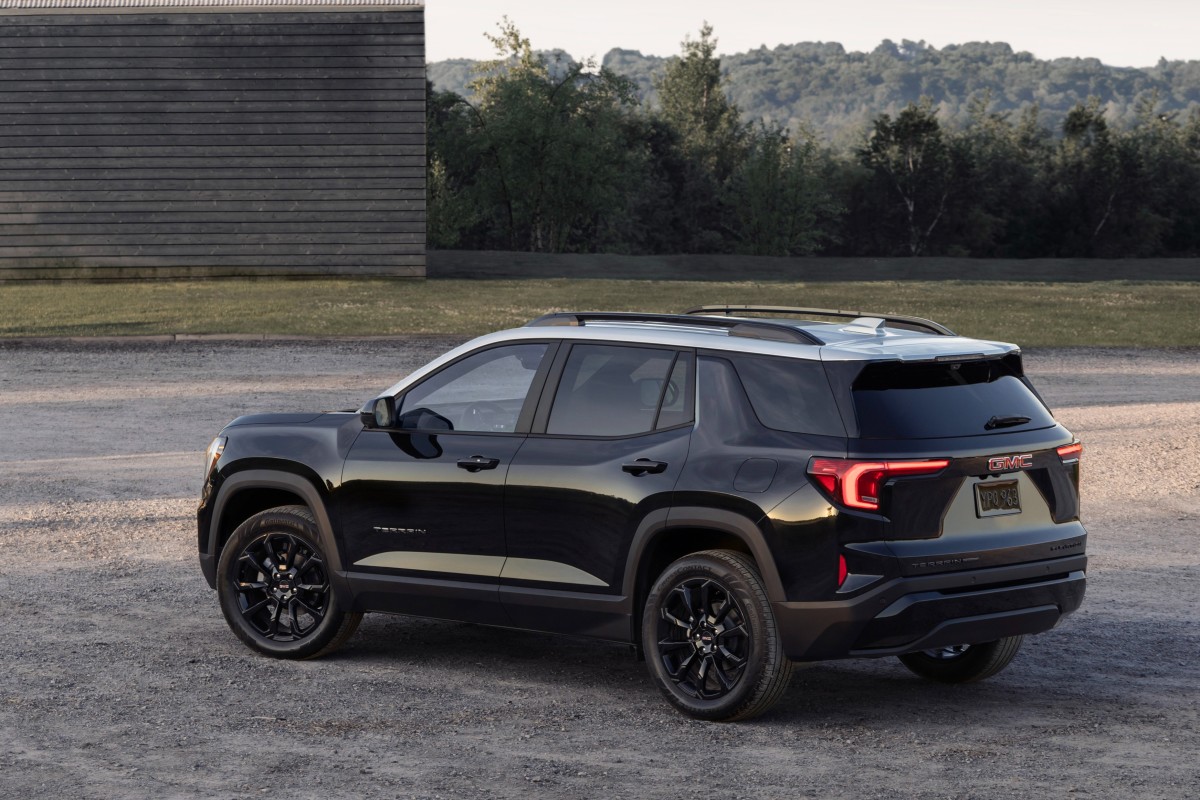
The third and most recent version of the GMC Terrain debuted for the 2025 model year with a single trim level. Standard features for the 2025 GMC Terrain Elevation include an impressive 15-inch touchscreen that runs the latest GMC infotainment system software with Google Built-in. A second 11-inch screen—which GMC calls a digital driver information centre—is positioned directly in front of the driver. Heated front seats and a heated steering wheel are also standard. At the time of writing, the 2025 Terrain’s base price was $38,433, while adding all-wheel drive (AWD) bumps the price to $40,733.
Cloth seats are standard, while the Elevation Premium package adds leatherette seats, dual-zone climate control, a power liftgate and wireless charging for phones. This package swaps the standard 17-inch alloy wheels with 19-inch machined aluminum wheels. Available features with the 2025 Terrain Black Edition package include gloss black exterior accents and badges, while an optional Technology Package II includes driver assistance features such as a rear camera mirror, rear pedestrian alert, HD surround vision with extra digital camera views, and traffic sign recognition.
For 2026, an AT4 off-road edition with extra ground clearance, all-terrain tires, and rugged underbody skid plates will join the Terrain line-up, along with a top-spec Terrain Denali model swathed with perforated leather inside and chrome outside. The GMC Terrain AT4 comes standard with AWD and starts at $46,733, while the 2026 Terrain Denali also includes AWD and costs $50,733.
All 2025 and 2026 GMC Terrain models are powered by a 1.5-litre turbocharged engine. Terrains with front-wheel drive (which would only include some Elevation models since the Terrain AT4 and Denali come standard with AWD) offer 175 hp and 184 lb-ft of torque sent through a continuously variable transmission (CVT) and can tow a maximum of 360 kilograms (800 pounds). Opting for AWD increases output to 175 hp and 203 lb-ft of torque, which is sent through an eight-speed automatic in place of the CVT and bumps towing capacity to 680 kilograms (1,500 pounds). GMC doesn’t currently list a trailering package with a hitch as an option, but a ‘Hit the Road’ package includes cross rails for the longitudinal side rails.
In its standard FWD guise, the 2025 Terrain achieved fuel economy of 9.2 litres per 100 kilometres in the city, 8.3 on the highway, and 8.8 combined. Opting for AWD increases the Terrain’s fuel consumption to 9.9 L/100 km city, 8.5 highway, and 9.3 combined. The 2026 Terrain AT4 and Denali post a slightly higher highway figure of 8.9 L/100 km and combined figure of 9.5 L/100 km. Unlike some competitors, including the best-selling Toyota RAV4, there is no hybrid powertrain option with the Terrain.
A drive mode selector is new for the GMC Terrain beginning in 2025. Front-wheel drive models feature Normal and Snow modes, while all-wheel drive versions get Normal, AWD, Snow and Off-Road modes. GMC includes a comprehensive set of safety features and technologies with the 2025 Terrain such as adaptive cruise control, lane keep assist with lane departure warning, enhanced automatic emergency braking, front pedestrian and bicyclist braking, intersection automatic emergency braking, rear cross traffic braking, reverse automatic braking, side bicyclist alert, and blind zone steering assist.
Families with young drivers may appreciate the Terrain’s Teen Driver technology, which allows individual keys to be programmed with speed limits and maximum audio levels. LED headlamps are standard across the range.
There’s plenty of space for four adults in the GMC Terrain, or five at a pinch. Cargo capacity, however, is on the small side for the compact crossover segment, with 844 litres available with the rear seats in place, or up to 1,798 litres when they’re folded flat. The Toyota RAV4 offers 1,059 litres behind the rear seats, and the Honda CR-V is even larger with up to 1,112 litres of cargo space.
The third-generation GMC Terrain was still relatively new at the time of writing, so reliability data and used vehicle pricing were not yet available.
Second Generation (2018-2024)
The GMC Terrain’s second generation was launched alongside the third generation of the similar Chevrolet Equinox. General Motors, the parent company of both Chevrolet and GMC, differentiated the two with distinct styling inside and out. As the more premium offering with a slightly higher price, GMC offered the Terrain with features such as a push-button gear selector, better sound insulation, and a slightly smarter interior. While some may enjoy the extra space and the push-button gear selector’s clean design, others are likely to dislike the push-pull complication.
The second-generation GMC Terrain came standard with a 1.5-litre turbocharged engine producing 170 horsepower. A 252-horsepower 2.0-litre turbocharged four-cylinder engine was optional with most models and standard with the top-shelf Denali trim level until it was discontinued for 2021. A nine-speed automatic came standard with both gasoline-fueled engines. A unique 1.6-litre diesel engine was offered in 2018 and 2019, and while it was rated at a seemingly low 137 horsepower, its strong 240 lb-ft of torque gave it good mid-range punch.
The diesel engine offered excellent fuel economy at 8.5 litres per 100 kilometres in the city, 6.0 to 6.1 on the highway, and 7.4 combined. Compared to the Terrain’s 1.5-litre (8.6 to 9.3 L/100 km combined depending on drivetrain and model year) and 2.0-litre (10.2 L/100 km combined), the diesel was the efficiency champ, particularly on long highway drives.
The second-generation GMC Terrain was a bit smaller and significantly lighter than the version it replaced. Externally, its reduced proportions set it apart from the larger Acadia and put it square in the middle of the compact SUV segment. Inside, though, the second-generation Terrain’s cargo capacity behind the rear seat trailed that of its most popular rivals, though its maximum rated numbers with the rear seats folded down were competitive for the class.
GMC’s second-generation Terrain benefited from the automaker’s latest infotainment technology, with many models featuring an eight-inch touchscreen. Apple CarPlay and Android Auto were standard with this generation, but you may need the proper USB type to use it with the latest smartphones.
For 2020, the Terrain lineup was updated, and important safety technology became standard such as automatic emergency braking, forward collision alert with pedestrian detection, lane keep assist, lane departure warning, and automatic high beams (some of these were optional in previous years). The diesel engine was dropped, and the Terrain Denali received an upgraded suspension package to improve its ride and handling. The 2021 Terrain lost the larger 2.0-litre engine option, leaving the 1.5-litre turbocharged engine the only choice.
A refresh for the 2022 model year introduced a new Terrain AT4 edition with rugged looks and underbody skid plate protection for the small SUV. Wireless Apple CarPlay and Android Auto removed the need for cables. A head-up display was also available. Not much changed for the GMC Terrain in the final two model years of the compact SUV’s second generation.
Buyers who value performance or want the maximum 1,587-kilogram (3,500-pound) towing capacity will want to look for a second-generation GMC Terrain with the 2.0-litre engine. While the 1.5 is sufficient for most driving tasks, its highway acceleration isn’t very good, and it has a much lower towing rating of 680 kilograms (1,500 pounds). The 2023 GMC Terrain had an upgraded trailer braking feature, but it didn’t increase towing capacity.
Both gasoline engines offer good reliability scores. The optional diesel offered in 2018 and 2019 isn’t easy to find on the used market and is rated to tow a meager 680 kilograms (1,500 pounds), but it does offer stellar fuel efficiency on the highway.
Second-generation GMC Terrains are plentiful on the Canadian used car market. Expect to pay around $15,000 for an early second-generation GMC Terrain with less than 200,000 kilometres. Newer models from the 2022 to 2024 model year are pricier but can still be found in the $27,000 to $35,000 range with top-shelf Denalis toward the top of that range.
Those prices make the Terrain somewhat cheaper than Japanese rivals such as the Honda CR-V and the Toyota RAV4. Considering the generally good reliability scores of these used late-model GMC SUVs, they offer good value for money. The 2020 GMC Terrain Denali stands out as the only version that paired the more powerful 252-horsepower engine with the improved suspension package that the Denali received that year.
First Generation (2010-2017)
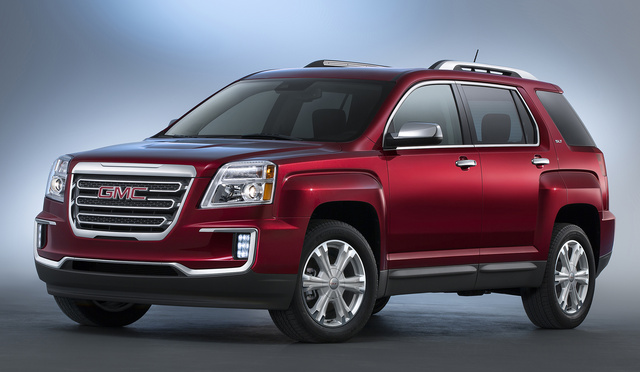
The first-generation Terrain represented GMC’s inauguration into the increasingly popular compact SUV segment. The Terrain replaced the Pontiac Torrent, which was discontinued after just one generation—along with the rest of Pontiac’s lineup. Both the Torrent and the GMC Terrain were closely related to the Chevrolet Equinox, the first generation of which ran from 2005-2009 and the second from 2010-2017.
The first-generation GMC Terrain, launched in 2010, came standard with a 182-horsepower 2.4-litre four-cylinder engine, while a 264-horsepower 3.0-litre V6 was optional. Both engines were mated to six-speed automatic transmissions, while front-wheel drive was standard and all-wheel drive optional. There were two core GMC Terrain trim levels in its first generation. Terrain SLE models came standard with cloth seats, while the Terrain SLT featured the likes of leather seats and remote start.
Unfortunately, both the standard 2.4-litre and optional 3.0-litre engines suffered from serious reliability issues. Models built between 2010 and 2013 were particularly troublesome and known for heavy oil consumption. Multiple class action lawsuits and technical bulletins can be found with a search online. Our suggestion would be to steer clear of these particular GMC Terrain models.
A new 3.6-litre V6 engine with 301 horsepower replaced the problematic 3.0-litre V6 in 2013. This was the only engine offered in the first-generation GMC Terrain that isn’t known for significant reliability issues, so the 3.6-litre V6 is the one we suggest for customers looking at a Terrain built between 2010 and 2017. The 2013 GMC Terrain was also the first version offered in luxurious Denali trim, complete with a large chrome grille up front and extra luxury features and trim inside.
All first-generation GMC Terrain models—which amounted to around 740,000 vehicles in total—were recalled in 2022 due to overly bright headlights. The 2014 GMC Terrain received a Top Safety Pick+ rating from the Insurance Institute for Highway Safety, and the agency lists 2014 and later Terrain models on its list of good used cars for teen drivers.
We don’t recommend the four-cylinder Terrain from the first generation (2010-2017), so look for a Terrain powered by the 3.6-litre V6 engine option if you’re shopping within this era. You should be able to find such an example for between $12,000 and $19,000 with less than 150,000 kilometres on the odometer. Higher-kilometre examples can be found for $10,000 or less.
Related Topics