The Ford Fusion midsize sedan was a much-needed hit right from the start. A decade after giving up the sedan sales lead to Toyota when the lozenge-shaped 1996 Taurus failed to excite consumers, and as GM and Chrysler struggled with mediocre family sedan offerings, Ford stormed back with the sleek, fun new Fusion in late 2005. At the time, Ford owned Mazda and tapped that company’s expertise to create a family sedan that drove as good as it looked, and it came out ahead of the Honda Accord and Toyota Camry in many comparison tests.
That first Fusion, using a name that been previously used on a European Ford crossover, was based on the Mazda6, and fancier cousins, the Mercury Milan and Lincoln Zephyr/MKZ. Unlike the Mazda, both offered hybrid models starting in 2010. Though it did not conquer the Accord or Camry in sales, the first Fusion was well-liked by consumers. But Ford aimed higher with 2013’s second-gen model. Like the largely unloved 1990s Ford Contour, this new Fusion was developed entirely in-house in concert with Ford of Europe, who sold a slightly smaller version as the Mondeo.
Fusion number two looked faintly like a four-door Aston Martin but had room comparable to a Camry. It drove just as well as the original but was better made, meaning fewer reliability foibles over time. It also gained available all-wheel drive and a plug-in hybrid (PHEV) version, some ten years ahead of PHEVs coming into vogue. This new Fusion debuted to serious popularity. But with sedan sales steadily falling in favour of crossovers after that, Ford did not see fit to give us a third generation, at least not yet.
The automaker gave the Fusion significant updates in 2017 and 2019, in the latter case fitting the car with a wide variety of active safety features, including lane-keeping assist and automatic emergency braking. With Ford’s eye on SUVs, the Fusion was discontinued in 2020, but leftover models could still be found on dealer lots even into 2021. Today, Ford’s only car product is the Mustang but used Fusions abound as good deals.
Ford Fusion: Cost, Reliability, and the Best Years to Buy
Frequently Asked Questions
Which Ford Fusion years are the best?
Undoubtedly the newest ones, 2019 and 2020. These are the best-equipped versions, they tend to have the least wear and tear on them, and they have good reliability records according to data from places like Consumer Reports, J.D. Power, and RepairPal. But all of the second-generation models (2013-2020) are fairly reliable machines save for the early Fusion Energi and hybrid models. We’d stick to 2016 or newer if you’re interested in one of those, as there were some mechanical updates that improved transmission reliability on them.
What are the worst Ford Fusion years?
First-generation Fusions tend to be less reliable than their second-generation replacements, and according to places like RepairPal and CarComplaints, the worst years for Fusion complaints are 2010 to 2012. Most issues centre around electrical, steering, and especially brake system issues, but these cars also have a predisposition to rust in very snowy climes like Canada. Early Ford Hybrid batteries and systems also aren’t as robust as their Toyota counterparts, and that’s reflected in the relative rarity and resale values of the first-gen Fusion hybrid.
Is a used Ford Fusion a good deal?
Yes. While the first-gen models aren’t as desirable, the second-gen Fusion is a good car at a good price. In Canada, the latest 2019 and 2020 models can top $25,000 in good shape or with extended warranties, but even among them, it’s possible to find clean, lightly used, sub-10,000-kilometre examples for less than $18,000, and even less for pre-2017s. Bargain hunting requires time, but the Fusion offers a Camry-like experience for less money. The best deals are found on the pure gas models, which are also the most trouble-free Fusions.
Ford Fusion Pros and Cons
Pros:
- Sharp styling, lots of room
- Good driving dynamics in both generations
- Availalbe hybrid and AWD variants
Cons:
- Not as deluxe as its price tag suggests
- First generation model has a below-average repair record
- Non-hybrids lag rivals in MPG
Ford Fusion Generations
Second Generation (2013-2020)
Ford overhauled the Fusion for the 2013 model year, dovetailing its development with the European Ford Mondeo. The new car brought strikingly sharp styling and loads of new tech, including available all-wheel drive (AWD) and the Fusion Energi plug-in hybrid (PHEV) model. A very potent 325-horsepower EcoBoost V6 was added during the car’s 2017 refresh. With that engine, the Fusion Sport was the most powerful mainstream midsize sedan of its era, but most Fusion buyers chose four-cylinders, and many were available.
All through the run the lowest-end engine was the 175-horsepower 2.5-litre Duratec, but there was also a turbocharged 1.5-litre EcoBoost from 2014-2020 (181 hp) and a 1.6-litre EcoBoost four (179 hp) in 2013-2014. Consumers could also choose a 240-hp 2.0-litre EcoBoost Turbo. Hybrid models use a 2.0-litre Duratec four mated with an electric motor for up to 188 hp. Most second-gen Fusions use a six-speed automatic transmission, but a few 1.5s have a six-speed manual, and hybrid models have a continuously variable automatic transmission (CVT).
About 60% of used gas-only Fusions are 1.5s, which is a perfectly acceptable engine and also happens to return the best fuel economy among the gas models, as low as 8.0 litres per 100 kilometres combined. AWD comes only on the top two engines, but the Fusion is a sure-footed, capable-handling machine even in foul weather and in front-drive form. The 2.7-litre Fusion Sport feels truly quick and commands a small price premium, but the other gas engines do not. Hybrid Fusions are also capable drivers, but they feel a little slow.
Over time, the second-generation Fusion also got several advanced driver aids. Ford added lane-keeping assist, blind-spot monitoring with rear cross-traffic alerts, inflatable seatbelts, automatic stop-start, forward-collision warnings, adaptive cruise control, automatic emergency braking, and more. The best-equipped versions are 2019 and 2020 models, which have some of these features standard. There’s plenty of room, too. The second-gen Fusion’s back seat has 973 millimetres of legroom and there’s a 450-litre trunk, more than adequate numbers.
Higher trim levels like the Fusion Platinum and Titanium got luxury-level MSRPs, but Ford was generous with features and tech. Top models like the Ford Fusion Titanium got upgraded infotainment systems, leather seating, rain-sensing wipers, dual-zone climate controls, automatic high beams, a power moonroof, and more. Ford’s SYNC 3 infotainment system was added in 2017, bringing Apple CarPlay, Android Auto, and other features.
Despite all these qualities and a decent reliability record, second-generation Fusions won’t break the bank. The newest models, with odometers under 100,000 kilometres, are still $20,000+ vehicles, especially the final Fusion Sports. But it’s possible to find a wide array of clean, low-mileage 2015 to 2018 Fusions for less than $16,000. We’d steer clear of the early hybrid models unless the deal is very tempting, as the gas models have better repair records, but all of these Fusions are potentially good deals.
First Generation (2006-2012)
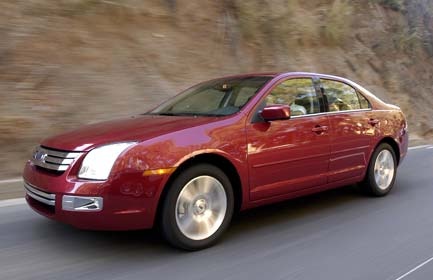
The Fusion entered Ford's automotive lineup with the 2006 model year. Built at Ford's plant in Hermosillo, Sonora, Mexico, the Fusion rides on a platform created by Mazda for the Mazda6 and shared with the Mercury Milan and the Lincoln MKZ. Slotted between the Focus and the Five Hundred (which replaced the Taurus for a short time), the Fusion was the first Ford vehicle to showcase the automaker's distinctive new design style, which continues to this day. The exterior design was inspired by the Ford 427 concept car and highlighted by the three-bar chrome grille and multi-element projector-beam headlights up front.
Upon introduction, the Fusion came in SE and SEL trims in Canada, all powered by a base 160-horsepower, 2.3-litre, all-aluminum DOHC Duratec four-cylinder engine mated to either a five-speed manual or a five-speed automatic transmission. Owners could opt for a 221-hp, 3.0-litre Duratec V6 on both trims. Variable cam timing and electronic throttle control on both engines maximized fuel economy and responsiveness while ensuring low emissions.
The Fusion displayed an exterior design described as athletic by the automaker, with a muscular stance and plenty of room in the cabin for both front- and rear-seat passengers. Emphasis was placed on fuel economy, safety features, and good driving dynamics, as well as on design and interior space.
A stiff chassis ensured responsive handling and minimal flexing, while a four-wheel independent suspension provided a comfortable ride. The Fusion sat on a 2,718-millimetre wheelbase with an overall length of 4,831 mm and a width of 1,834 mm. Those generous measurements for a midsize car, aided by the fact that Ford pushed the C-pillar back as far as possible, ensured ample legroom in the rear seat and plenty of space throughout the cabin. Fortunately, cargo space didn't suffer, with the Fusion offering a respectable 447 litres of space in the trunk.
Inside, standard features for the five-passenger Fusion included front bucket seats, remote keyless entry, a tilting and telescopic steering wheel, cruise control, and a 60/40-split, fold-flat rear seat.
A year after launch, in 2007, Ford added an optional AWD system for V6-powered trims and offered Sirius satellite radio as an option.
In addition, front-seat side and side-curtain airbags became standard on all Ford Fusion trims. Other new standard features included an MP3 input jack, while a DVD-based navigation system was added as an option.
For 2008, antilock brakes and a tire-pressure monitoring system joined the standard equipment list. Late in the 2008 model year, Ford added its SYNC communications and connectivity technology as an option, enabling hands-free access to cell phones and MP3 players through the car's audio system. Other new features for 2008 included an optional colour-configurable ambient interior lighting system and an optional Sport Appearance Package, which included a black chrome grille, a unique spoiler, colour-keyed fog lights, a sport-tuned suspension, red seat inserts, and red stitching on the seats, steering wheel, and console.
Stability control, which improved handling and wheel traction, became an option in 2009. In addition, Ford offered a Blue Suede options package, which included a charcoal black interior, ambient lighting, 18-inch painted wheels, and Alcantara blue-suede seat and door-panel trim inserts.
Related Topics: