The Ford Expedition was created to pick up where the original Bronco left off, but it became the quintessential family hauler. It offers a third row of seats, plenty of passenger space, and a smooth ride thanks to its independent rear suspension, which it offered long before the Chevrolet Tahoe or GMC Yukon. Something else you can get on the modern Expedition but not the GM twins? Adjustable pedals. While the previous generations of GM full-size SUVs offered this feature, it stopped in 2021 with the fifth generation of those vehicles.
All generations of the Ford Expedition are closely related to the Ford F-150 full-size truck, so we see similar styling cues, lots of the same technology, and a shared body-on-frame rear-wheel drive architecture in the two vehicles. For many years, the Expedition has been sold in Canada with standard four-wheel drive (4WD). Since 2007, the Expedition has offered standard and extended-wheelbase models, the latter known as the Expedition Max.
This full-size SUV has always kept in step with modern technology, adding the likes of satellite radio, navigation, Apple CarPlay and Android Auto, 360-degree cameras, and hands-free driving capabilities. Though you wouldn’t necessarily call the Expedition a luxury vehicle, the top-trim models certainly offer luxury amenities such as a Bang & Olufsen sound system, a 15.5-inch infotainment touchscreen, massaging seats, and special leather seating surfaces. However, the Expedition doesn’t offer a hybrid like the F-150.
Ford Expedition: Cost, Reliability, and the Best Years to Buy
- Frequently Asked Questions
- Ford Expedition Pros and Cons
- Ford Expedition Generations
- Ford Expedition Fourth Generation (2018–present)
- Ford Expedition Fourth Generation (2018–2024)
- Ford Expedition Third Generation (2007–2017)
- Ford Expedition Second Generation (2003–2006)
- Ford Expedition First Generation (1997–2002)
Frequently Asked Questions
Which Ford Expedition years are the best?
The fourth-generation Expedition has far fewer customer complaints than the previous generations according to CarComplaints.com, but Consumer Reports repeatedly gives this generation poor predictive reliability, so we’d go back a generation. Overall, the third-generation Explorer has far fewer complaints and recalls than the current one. In fact, 2010, 2011, 2013 and 2014 have zero recalls.
What are the worst Ford Expedition years?
Beyond the fourth generation’s poor predictive reliability ratings from Consumer Reports, the second-generation models have lots of complaints logged by both CarComplaints.com and the U.S. National Highway Traffic Safety Administration. The 2003 model logs more than 1,000 complaints between the two sites, and that vehicle has six recalls. The most frequently reported problem concerns spark plugs blowing out of the head. However, CarComplaints.com com dubs 2004 the worst model year because of engine problems.
Is a used Ford Expedition a good deal?
Full-size SUVs are expensive, and the most recent Ford Expeditions are holding their value fairly well. You’ll have to look back at least three years to start finding any kind of a deal. At the 2022 model year, you can get a top Platinum trim for $30,000 less than the original MSRP, and we think that’s a good deal. If you go back to 2010 to 2014 models, you can get a unit with around 200,000 kilometres on the clock for roughly $8,000 to $15,000. We also think that’s a good deal: a well-maintained Expedition should be good for at least 100,000 kilometres more, and that vintage is holding up well and has zero recalls.
Ford Expedition Pros and Cons
Pros:
- Lots of interior space
- Strong powertrain
- Comfortable seats
Cons:
- Loud on the highway
- Tough to drive in tight spaces
- Max horsepower is dependent on premium fuel
Ford Expedition Generations
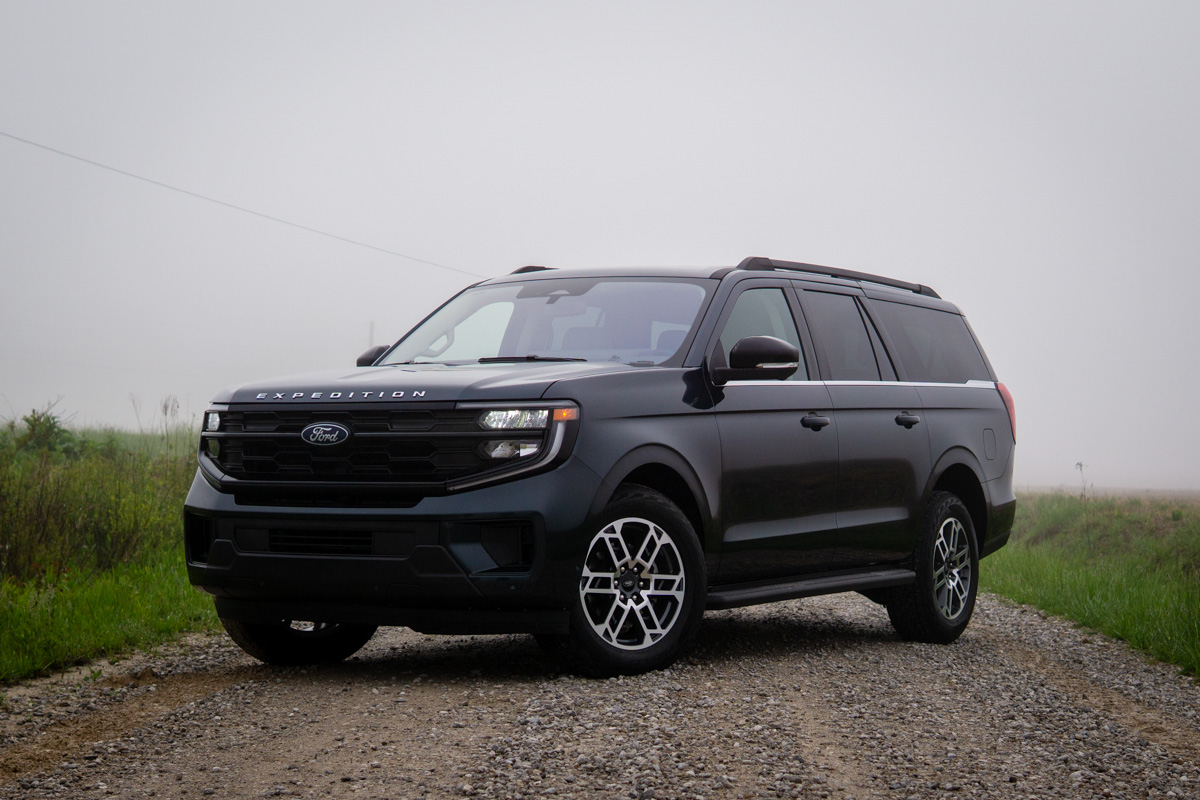
Ford Expedition Fifth Generation (2025–present)
The fifth generation of Ford’s largest SUV launched in late 2024 for the 2025 model year. This fully redesigned model introduced the first-ever Expedition Tremor trim for added off-roading capability. It also added new-to-Expedition technology and convenience features.
The new Expedition Tremor sits third in the 2025 trim line-up, above Active and Platinum and below King Ranch. It comes with 33-inch all-terrain tires on 18-inch alloy wheels, an electronic locking rear differential, class-leading ground clearance of 27 centimetres, skid plates, and additional off-roading features.
The most important technology update is the new Ford Digital Experience, which uses a standard 24-inch panoramic digital display and separate 13.2-inch touchscreen that Ford calls a “family command centre.” The display is customizable with a series of widgets that can be configured using the touchscreen. While the version in the Expedition is smaller, its functionality is similar to the full-width dashboard screens launched in the 2024 Lincoln Nautilus. Wireless Apple CarPlay and Android Auto accompany this setup on all models.
Other developments include a 40-20-40 folding third row bench seat, a new split-gate tailgate with an available seatback, table and shelf for cargo management and leveled-up tailgating, and an available sliding front centre console that lets owners balance storage space for the first two rows.
All 2025 Expedition models come with the equipment to enable BlueCruise, Ford’s hands-free highway driving technology. It can be activated for the life of the vehicle at time of purchase for $3,295 as of this writing, or it can be activated for one year for $650. A 90-day trial is included with all new Expeditions. A one-year trial for the Ford Connectivity Package is also standard, which includes cellular connectivity for the Ford Digital Experience, an unlimited 5G Wi-Fi hotspot, Google Maps, video conferencing functionality, a voice assistant, and built-in karaoke and gaming. Once the trial expires, these features will require a subscription.
The fifth-generation Expedition comes with a long list of standard safety and driver assistance technologies. These include a surround-view camera, front and rear parking sensors, adaptive cruise control with lane centring and stop and go, automatic emergency braking with pedestrian protection and intersection assist, automatic high beams, blind spot monitoring and rear cross-traffic alert with trailer coverage, evasive steering assist, lane keep assist, Pro Trailer Hitch Assist, Pro Trailer Backup Assist, and a rear camera washer.
The 3.5-litre EcoBoost V6 engine carries over from the previous generation and receives a power bump in its default form to 400 horsepower and 480 pound-feet of torque. This engine is standard in the Active, King Ranch and Platinum grades. A high-output version with 440 hp and 510 lb-ft of torque is standard on the Tremor and available with the Platinum. A 10-speed automatic transmission is the default on all models, and four-wheel drive (4WD) continues to be standard in Canada.
When properly equipped, the current-gen Expedition can tow up to 3,175 kilograms (7,000 pounds) without a load-leveling bar and up to 4,350 kilograms (9,600 pounds) with a weight distributing hitch.
The Insurance Institute for Highway Safety give the current Expedition a Marginal rating in its Small Overlap Front and Moderate Overlap Front crash tests, which are somewhat concerning results. Of particular note, the structure and safety cage and driver’s foot protection are both rated as Poor, the Institute’s lowest score. The U.S. National Highway Traffic Safety Administration (NHTSA) has not yet rated the 2025 Expedition.
Since the 2025 Ford Expedition is brand new as of this writing, there are not yet enough examples on the used car market to assess pricing trends.
Ford Expedition Fourth Generation (2018–2024)
Still based on the Ford F-150 truck, the fourth-generation Ford Expedition moved to the T3 platform, which uses a new four-wheel independent suspension design. This Expedition still features a body-on-frame architecture but now uses high-strength, lightweight material consisting of boron steel and aluminum.
It’s an eight-passenger, three-row SUV, while a seven-passenger seating option is available. There were three trim levels at launch: Ford Expedition XLT, Limited, and Platinum. The extended-wheelbase model continued as the Ford Expedition Max.
In addition to increased ground clearance and extensive interior and exterior design tweaks, the fourth-generation Expedition also got a serious tech upgrade. New available features include a 360-degree camera, park assist, automatic emergency braking, lane keep assist, adaptive cruise control, blind-spot monitoring, USB ports, Apple CarPlay/Android Auto compatibility, and Ford Sync 3.
There’s also an electronic locking rear differential available for the four-wheel drive (4WD) system. A Terrain Management System adapted from the Ford Raptor has seven drive modes: Normal, Eco, Sport, Tow/Haul, Gravel/Snow, Mud/Ruds, and Sand. Another new big bit of tech is the semi-autonomous Pro Trailer Backup Assist system, which allows the Expedition to reverse itself with a trailer coupled. The driver controls the system with a dial, and the Expedition steers and limits its reversing speed.
Though the EcoBoost 3.5-litre V6 was carried over from the previous generation, it gets a power boost, now delivering 375 horsepower. It can also tow a maximum of 4,210 kilograms (9,300 pounds) when fitted with the heavy-duty trailer tow package. The old six-speed transmission was replaced by a new 10-speed automatic.
The Expedition King Ranch trim returned for 2020 as the range topper, but it was 2022 that heralded the mid-cycle refresh. This included revised front styling, a new interior, a digital gauge cluster, larger 12- or 15-inch infotainment screens, Sync 4, available GPS navigation, an optional BlueCruise hands-free driving system, a new off-road oriented Expedition Timberline trim with all-terrain tires, and a Ford Expedition Limited Stealth Edition package that included a high-output of the turbo V6 engine.
With all its modern technology, the fourth-generation Expedition won’t necessarily come cheap, but it can be a very good deal if you go for an early example. The average price for the top-end 2018 Expedition is just over $40,000. Later models are pricier, but you’ll still often see $20,000 or more off the original MSRP. This isn’t a common vehicle in Canada, so be prepared for a lack of selection in your local area and note you may need to travel if you’re looking for a specific configuration.
Ford Expedition Third Generation (2007–2017)
The third generation of the Ford Expedition saw big changes, including the addition of the extended-wheelbase Expedition Max. While it was known by this name from the start in Canada, you may sometimes see it called the Expedition EL, which was the early designation for extended-wheelbase Expeditions in the U.S.
The Expedition was still based on the F-150 and, as the truck had switched to the new T platform, so did the SUV. This T1 platform replaced the one going back to the original model, and it incorporated four-wheel independent, long-travel suspension with all-new, five-link rear suspension and new rear lower control arms for improved damping.
The exterior has more of an F-150 vibe with its similar blocky headlamps. Inside were redesigned seats, a new dashboard, a new centre console, updated electronics, and a more powerful air conditioning system. This generation also added an MP3 player input jack and Sirius Satellite Radio. To help make the interior quieter, the Expedition received a SoundScreen laminated acoustic and solar-tinted windshield, as well as thicker laminated side-window glass. There were three Expedition trim levels available at launch: XLT, Eddie Bauer, and Limited.
The third-gen Expedition carried over the 5.4-litre V8, but it added a new six-speed automatic transmission. This generation could tow up to 4,170 kilograms (9,200 pounds) when properly equipped.
In 2008, the Expedition added available power running boards and a rearview camera, and the King Ranch trim was reintroduced to the lineup. The following year saw some tech upgrades, including the availability of Ford Sync, an LCD touch screen on the console on navigation-equipped models, and Bluetooth phone compatibility. In 2011, Ford dropped the King Ranch trim in Canada and made the long-wheelbase Max available only in Eddie Bauer trim.
The third-gen Ford Expedition was significantly refreshed for 2015. They included new suspension options and styling upgrades, a 365 hp, 3.5-litre twin-turbocharged V6 that replaced the old V8, and a new Ford Expedition Platinum trim. The infotainment system was upgraded to Ford’s latest MyFord Touch with a standard eight-inch screen.
New optional equipment included blind-spot monitoring with rear cross-traffic alert and infotainment apps that helped with towing and off-roading. The final two years of this generation had no major changes, except that Ford upgraded its infotainment system to Sync 3. With 10 years under its belt, this generation has a wide used price range from 300,000-kilometre finds priced at $7,000, to $28,000 for a 2017 Limited Max with 130,000 kilometres. On average, expect to pay between $10,000 and $18,000, and know that most units will have 200,000 kilometres or more on the odometer.
Ford Expedition Second Generation (2003–2006)
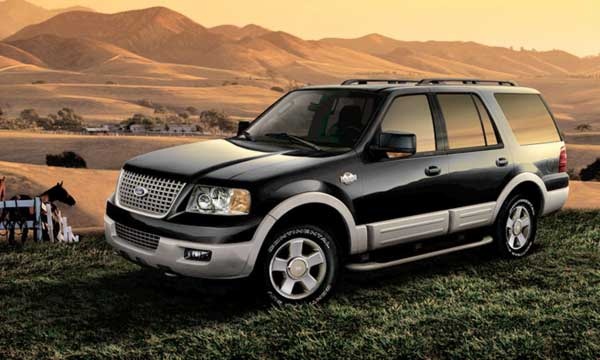
The second-generation Ford Expedition still shared a platform with the Ford F-150, and one of the biggest innovations was the new four-wheel, independent, long-travel suspension system. This made the Expedition the first full-size SUV with fully independent suspension. The worry at the time was that the Expedition’s towing capacity would be affected, but because of the hydroformed fully boxed frame, towing capacity actually increased by 360 kilograms (800 pounds) to 4,030 kilograms (8,900 pounds), while payload also increased to 732 kilograms (1,614 pounds).
To help with towing, this generation of Expedition also got new steering, braking and electronic systems to help the full-size SUV better control hefty trailers. The V8 engines were carried over from the previous generation but were tweaked to improve fuel economy.
As a part of the new generation, the exterior of the Expedition featured a new grille, headlights, front and rear fascia, tail lamps, and liftgate. The interior got a new dash, door panels, and carpeting. Trims available at launch included the XLT, the FX4, and Eddie Bauer. Another big innovation for this generation was the fold-flat, stow away third-row seats, while power folding third-row seats were an option. Other options included rear-seat DVD entertainment, parking sensors, power-adjustable pedals, and a power moonroof. In terms of advanced safety technology, this generation Expedition introduced AdvanceTrac electronic stability control with traction control as an option. In 2005, this system expanded to include roll stability control.
There were no design changes in 2004, but it’s worth noting that the FX4 trim was dropped in Canada. In 2005, the Expedition got new roof rails and a new Limited trim. The 4.6-litre V8 was dropped, and the 5.4-litre Triton V8 became the standard, and only, engine.
Canadian winters have done their work on this generation of Expedition, and it’s now very rare on our used vehicle market. If you do find an Expedition of this vintage worth picking up, you should be able to do so for $5,000 or less.
Ford Expedition First Generation (1997–2002)
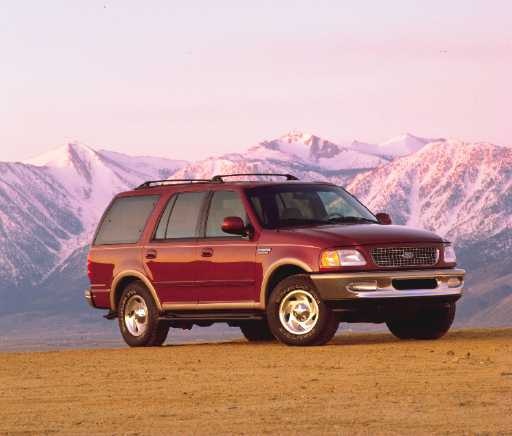
The first-generation Ford Expedition replaced the discontinued two-door Ford Bronco. Like the Bronco, it was based on the Ford F-150, but had four doors and offered the likes of optional three-row seating for up to nine passengers, first-row captain’s chairs, leather seats, illuminated running boards, heated sideview mirrors, power moon roof, and dual-zone climate control. Similarly to the F-150, the base trim was an XLT.
Because it was based on the F-150, the Expedition featured a body-on-frame construction, and was also was available with automatic full-time ControlTrac four-wheel drive with a two-speed transfer case and center multi-disc differential. It also introduced an optional, electronically controlled pneumatic air suspension system, which could raise and lower the vehicle depending on road and load conditions.
This generation was rear-wheel drive as standard, while four-wheel drive was available. It offered two V8 engines of 4.6 and a 5.4 liters, and the only transmission was a four-speed automatic.
This Expedition got a mid-cycle refresh in 1999, comprising a new grille and new front bumper that incorporated the fog lamps into the lower valance on the exterior, along with a new dashboard, gauge cluster, radio, and HVAC controls inside. This was also the year Expedition got a digital odometer for the first time. and the V8 engines got a little more power.
Kelley Blue Book stated that the national average transaction price for a vehicle of this generation ranged from $2,000 and $3,000, and we saw listings from $1,000 for a high-mileage model in fair condition to $19,000 for an Eddie Bauer with the flagship engine in excellent condition.