The Chevrolet Volt was well ahead of its time. When the first generation came on the scene for 2011, it was a truly novel new car—an extended range electric vehicle (EREV) before the term was coined. It was a difficult concept to swallow because it had an engine and you put gas in it, but the gas engine served purely as a generator and electric motors powered the wheels. Things got even more confusing when the second generation came out with a plug-in hybrid powertrain. Though it could operate in all-electric mode with zero tailpipe emissions, the engine sent power to the wheels when it took over.
The end result was the same, though, and it provided significantly more EV range than other plug-in hybrid vehicles of the time. At the end of the Chevy Volt’s life, all-electric vehicles were starting to take off, spurred by Tesla’s success. The Chevrolet Bolt EV edged out the Volt as General Motors pledged—then backed off from—an imminent all-electric future. The Volt still paved the way for today’s Blazer EV and Equinox EV, though.
Ironically, as the electric car craze has stalled, hybrid and plug-in hybrid sales have started to rise. General Motors announced a new plug-in hybrid for 2027, but there’s little in the way of details. We can guess it won’t be a new version of the Volt, which is too bad in our book because the Volt was a darn good car.
That makes it an excellent consideration as a used vehicle right now because you can cash in on the PHEV craze without paying full price. And if you opt for a second-generation model, you’ll get a lot of modern amenities to go with it.
Chevrolet Volt: Cost, Reliability, and the Best Years to Buy
- Frequently Asked Questions
- Chevrolet Volt Pros and Cons
- Chevrolet Volt Generations
- Chevrolet Volt Second Generation (2016–2019)
- Chevrolet Volt First Generation (2011–2015)
Frequently Asked Questions
Which Chevrolet Volt years are the best?
If you’re looking at one of the original EREV Chevrolet Volts, the 2014 and 2015 model years receive the fewest complaints and recalls of that generation, according to the U.S. National Highway Traffic Safety Administration (NHTSA). Consumer Reports shows owner satisfaction is higher than average for those two model years. If you want a more current model, 2019 is the year to buy. Even though there were two recalls, it has the fewest complaints and owner satisfaction gets top marks. Plus, it has Apple CarPlay and Android Auto.
What are the worst Chevrolet Volt years?
According to CarComplaints.com, the 2017 Volt is the worst year. It has the most complaints of any model year by far, and it’s one of two model years for which Consumer Reports shows less-than-average owner satisfaction. Loss of power steering while driving is the biggest complaint.
Is a used Chevrolet Volt a good deal?
If you’re looking for electrification with modern amenities, the Chevrolet Volt could be a good deal. Looking at the 2019 model year, current prices for used vehicles are 50% or more off the original MSRP, so you’ll pay between $16,000 and $20,000 and potentially less if you’re willing to take one with a higher odometer reading. If you’re okay with an older model and go with the first generation, many cars are priced at less than $10,000.
Chevrolet Volt Pros and Cons
Pros:
- Electric-only power for short distances
- Perfect size for urban streets
- Lots of standard features
Cons:
- Cramped rear seats
- Small cargo area
- Cheap interior materials
Chevrolet Volt Generations
Chevrolet Volt Second Generation (2016–2019)
In addition to a complete redesign, the second-generation Chevrolet Volt had different electrical architecture and became more of a plug-in hybrid than a range-extended electric vehicle. For the 2016 to 2019 models, engine torque was sent directly to the wheels through a mechanical connection, which boosted the Natural Resources Canada-estimated all-electric range to 85 kilometres.
Other big changes of note for this generation were that it seated five, it got Apple CarPlay and Android Auto, and it could run on regular fuel.
This second-gen Volt was equipped with an 18.4 kWh lithium-ion battery pack, a dual-electric motor/generator, and a front-wheel drive drivetrain. The engine became a 1.5-litre inline four, horsepower remained the same at 149, and torque increased to 294 pound-feet. Fuel economy improved, too, with estimates of 5.6 litres per 100 kilometres combined and 2.2 litres-equivalent per 100 kilometres in electric mode, while the total range (gas and electric powertrains combined) jumped to 591 kilometres. A full charge took about 4.5 hours on a 240-volt plug and about 13 hours on a standard 120-volt plug.
The second-generation had two primary trim levels: the Volt LT and the Volt Premier. At launch, the LT trim was fitted with the likes of automatic climate control, remote start, passive entry, heated front seats, a heated steering wheel, a built-in Wi-Fi hotspot, an eight-inch infotainment touchscreen display, a rearview camera, and cruise control. Available features included heated rear seats, leather upholstery, wireless phone charging, ambient lighting, blind-spot monitoring, lane departure warning, and automatic emergency braking.
There was no major refresh or redesign, but full-range adaptive cruise control and Chevrolet’s Teen Driver safety suite were added in 2017. The final model year, 2019, saw the biggest changes, with the addition of a newly available 7.2-kW onboard charging system for faster charging times, an HD rearview camera, an available power driver’s seat, and a new front and rear pedestrian alert system.
Volts of this generation are more abundant, but you’ll probably still have to travel for them. The good news is they offer a lot of modern technology and safety features and max out at about $21,000. If you want less than 100,000 kilometres on the vehicle, you’ll spend at least $15,000, but if you’re okay with a higher odometer reading, you should be able to find something in good condition for around $10,000.
Chevrolet Volt First Generation (2011–2015)
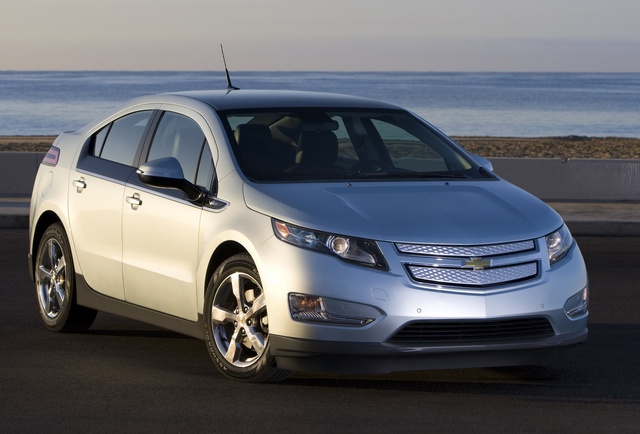
The first-generation Chevrolet Volt helped to usher in the era of electrification. It operated as a pure electric vehicle up to about 56 kilometres, then the gas engine generator kicked in to charge the battery, which powered the motors. It was therefore considered more of an electric vehicle than a plug-in hybrid because the electric motors, not the gasoline engine, sent power to the wheels.
The first-gen Volt had a 16 kWh lithium-ion battery and the electric motor delivered 149 horsepower and 273 pound-feet of torque. The range-extender was a 1.4-litre, 84-horsepower, four-cylinder engine which, when engaged, added 494 kilometres of extra range. Fuel economy was 6.4 L/100 km combined when the range-extender was active and 2.5 Le/100 km in all-electric mode. It also had regenerative braking, which contributed to on-board electricity generation and increased efficiency. It was front-wheel drive only, had a single-speed, direct-drive transmission, and required premium fuel.
As a hatchback with seating for four, the Volt essentially had just one trim level, but it offered a premium trim package and a rear camera and park assist package. At launch, it included standard features such as a seven-speaker Bose audio system, navigation, USB connectivity, and a 60 MB hard drive with 30 MB of space for music. Available features included a rear camera, heated front seats, front and rear parking sensors, and leather seats.
With just a five-year span, the first generation Volt didn’t get a mid-cycle refresh, but it benefitted from continuous improvement each year. It got push-button start in 2012, as well as Bluetooth steaming audio capability. In 2013, it got a “hold” mode that allows the driver to save electric power for when it was most efficient, and the range estimate increased to 61 kilometres. In 2015, it got 4G LTE, which enabled the vehicle to become a Wi-Fi hotspot with an active subscription.
Used first-gen Chevrolet Volts are available, but nearly all of them are in Ontario and Quebec and you’ll probably need to travel to find one. The good news is, nearly all of them were advertised for less than $15,000, and you might even be able to find one with under 100,000 kilometres in good condition for $12,000 or less.