The BMW 7 Series is the German automaker’s flagship full-size sedan. Along with its archrival, the Mercedes-Benz S-Class, plus fellow luxury contenders such as the Audi A8, the Lexus LS, and arguably the Porsche Panamera (even though it’s a four-door coupe), the 7 Series has always been at the cutting edge of automotive technology, even if the design has been fairly conservative. It had an on-board computer and a Dictaphone back in the 1980s, adopted safety technology such as rear-view cameras well before the masses, and incorporated night vision and smart keys in the early 2000s.
Another big selling point for the BMW 7 Series sedan is its variety of powertrains, because it has had it all. It added a hybrid for 2011, moved into plug-in electric hybrids for 2017, and then added a battery electric vehicle for 2023. A diesel option was even offered in Canada for a single model year in 2015.
The 7 Series has grown longer, larger, and more luxurious over time. Now in its seventh generation, it’s the pinnacle of a powerful luxury sedan and leans into the brand’s sporting nature.
BMW 7 Series Buying Guide: Cost, Reliability, and the Best Years to Buy
- Frequently Asked Questions
- BMW 7 Series Pros and Cons
- BMW 7 Series Generations
- BMW 7 Series Seventh Generation (2023–Present)
- BMW 7 Series Sixth Generation (2016–2022)
- BMW 7 Series Fifth Generation (2009–2015)
- BMW 7 Series Fourth Generation (2002–2008)
- BMW 7 Series Third Generation (1995–2001)
- BMW 7 Series Second Generation (1986–1994)
- BMW 7 Series First Generation (1977–1986)
Frequently Asked Questions
Which BMW 7 Series years are the best?
German vehicles have a reputation for being expensive to maintain, so as long as your heart isn’t set on an older 7 Series, newer is better when it comes to reliability. There were no recent complaints listed on CarComplaints.com at the time of writing, and Consumer Reports gave the new BMW 7 Series an average predictive reliability rating. EnginePatrol.com says models built from 2020 have higher reliability and do better in owner satisfaction scores.
What are the worst BMW 7 Series years?
There is one year with several issues: 2012. It has the most overall complaints according to CarComplaints.com, and the most frequently reported problem is a seized engine. Early 2000s cars also had a flurry of powertrain problems, radiator issues, and coolant system troubles. In short, fourth-generation models are best avoided.
Is a used BMW 7 Series a good deal?
The BMW 7 Series has a huge problem with depreciation, which is bad for those selling a new BMW but great for used buyers. So, yes, we think the BMW 7 Series can be a good deal. Take the 2021 7 Series as an example; it was at least $120,000 Canadian when new but used examples with reasonable odometer readings are listed for roughly $50,000.
BMW 7 Series Pros and Cons
Pros:
- Strong engines
- Comfortable but sporty ride and handling
- Excellent rear passenger room
Cons:
- Expensive options
- High depreciation
- Poor turning circle
BMW 7 Series Generations
## BMW 7 Series Seventh Generation (2023–Present) The current BMW 7 Series began production in 2022 for the 2023 model year and had the internal designation G70. This generation marks the electrification of the entire 7 Series lineup, as it now consists of 48-volt mild hybrids, a plug-in hybrid, and a zero-emission all-electric model known as the BMW i7.
The seventh generation did away with the long-wheelbase designation for the 7 Series as that’s now the only option in North America. It’s a full 13 centimetres longer than the long-wheelbase model from the previous generation. This version sports the biggest grille to date and adopts the same split-headlight treatment seen on the BMW X7. The i7 even features Swarovski crystals as headlamps. Both the 7 Series and the i7 are sold in Canada with BMW’s xDrive all-wheel drive (AWD) drivetrain as standard.
It’s a proper luxury car, and the interior is brimming with tech. This includes what BMW calls a Live Cockpit setup, which combines a 12.3-inch digital cluster with a 14.9-inch curved infotainment display. It offers wireless Apple CarPlay and Android Auto, over-the-air updates, in-car gaming, a standard head-up display, quad-zone climate control, USB-C charge ports, front seat massagers, a panoramic glass roof, an available 31-inch ‘theatre screen’ with 5G connectivity and built-in Amazon Fire TV, and a host of driver assistance features. For the first time on a 7 Series, BMW offers a leather-free configuration, while the good old M Sport package adds uprated brakes and sports styling features.
There’s double wishbone aluminum suspension at the front, integral-V multilink aluminum suspension at the rear, adaptive air suspension, active anti-roll bars, and all-wheel steering (known as BMW’s Integral Active Steering).
As for specs, the 4.4-litre V8 engine in the 760i delivers 544 horsepower and is fitted with a 48-volt mild hybrid system to boost fuel economy. The 483 hp 750e plug-in hybrid has a 3.0-litre inline-six paired with an electric motor, along with an estimated electric-only range of 55 kilometres.
In Canada, the i7 offers two variants: the i7 xDrive60 and i7 M70 xDrive sedan. Power output for the two models is 536 hp and 650 hp respectively. The i7 comes with a CCS port and can charge from 10 to 80 percent in about 30 minutes using a DC fast charger, and electric range is 431 to 500 kilometres respectively, depending on the powertrain and configuration.
As the latest 7 Series is still relatively new, used examples are hard to find, but they can present solid discounts versus a new model. Units listed at CarGurus.ca with reasonable odometer readings were priced between $100,000 and $120,000 as of this writing, which means a minimum saving of $35,000 versus a base 2025 750e.

BMW 7 Series Sixth Generation (2016–2022)
The sixth-generation BMW 7 Series continued with standard- and long-wheelbase models, dubbed the G11 and G12, respectively. This version was based on the BMW CLAR (cluster architecture) platform and had a passenger cell made of carbon-fibre-reinforced polymer (CFRP), tensile steel, and aluminum, which resulted in this generation dropping 40 kilograms (88 pounds). It had an even larger kidney grille, which incorporated grille shutters to increase airflow to the engine and boost aerodynamics.
It was the first 7 Series to have four-wheel steering (BMW’s Integral Active Steering) and featured an upgraded iDrive system with gesture controls and touchscreen capability, an LED “light carpet” or puddle lamp to illuminate your entry, ambient lighting, a standard rear-view camera, and parking sensors. This was also the first generation of BMW 7 Series available as a plug-in hybrid.
This BMW 7 Series launched in Canada in 2016 with a 450 hp, 4.4-litre turbo V8. For 2017, a plug-in hybrid arrived fitted with a turbocharged 2.0-litre inline-four mated to an electric motor for a combined 325 hp. A V12 engine returned in 2018 delivering 610 hp. Every powertrain received a power upgrade in 2020, and the plug-in hybrid swapped out the inline-four for an inline-six with a combined power output of 395 hp that same year. The last V12 appeared in 2022.
The sixth-gen BMW 7 Series received a facelift for the 2020 model year, including an even larger kidney grille, sleeker headlights, optional laser headlights, an available hands-free driving system, LED taillights, a 12.3-inch instrument cluster, a 10.25-inch infotainment screen, and an upgraded iDrive system with a voice assistant.
Given that these were six-figure cars when new, used vehicle prices are surprisingly reasonable. Expect to pay between $25,000 and $65,000 for a used sixth-generation 7 Series in Canada, with the low end of that range being base models and the high end being the ultra-luxury Alpina B7.
BMW 7 Series Fifth Generation (2009–2015)
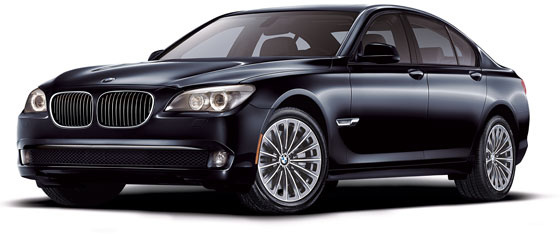
The fifth-gen BMW 7 Series, known internally as the F1, had relatively subtle styling. It got a bigger kidney grille, sleeker headlights, and gained almost five centimetres in length.
Continuing the tradition of firsts, this generation was the first BMW to get an available hybrid powertrain, an eight-speed transmission, and a turbocharged V12 engine, known as the BMW 760i. It was also available with rear-wheel steering, all-wheel drive (xDrive), pedestrian recognition within the night vision system, blind spot monitoring, massaging rear seats, and adaptive cruise control with stop-and-go functionality.
There were two engine options at launch—a 402 hp, 4.4-litre twin-turbo V8, and a 536 hp, 6.0-litre V12. In the mid-cycle refresh of 2013, a 315 hp twin-turbo inline-six joined the line-up, and the V8 was replaced with a 444 hp twin-turbo. The hybrid hit the scene in 2011 with a 4.4-litre twin-turbo V8 and a combined power output of 455 hp. It was replaced in 2013 with a 3.0-litre turbo inline-six, which had a lower combined power output of 349 hp. A diesel engine—a 315 hp 3.0-litre turbo inline-six—was offered for just one model year in Canada in the 2015 740Ld.
The mid-cycle refresh rolled out in the middle of 2012 for the 2013 model year. Other than the engine changes already noted, it also brought full-LED headlamps, a revised kidney grille and headlights, standard self-leveling air suspension, automated parking assist, driver drowsiness detection, and automatic emergency braking.
The fifth-generation 7 Series is somewhat scarce on the Canadian used car market, but it is very affordable, averaging from just over $10,000 to $20,000 for serviceable examples.

BMW 7 Series Fourth Generation (2002–2008)
The fourth-generation BMW 7 Series launched in the fall of 2001 at the Frankfurt Auto Show. It was known for its controversial styling, overseen by designer Chris Bangle, and a lot of interesting tech. Dubbed the E65 (standard wheelbase) and E66 (long wheelbase) internally, this 7 Series had an elongated rear decklid that was nicknamed “the Bangle Butt” by critics. It was nearly five centimetres longer and four centimetres wider than the E38 it replaced, but only 15 kilograms (33 pounds) heavier.
The E65 7 Series was the first BMW to include the iDrive infotainment system and also moved the traditional console-mounted gear shifter to a stalk on the steering column. In its place, BMW added two front cup holders. And yes, this meant the only transmission available throughout this generation was a six-speed automatic. Other new features included active anti-roll bars, an electronic smart key, and night vision.
Out of the gate, the fourth-gen BMW 7 Series had a pair of engines: a 4.4-litre V8 with 325 hp, and a 6.0-litre V12 with 438 hp. The original V8 was replaced with a larger and more powerful 362-hp 4.8-litre at the mid-cycle refresh in 2006. The facelift included revised front and rear styling, an updated iDrive system with clearer graphics, and upgraded adaptive cruise control.
Listings for this generation are scarce in Canada, while prices are generally $10,000 or less.

BMW 7 Series Third Generation (1995 – 2001)
Continuing with the innovative spirit, the third-generation BMW 7 Series was the first car available with curtain airbags, the first European car to offer satellite navigation, the first BMW with a built-in television, and the first 7 Series available with a diesel engine (offered in other markets). It was also the last generation with a manual transmission.
Similar to the second-gen model, the E38 BMW 7 Series offered both standard and long wheelbase (iL) sedans. The 740i/iL initially carried over the BMW M60 engine with four additional horsepower, but it was replaced in 1996 by a 286-hp 4.4-litre V8. The 750i/iL upgraded to a 5.4-litre 326-hp V12.
The primary transmission for the E38 was a five-speed automatic, but a six-speed manual was available with the 740i.
The E38 was facelifted for the 1999 model year, which comprised revised styling for the headlights and taillights, an available sport package, standard electronic stability control, and standard head airbags.
We found exactly one third-generation 7 Series listed on CarGurus.ca in our research for this guide—a 1998 740iL with 172,000 kilometres priced at $12,000.

BMW 7 Series Second Generation (1986 – 1994)
Production of the second-generation BMW 7 Series—known as the E32—kicked off in 1986. This generation introduced a lot of BMW firsts, including electronic damper control, xenon headlights, traction control, and dual-zone climate control.
The E32 was available in long-wheelbase versions (indicated by an “L”) and had an extra roughly 11.5 centimetres of legroom. It had L-shaped taillights and circular headlights, plus BMW’s trademark Hofmeister kink in the rear window line.
Initially, E32 7 Series models were available with a pair of BMW M30 inline-six engines, and the launch versions consisted of the 730i/iL and 735i/iL, available with either a four-speed automatic or a five-speed manual transmission. The 750i/Li, released in 1987, was also considered a launch model, and it was the first BMW with a V12 engine since World War II. This 5.0-litre M70 engine delivered 295 horsepower and was only available with a four-speed automatic transmission. In 1992, the 7 Series got BMW’s first V8 engine since the 501/502, which was last produced in 1962. This M60 engine was found in the 740i/Li, delivered 282 horsepower, and only had a five-speed automatic transmission
The second-generation BMW 7 Series is all but extinct in Canada today. Classics.com shows U.S. auction sale prices of USD$2,000 to USD$44,000 for this 7 Series, while the average sold price hovers around USD$10,000.

BMW 7 Series First Generation (1977 – 1986)
The first-generation BMW 7 Series followed the New Six sedan series, also known as the E3, which was produced from 1968 to 1977. Unveiled in 1977, the 7 Series, known as the E23 internally, featured inline six-cylinder engines and an inward-sloped grille that gave it a shark nose profile. This generation introduced lots of electronic features, including an on-board computer, warning lights, and a Dictaphone. It was also the first BMW to offer anti-lock brakes.
Initially, the E23 BMW 7 Series had three inline-six engine options—a 150-hp 2.5 in the 725, a 170-hp 2.8 in the 728, and a 184-hp 3.0 in the 730. A 177hp 3.2 was added in the 733i in 1978, and the 725, 728, and 730 were ditched in 1979. The 733i was replaced by the 735i in 1985, which was equipped with a 218-hp 3.4-litre engine. The 725 and 728 had three-speed automatic and four-speed manual transmission options, the 730 offered four-speed automatic and manual transmissions, and both the 733i and the 735i offered three-speed automatic and four-speed manual transmissions.
The first-generation BMW 7 Series got a mid-cycle refresh in 1983, which included a wider “kidney” grille, new bumper bars, and a new instrument cluster. The rear suspension was also updated. In 1985, the E23 received an optional driver’s side airbag and redesigned front suspension.
As of this writing, there were no first-generation BMW 7 Series units available on the used car market in Canada. In the U.S., Classics.com recorded sold prices of USD$550 to USD$200,000 for cars of this generation, but the average prices were typically USD$12,000 to USD$13,000.