The BMW M4 has existed as a nameplate since 2014, but it has plenty of history as the successor to a line of legendary performance cars stretching back to the first BMW M3 of 1986. BMW’s decision to rename the coupe and convertible versions of the 3 Series as the 4 Series from the sixth generation onwards saw the switch to an M4 badge for the high-performance variant, while the M3 continues in sedan form.
Arriving a year or so after the standard 4 Series, the first-generation BMW M4 got the usual treatment by BMW’s famous M Division. That meant major chassis and bodywork changes, special alloy wheels, and a bespoke and hugely powerful engine. While the previous M3 had switched to a V8, the M4 saw a return to an inline six-cylinder engine, although this time with a twin-turbo setup for a mighty 425 horsepower.
With a choice of a six-speed manual transmission or a seven-speed M-DCT (dual-clutch) transmission and rear-wheel drive (RWD) as standard, the M4 faithfully followed the ethos of previous high-performance BMWs. Some high-tech innovations and refinements were added but, at heart, the M4 is a brutally quick car aimed at enthusiastic drivers. As usual, some hardcore versions were added later in the model run, aimed at those after an even more visceral feel on the road or the racetrack.
The second-generation BMW M4 arrived in 2021. While it has the classic BMW M division makeover, the exterior—as with the equivalent 4 Series—is notable for its shift away from traditional BMW styling elements and for its huge vertical twin kidney grilles. Power comes from an uprated twin-turbocharged 3.0-litre inline-six engine, with a choice of six-speed manual or conventional eight-speed automatic transmissions. The big news this time round was the option of all-wheel drive (AWD) for the M4 Competition models that arrived later in 2021.
Our guide to the BMW M4 has the lowdown on which models you can buy, the best and worst versions, and how much you can expect to pay.
BMW M4 Buying Guide: Cost, Reliability, and the Best Years to Buy
Frequently Asked Questions
Which BMW M4 years are the best?
If the in-your-face grille doesn’t bother you, the second-generation BMW M4 is your best bet. It’s a thrilling car to drive and comes with all the high-tech refinements of a contemporary luxury model.
What are the worst BMW M4 years?
There are no major worries but, as with most cars, the earliest models in the BMW M4’s production run are those that seem most prone to subsequently corrected issues.
Is a used BMW M4 a good deal?
There are a few other coupes and convertibles that offer similar performance to the M4, but the BMW is hard to beat for its well-rounded dynamics and involving feel. It’s a good deal if you can find one that’s been well cared for because these cars hold their value well and make decent long-term investments.
BMW M4 Pros and Cons
Pros:
- Incredibly quick and fun to drive
- Practical for a car with such extreme performance
- Every version is well-equipped
Cons:
- High-spec versions are expensive
- Second-generation’s brash styling not for everyone
- First-generation convertible has a small boot
BMW M4 Generations
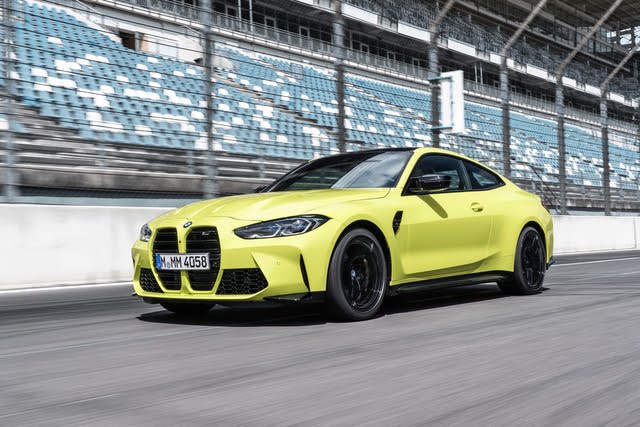
Second Generation (2021-present)
As with its 4 Series counterpart, any discussion about the merits of the new BMW M4 introduced in 2021 tend to revolve around its exterior design, specifically its huge, vertically oriented grille. That said, the grille and the latest version’s muscle-car-like profile are arguably better suited to the M4’s intrinsically brutish character. The usual “M” makeover includes wider bodywork with extra air vents and tweaks inspired by BMW’s race cars. An optional M carbon package adds even more motorsport vibes with additional carbon fibre reinforced plastic (CFRP) elements.
Looks aside, the latest M4 kicks off where the previous one left off, with power from a twin-turbocharged 3.0-litre inline six and a choice of two-door coupe or convertible body styles. The high-grade interior includes heated M sport seats and leather trim, while lighter M Carbon bucket seats are an optional extra. As you’d expect, it’s a much more high-tech interior than you’ll find in the first M4, with wireless support for Apple CarPlay and Android Auto, a 12.3-inch driver display, and a 10.25-inch centre display.
Power for the standard models is up by 48 to 473 horsepower, but torque remains the same as the first-generation’s 406 lb-ft. Competition models are punchier with 503 horsepower and 479 lb-ft of torque, increases of 59 hp and 73 lb-ft respectively. While standard versions have a six-speed manual transmission, the BMW M4 Competition models have an eight-speed automatic transmission as standard.
One major technical change is the availability of all-wheel drive (AWD) for the first time for any M3 or M4 model. Branded M xDrive, it’s an option for M4 Competition models only. BMW’s Adaptive M Suspension—which allows you to choose between different settings for the electronically controlled dampers—is standard.
A (very) limited-edition M4 CSL was introduced in 2022. It features a boost in power to 543 horsepower, chassis mods, and a weight reduction of 108 kilograms (240 pounds) thanks partly to the removal of its rear seats. The M3 CS, another limited-edition model with a similar range of upgrades to the CSL and the same power output, was introduced in 2023.
An update in early 2024 for the 2025 model year brought the M4 into line with other 4 Series models. Changes included updated headlight and taillight lenses and a switch to the “BMW Curved Display” for the dashboard, which combines a 12.3-inch driver display and a 14.9-inch centre display to form one large screen that curves towards the driver. Other changes include new alloy wheel and steering wheel designs and a 20-horsepower boost for M4 Competition xDrive Coupe and Convertible models, taking them to 523 horsepower.
The second-generation BMW M4 has a good reliability record so far, and owners haven’t raised any issues on carcomplaints.com. BMW was among the top 10 car brands in the 2024 Consumer Reports predicted reliability survey and has performed solidly in similar surveys in recent years.
The MSRP for the BMW M4 started at just over $85,000 before fees when it went on sale in 2021 and it was $101,425 at the time of writing. Now, the earliest used examples start from about $75,000 so it’s safe to say it’s holding its value very well. Later, high-spec models with lots of optional extras can set you back $110,000 or more.
First Generation (2014-2020)
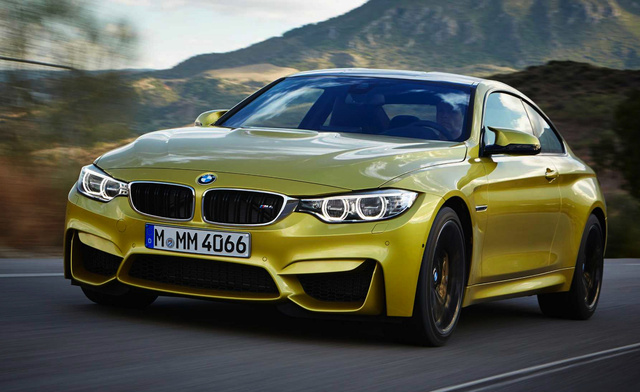
The name might have been new, but the first-generation BMW M4 followed a familiar formula when it was introduced in 2014. As the high-performance version of the 4 Series, it got the kind of cosmetic overhaul that BMW M models have received since the early noughties. Things like the lights, the door handles and the windows are carried over from the 4 Series, but the M4 had pumped-up bodywork, including wider front fenders and flared rear wheel arches, a rear spoiler, and a bulging power dome on the hood. There were characteristic “twinstalk” door mirrors, while coupe versions had a roof made from carbon fibre to reduce weight and convertibles had the same folding metal roof as the 4 Series coupe. One thing to note is there are only two-door body styles offered, so there's no M4 version of the five-door 4 Series Gran Coupe.
Power came from a twin-turbo 3.0-litre inline-six engine with 425 horsepower. That’s 11 horsepower more than the previous-generation M3, which had a naturally aspirated 4.0-litre V8. Maximum torque was 406 lb-ft—a 40% increase—but fuel consumption and emissions were about 25% lower. The gains were relative, of course, so don’t expect great fuel economy outright.
All versions were rear-wheel drive (RWD), and six-speed manual and seven-speed automatic transmissions were available. A range of motorsport-derived features provided the kind of sporty driving dynamics for which BMW M models are renowned.
As well as lightweight suspension and body parts to keep weight to a minimum, there was an “Active M Differential,” an electronically controlled limited-slip differential that shuffled the power delivery to improve traction. Early models even had a carbon fibre driveshaft, although this was later replaced by a narrower steel version in the interests of making space for a petrol particulate filter. Special “M compound” brakes were standard, but carbon ceramic brakes with gold calipers were an option. Adaptive M Suspension—which gives the choice of Comfort, Sport and Sport+ modes—was another option.
While the basic interior architecture was shared with the 4 Series models, the M4 had a range of bespoke M Division features, including M sport seats and an M-specific driver display, gear lever and steering wheel designs. Standard equipment was generous—as you’d hope of a car with an MSRP of at least $75,000 when new—and includes leather upholstery, climate control, LED headlights, and 18-inch alloy wheels.
In 2016, BMW added the M4 Competition Package as an option, offering 20-inch alloy wheels, an additional 19 horsepower, uprated springs, dampers and anti-roll bars, black chrome tail pipes, and Shadowline (high-gloss black) exterior trim details. Several special-edition M4 models were also available.
The M4 GTS introduced in 2016 had 493 horsepower and a range of track-focused chassis and cosmetic tweaks, while the BMW M4 CS of 2017 sat between these, with 454 horsepower and a slightly less aggressive makeover than the M4 GTS.
The BMW M4 was a high-end performance car that generally has a good reliability record. As with any car of this type, however, it may have been driven hard or seen use on the racetrack, so check that the brakes, the suspension and steering behave as they should on a test drive and look out for any aftermarket modifications.
Early BMW M4s start at just over $38,000, and those will be high-kilometre examples. You may be better off spending a bit more for a lower-odometer car because it’s more likely to get you better money at resale time, and another $8,000 should bag one with less than 100,000 kilometres on the clock. M4 GTS models are scarce and command good money, so expect to pay $150,000 or more.
Related Topics